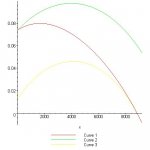
No, you mistake the X-axis. It is the DV which the first stage should deliver out of 9200 m/s. The second stage does the rest of the flight.
No, I think I understand the x-axis OK - the dV imparted by the 1st stage
at burnout of 1st stage(all fuel consumed)
The Y-Axis is the payload mass ratio you get for the different stage ratios.
That definition is not entirely clear to me - could you define it mathematically in terms of:
payload mass = a
2nd stage empty mass = b
2nd stage propellant mass = c
1st stage empty mass = d
1st stage propellant mass = e
And is it the
initial value (before launch) or
final value(at end of 1st stage burnout)?
I would at least like to understand this plot that you have kindly made....
* * * * * *
Also, I would like to be clear about exactly what I'm being told here (and is confusing for me to understand) which is that:
"For a given stage (1st or 2nd or 3rd, etc) of a multistage launch vehicle, there is an
optimum ISP. Increasing the ISP for that stage (while keeping all other factors constant) beyond the optimum will decrease the overall performance in terms of final payload dV"
And I just don't see why that should be.
* * * * *
The original question in this thread from DanP was:
"How come they use RP-1/LOX on the Falcons then?"
[rather than higher ISP H2/LOX]
RocketMan_Len gave the kind of answer I expected:
"Yes, you lose a bit of payload... and the 'wet' weight is greater. But - you use smaller tanks, no insulation, so you get a more robust vehicle."
But Urwumpe says:
"Still, there is also the external efficiency, which tells how much kinetic energy stays at the rocket (and how much gets lost for fuel). This phenomena has the effect, that a hydrogen+oxygen rocket engine can operate effective at higher velocities relative to Earth, while others are more effective at lower speeds
"
Which implies that the low ISP RP-1/LOX fuel of the Falcon 2nd stage was chosen
because it is more energy efficient.
Well, I can understand that it can be more energy effcient than using H2/LOX - but (by my understanding) in the end you will get more dV if you use H2/LOX (if you keep the empty stage mass, thrust, etc. the same).
To put it another way:
If someone came up with a fuel that had the same properties as RP-1/LOX (so you can use the same tank, engine, etc) except that it had the same ISP as H2/LOX - why wouldn't you use it on the Falcon? Sure, it wouldn't be as energy efficient - but you'd still get more dV by the end of the burn - wouldn't you?
Many thanks,
Brian



 So I'm just going to keep asking questions until everyone gets tired of trying to explain it to me :lol:


