Hardware Developing low-cost flight control (WIP)

MVA

Active member
Joined
Apr 28, 2008
Messages
32
Reaction score
39
Points
33
This is just information for your consideration. I started experimenting with 3D printing to test a few ideas, but ended up with something more. Perhaps this is what you need.
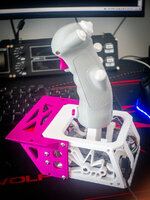
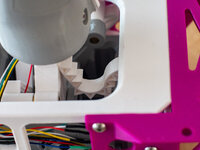
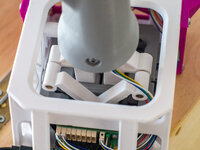
_2150540.jpg _2150546.jpg _2150548.jpg
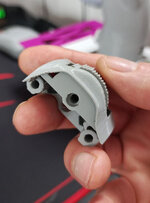
So, what I have. The joystick made out of 3D printed parts made of inexpensive PETG plastic. It has only a few axes, the mounts of which need to be made on a lathe and milling machine. The joystick contains entirely 3D printed PETG plastic springs. They are fully functional and offer the same force as metal springs (compliant mechanism).
  1. The Arduino-based controller uses TLE 51011 sensors.
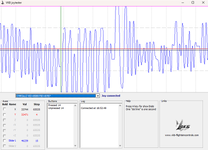
  2. Control accuracy is at least 300 steps per 1° (or at least 9500 steps per axis).
  3. Joystick axis travel range is 31°.
  4. No jitter at all. I don't use axis smoothing functions in the controller settings.
  5. Mechanical impacts on the grip or housing do not distort the signal.
  6. New kinematics provide significant control advantages.
  7. Can be rigidly mounted to any (probably almost any) table. The mounting cost is equal to the cost of 100 grams of plastic. The mounting is more rigid than any screw clamps. It does not damage the coating and can be replaced, moved, or removed without leaving any marks on the surface.
If I were to sell you one of these devices, its final cost would likely be no more than $100. So a low cost high-end joystick for the free Orbiter may be available
But this is not a finished device yet, I plan to make a similar complex of two such devices. 2 axes on one joystick and 3 axes on the other joystick, so that it would be possible to have six-coordinate control without using pedals. In this case, these devices will not take up space on the table and, in general, can be used anywhere.
 
Without sharing my opinion about the price, I want to express how inspiring is this kind of work because industrial joysticks target atmospheric flights and home-made joystick could target all controls in Orbiter for "space" flight (e.g. RCS modes and cockpit/2D views & zooms, probably with the need for some API in Orbiter to this aim): so, IMHO, it's a really cool project :hailprobe:
 
Without sharing my opinion about the price, I want to express how inspiring is this kind of work because industrial joysticks target atmospheric flights and home-made joystick could target all controls in Orbiter for "space" flight (e.g. RCS modes and cockpit/2D views & zooms, probably with the need for some API in Orbiter to this aim): so, IMHO, it's a really cool project :hailprobe:
Thank you! Yes, the project is aimed at maximum universal application. Now, using prototypes like this joystick, I can control everything in six coordinates at once. And this is very convenient for both atmospheric and orbital flights. In many cases, for example, atmospheric flights or flights on atmosphereless planets have become quite a simple and enjoyable experience, without the need for calculations or any special training. I just go and fly, like in a civilian flight simulator; all I need is good scenery to make the flight more interesting. I can't comment on software interaction, as I'm not an expert, but mechanics and operator psychology are my favorite things.
 
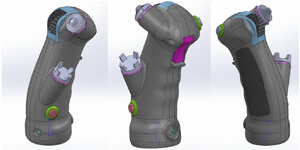
Well, I've taken another step towards getting my space joystick. I designed the left stick.
Lift Stick.jpg
This stick has one high-resolution axis (at least 8000 steps of real resolution), two HAT switches (or 8 buttons), and 4 more buttons. This allows me to use the mechanical base to create a second joystick with a left stick, giving me 5 axes and 20 buttons on two devices. The right stick has two control axes: roll and pitch. The left stick, similar to the ones found on PC model remotes, has a throttle axis, left-right movement as a yaw axis (or any desired axis), and a thumb-controlled axis. In my control configuration for simultaneous six-coordinate control, the "major" throttle axis is used for hovering, and the "minor" throttle axis controls the main rocket engine, as it doesn't require as much precision as hovering.
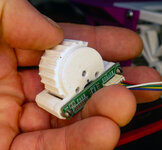
I made a working prototype of a tiny throttle axis to test the idea.
_2150574.jpg
The idea turned out to be 100% functional and demonstrated very high performance and ease of control.
Без имени.png
So I continued the design and tried a more compact enclosure so that it could fit on top of the joystick handle without having to change the dimensions.
photo_2026-03-29_10-01-01.jpg
Strictly speaking, I already implemented this control scheme over five years ago, but now it's time to repackage it into something more compact and user-friendly. I can't remember, but I think I posted this video before, but I'll show it again. The left stick is the same, except instead of the "small" throttle axis, there's a rotary stick like on a helicopter.
Note that the hands appear motionless. This effect occurs on joysticks with short throws, in this case 20°, and high-resolution axes. In the new version, the throw angle has been increased to 31°, as the kinematics here are not traditional, and the longer travel provides a lot of kinesthetic pleasure.
 
Back
Top