MVA
Active member
- Joined
- Apr 28, 2008
- Messages
- 32
- Reaction score
- 39
- Points
- 33
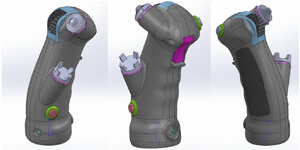
This is just information for your consideration. I started experimenting with 3D printing to test a few ideas, but ended up with something more. Perhaps this is what you need.
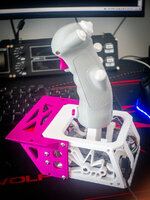
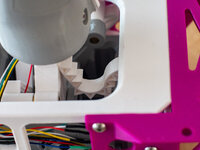
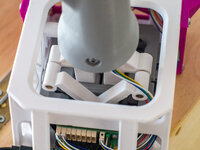
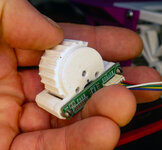
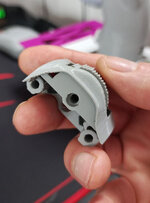
So, what I have. The joystick made out of 3D printed parts made of inexpensive PETG plastic. It has only a few axes, the mounts of which need to be made on a lathe and milling machine. The joystick contains entirely 3D printed PETG plastic springs. They are fully functional and offer the same force as metal springs (compliant mechanism).
But this is not a finished device yet, I plan to make a similar complex of two such devices. 2 axes on one joystick and 3 axes on the other joystick, so that it would be possible to have six-coordinate control without using pedals. In this case, these devices will not take up space on the table and, in general, can be used anywhere.
So, what I have. The joystick made out of 3D printed parts made of inexpensive PETG plastic. It has only a few axes, the mounts of which need to be made on a lathe and milling machine. The joystick contains entirely 3D printed PETG plastic springs. They are fully functional and offer the same force as metal springs (compliant mechanism).
- The Arduino-based controller uses TLE 51011 sensors.
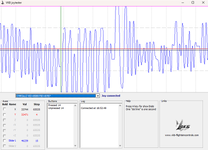
- Control accuracy is at least 300 steps per 1° (or at least 9500 steps per axis).
- Joystick axis travel range is 31°.
- No jitter at all. I don't use axis smoothing functions in the controller settings.
- Mechanical impacts on the grip or housing do not distort the signal.
- New kinematics provide significant control advantages.
- Can be rigidly mounted to any (probably almost any) table. The mounting cost is equal to the cost of 100 grams of plastic. The mounting is more rigid than any screw clamps. It does not damage the coating and can be replaced, moved, or removed without leaving any marks on the surface.