Low-Isp second stage

OK, I've got my head around the maths (thanks!).

But I still can't visualize the circumstances where you would choose a fuel/engine combination with a lower ISP over one with a higher ISP, even if the energy efficiency is greater overall for the lower ISP.

Any examples from real life?

Saturn V, Ariane 4, Ariane 5 ECA, Atlas 5....
 
:blink: I retract my former statement. I don't get it.

So, say, if I found a way to tweak the Saturn V engines (better nozzle design for instance) so that they gave a (much) higher ISP - I would not be able to lift as large a payload to a given orbit? Doesn't sound right to me ....but I can always try it Orbiter I guess :-)

Sorry, if I'm being dim about this but I'd really like to understand this concept and how it influences launch vehicle design. Thank you for your patience!

Regards,
Brian
 
The basic idea is: The more relative velocity you gain towards your reference, the higher is the ISP. Also, for the beginning of flight, it can be better to use a lower ISP stage, as it reaches maximum efficiency at lower velocities.

So, the basic effect is, that the ISP raises with the stage number - the first stages have low ISPs, the next a bit more and the upper stages, which should gain most kinetic energy during flight, have the highest ISP.
 
The basic idea is: The more relative velocity you gain towards your reference, the higher is the ISP. Also, for the beginning of flight, it can be better to use a lower ISP stage, as it reaches maximum efficiency at lower velocities.

So, the basic effect is, that the ISP raises with the stage number - the first stages have low ISPs, the next a bit more and the upper stages, which should gain most kinetic energy during flight, have the highest ISP.

I can see that , in terms of energy efficiency, that is completely logical.

But ultimately, when all the fuel is gone, surely you will get more dV for the payload from a rocket with a higher ISP than an identical rocket with a lower ISP.

i.e. What you lose by lower energy efficiency is less than what you gain by greater total energy available.

Yes? No?

Thanks,
Brian
 
Sorry, if I'm being dim about this but I'd really like to understand this concept and how it influences launch vehicle design. Thank you for your patience!

The Saturn V used LOX/RP1 in the SIC stage because:

1. The available LOX/LH2 engines had substantially higher ISP, but vastly lower thrust. You'd have needed dozens of engines to get it off the ground.
2. The volume required for the LH2 was vastly greater than the equivalent volume of RP1, so you'd have needed a much larger first stage to lift the second and third stages off the ground.

So it's not that a higher ISP would have resulted in less performance, but that using the different fuels required to get a much higher ISP would have been technically very difficult.
 
The Saturn V used LOX/RP1 in the SIC stage because:

1. The available LOX/LH2 engines had substantially higher ISP, but vastly lower thrust. You'd have needed dozens of engines to get it off the ground.
2. The volume required for the LH2 was vastly greater than the equivalent volume of RP1, so you'd have needed a much larger first stage to lift the second and third stages off the ground.

So it's not that a higher ISP would have resulted in less performance, but that using the different fuels required to get a much higher ISP would have been technically very difficult.

I totally understand that you might use a lower ISP fuel/engine system for design/technical reasons, such as the ones you mention.

But what I'd like to understand is in what circumstance would you choose a lower ISP because of the greater energy efficiency (all other things being equal).

I can't see where that would be logical.
 
Any examples from real life?

The Space Shuttle uses the 'most efficient' H2/O2 engines available today, but still needs the less efficient SRBs to get it off the ground. :lol:

The Saturn V booster used RP-1 and liquid oxygen, even though hydrogen motors were available, because the denser fuels had a greater 'mass flux' to provide the high levels of thrust needed to get that mass aloft.

On many modern rocket systems - every time you have a hydrogen/oxygen first stage, you have solid boosters providing the initial 'kick'. Even though they're less efficient, the high density of the fuel provides for more thrust in a compact container.
 
i.e. What you lose by lower energy efficiency is less than what you gain by greater total energy available.

I think that energy would be directly proportional to propellant, so if your energy efficiency is lower, you're wasting propellant (as explained previously in the thread).

One thing that bothers me though... why doesn't this effect show up in the rocket equation? I think this is the part that's confusing BrianJ too. Tsiolkovsky says: "Higher ISP = better payload capability for a given required dV". Or have I been reading this wrong all the time?
 
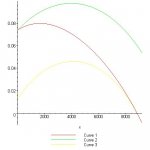
I think I can show you a plot, which makes it understandable. payload mass fraction over mission dV.

Here I have attached a small plot of the performance of two stage rockets. All to LEO (9200 m/s total impulse), the plots show payload mass fraction by first stage dV.

Plot one is the Saturn IB case - a kerolox first stage combined with a hydrolox second stage.

Plot 2 is the All hydrolox case.

Plot 3 is the Zenit2 case - all kerolox.
 

Attachments

  • TwoStageRockets.jpg
    TwoStageRockets.jpg
    20 KB · Views: 20
Last edited:
Wow, thanks. That's pretty counter intuitive (for me at least).

If I got this right... All hydrolox and all kerolox have about the same payload mass fraction to LEO, because hydrolox is inefficient during the early stages of ascent but later becomes more efficient, and vice versa for all kerolox. Kerolox/Hydrolox has far better payload fractions because it is the most energy efficient throughout the ascent.

So in practical terms, the energy efficiency has a far bigger impact on payload fractions than Isp. The rocket equation is only an approximation then?

BTW... all payload fractions need to be reduced slightly to account for the rocket itself, tanks, pumps, engine etc, or is it factored into the graph ? If not, than things should look even better for kerolox, because all this stuff weighs a lot less for kerolox.
 
If I got this right... All hydrolox and all kerolox have about the same payload mass fraction to LEO, because hydrolox is inefficient during the early stages of ascent but later becomes more efficient, and vice versa for all kerolox. Kerolox/Hydrolox has far better payload fractions because it is the most energy efficient throughout the ascent.

Well, actually, the pure hydrolox rocket is still more effective (9.5% vs 8.8% payload mass fraction) as the mixed rocket, but the difference is far lower as for the pure kerolox case. Also, you can see in the pure hydrolox case, that the payload mass fraction become maximal for the case when both stages shared the same dV.


So in practical terms, the energy efficiency has a far bigger impact on payload fractions than Isp. The rocket equation is only an approximation then?

The energy efficiency has an effect, as well as the rocket equation. Both are based on the same concept, but measure different quantities. In fact, both measures of external efficiency are directly derived from the rocket equation.


BTW... all payload fractions need to be reduced slightly to account for the rocket itself, tanks, pumps, engine etc, or is it factored into the graph ? If not, than things should look even better for kerolox, because all this stuff weighs a lot less for kerolox.

For the sake of fairplay, I gave all rockets the same structure mass ratio. The first stage has 8% dry mass, the second stage 6%.

Of course, A kerolox stage can have a lower dry mass, but that is not the goal of the plot.
 
Thank you very much for the plot Urwumpe. Unfortunately it hasn't made things any clearer for me:( So I'm just going to keep asking questions until everyone gets tired of trying to explain it to me :lol:

I'm not sure I'm interpreting the plot correctly.

Let's take a specific case of the Zenit (curve 3) with a payload mass fraction of 0.02 (that's 2% of the total initial mass of the launcher, right?)

twostagerockets2tx7.jpg


If I assume the 2nd stage propellant mass is constant - then the plot tells me that after I've used all the fuel for the 1st stage I will have a velocity of 400m/s and 7800m/s. I can't interpret that result in any meaningful way.


If I assume the 2nd stage propellant mass is exactly what is required to reach the mission dV of 9200m/s - then the plot tells me that there are 2 values the 2nd stage propellant can have:

One large value (1st stage gives 400m/s, 2nd stage gives 8800m/s)
One small value (1st stage gives 7800m/s, 2nd stage gives 1400m/s)

That's OK, I can understand that. But that doesn't really tell me much about why a low ISP is better in some cases than a higher ISP.

What I can see on the plot is that the pure hydrolox case (curve 2) can lift a larger payload mass fraction to a given dV than the pure kerolox case (curve 3).

hydrolox ISP > kerolox ISP
so..
Higher ISP = Better.

Oh dear. Back to square one.

Thanks,
Brian
 
BrianJ:

No, you mistake the X-axis. It is the DV which the first stage should deliver out of 9200 m/s. The second stage does the rest of the flight.

The Y-Axis is the payload mass ratio you get for the different stage ratios. I thought such a plot is more honest as me just pointing what I call the optimum.

Actually, the Zenit case has an optimum at about 4.5 %. That is higher as the real numbers (which include payload fairing and atmospheric effect on ISP). You see also, that you would need to stage after the first stage delivered about 4000 m/s DV (relative velocity + drag losses + gravity losses + control losses)

In the mixed case, the optimal staging point is at less than 2000 m/s DV.
 
No, you mistake the X-axis. It is the DV which the first stage should deliver out of 9200 m/s. The second stage does the rest of the flight.
No, I think I understand the x-axis OK - the dV imparted by the 1st stage
at burnout of 1st stage(all fuel consumed)


The Y-Axis is the payload mass ratio you get for the different stage ratios.
That definition is not entirely clear to me - could you define it mathematically in terms of:

payload mass = a
2nd stage empty mass = b
2nd stage propellant mass = c
1st stage empty mass = d
1st stage propellant mass = e

And is it the initial value (before launch) or final value(at end of 1st stage burnout)?

I would at least like to understand this plot that you have kindly made....

* * * * * *

Also, I would like to be clear about exactly what I'm being told here (and is confusing for me to understand) which is that:

"For a given stage (1st or 2nd or 3rd, etc) of a multistage launch vehicle, there is an optimum ISP. Increasing the ISP for that stage (while keeping all other factors constant) beyond the optimum will decrease the overall performance in terms of final payload dV"

And I just don't see why that should be.

* * * * *

The original question in this thread from DanP was:
"How come they use RP-1/LOX on the Falcons then?"
[rather than higher ISP H2/LOX]

RocketMan_Len gave the kind of answer I expected:
"Yes, you lose a bit of payload... and the 'wet' weight is greater. But - you use smaller tanks, no insulation, so you get a more robust vehicle."

But Urwumpe says:
"Still, there is also the external efficiency, which tells how much kinetic energy stays at the rocket (and how much gets lost for fuel). This phenomena has the effect, that a hydrogen+oxygen rocket engine can operate effective at higher velocities relative to Earth, while others are more effective at lower speeds"

Which implies that the low ISP RP-1/LOX fuel of the Falcon 2nd stage was chosen because it is more energy efficient.


Well, I can understand that it can be more energy effcient than using H2/LOX - but (by my understanding) in the end you will get more dV if you use H2/LOX (if you keep the empty stage mass, thrust, etc. the same).

To put it another way:
If someone came up with a fuel that had the same properties as RP-1/LOX (so you can use the same tank, engine, etc) except that it had the same ISP as H2/LOX - why wouldn't you use it on the Falcon? Sure, it wouldn't be as energy efficient - but you'd still get more dV by the end of the burn - wouldn't you?

Many thanks,
Brian

 
Back
Top