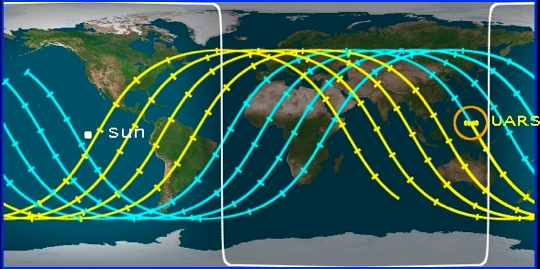
I've changed the scenario to start at the epoch of the orbital elements, not the current system time. That should make the results a bit more comparable.




I think time compression matters.

My first run showed Australia getting hammered again...SW of Brisbane.


"Re-entry is expected Sept. 23, plus or minus a day,"

So, if it drops on my porch, can I keep it?
In other words, if you see it plunge into the ground, you may want to leave it there for a few hours to cool and vent any propellant residue before putting it in a display case. I know I won't be calling NASA if it drops into my backyard. :lol:
I guess the fact that they did not deorbit it but only sent it to a lower orbit shows that all of it should be expended.

{...}
Debris from the space agency's defunct Upper Atmosphere Research Satellite poses a 1-in-3,200 risk of hitting someone, according to a space agency analysis.
Depending on the exact altitude at which the satellite's final plunge starts, most likely on Friday, the debris could scatter anywhere from Siberia to South America.
If the satellite enters over a populated part of the world, "people should see quite a show," resembling a shooting star, even in the daytime, says NASA orbital debris expert Nicholas Johnson of the Johnson Space Center in Houston.
{...}