Ah hah! Found the simple way, and it was using spherical trigonometry.
Apologies for the diagram, but I don't have a scanner so had to resort to paint!
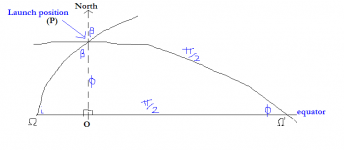
NOTE that this is a flat projection of a sphere. All lines are geodesics and thus 'straight'.
The diagram as constructed by drawing 4 geodesics on the unit sphere.
- One around the equator
- The meridian (north-south geodesic) passing through the launch site (P)
- The target orbit passing through the launch site. ΩP.
- The orbit if launching in a due east heading (ie, inclination of this orbit is equal to the latitude of the launch site).
The intersection of the equator and the meridian is O.
The length of the line OP is φ as it represents the latitude of the launch site.
OΩ' = PΩ' = π/2 (this is irrelevant but interesting as both OΩ' and PΩ' represent a quarter of an orbit.
Using the
second spherical law of cosines, namely:
cos(A) = -cos(B)cos(C) + sin(B)sin(C)cos(a)
with i=A, β=B and C=π/2, we get
cos(i) = -cos(β)cos(π/2) + sin(β)sin(π/2)cos(φ)
cos(π/2) = 0, sin(π/2) = 1, so this simplifies down to
cos(i) = sin(β)cos(φ)