Spherical trigonomentry and launch azimuth

What do you think of this one:

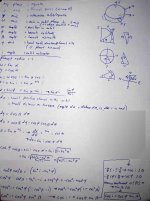
Maybe it can be done in a more simple way, but at least I managed to do it without help from any textbook or website. I even had to figure out what i, beta and phi usually mean (used the internet for that).
 

Attachments

  • derivation.jpg
    derivation.jpg
    52.5 KB · Views: 110
Maybe it can be done in a more simple way...
I have a feeling that it can be done a more simple way - the wiki says "using spherical trigonometry", which probably means that its simpler using that. However, I took a look yesterday and couldn't figure out a derivation.

Either way, thanks for the good work!
 
Ah hah! Found the simple way, and it was using spherical trigonometry.
Apologies for the diagram, but I don't have a scanner so had to resort to paint!
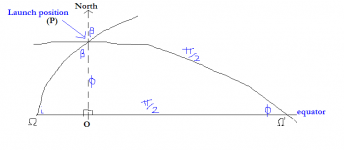
LaunchAzimuth.PNG
NOTE that this is a flat projection of a sphere. All lines are geodesics and thus 'straight'.

The diagram as constructed by drawing 4 geodesics on the unit sphere.

  • One around the equator
  • The meridian (north-south geodesic) passing through the launch site (P)
  • The target orbit passing through the launch site. ΩP.
  • The orbit if launching in a due east heading (ie, inclination of this orbit is equal to the latitude of the launch site).
The intersection of the equator and the meridian is O.
The length of the line OP is φ as it represents the latitude of the launch site.
OΩ' = PΩ' = π/2 (this is irrelevant but interesting as both OΩ' and PΩ' represent a quarter of an orbit.

Using the second spherical law of cosines, namely:
cos(A) = -cos(B)cos(C) + sin(B)sin(C)cos(a)
with i=A, β=B and C=π/2, we get
cos(i) = -cos(β)cos(π/2) + sin(β)sin(π/2)cos(φ)
cos(π/2) = 0, sin(π/2) = 1, so this simplifies down to
cos(i) = sin(β)cos(φ)

 
I have a feeling that it can be done a more simple way - the wiki says "using spherical trigonometry", which probably means that its simpler using that. However, I took a look yesterday and couldn't figure out a derivation.

Either way, thanks for the good work!

Yeah, I don't know much about spherical trigonometry. Even never heard of it before :huh:. Anyway, I showed you can do the same on a single A4 paper without knowledge of spherical trigonometry. I only used normal trigonometry, and relationships like cos^2(x)+sin^2(x)=1, and the derivative of sin(x).
 
Back
Top