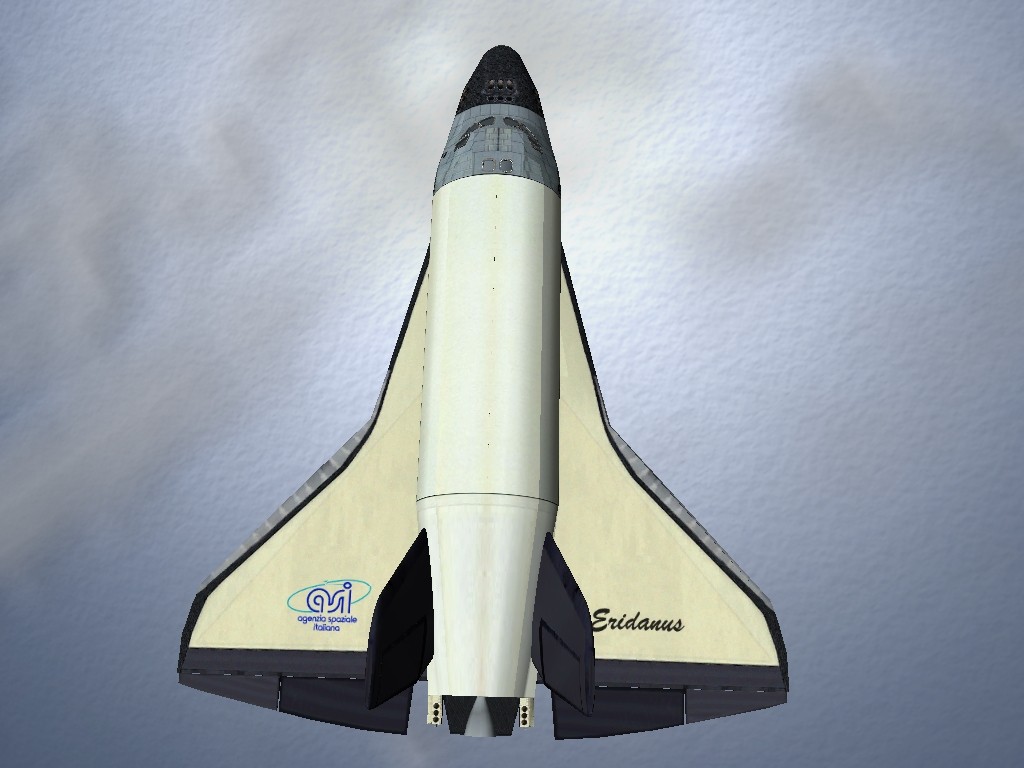
News Space Plane Eridanus, final development steps

Does it really require a sidemount configuration? Turbulence from the wings at supersonic speeds, sure... but does that outweigh the disadvantage of extra atmospheric drag with the sidemount option? Or the asymmetric drag and weight?

The TPS shield also looks like it would be pretty heavy.

I know Energia used the same sidemount option as STS, but I'm trying to figure out how bad that "supersonic turbulence" is gonna be, compared to the problems of a sidemount configuration...
 
Would vibration/swaying at the top of the stack be an issue in an inline configuration? I've heard accounts that the Apollo/Saturn V stack did a considerable amount of oscillation at the top of the stack (no citation to provide, I'm afraid).

**EDIT**
Here's what I found. Phenomenon is called 'pogo.' It appears to no longer be as much of an issue on modern rockets.
 
Last edited:
Does it really require a sidemount configuration? Turbulence from the wings at supersonic speeds, sure... but does that outweigh the disadvantage of extra atmospheric drag with the sidemount option? Or the asymmetric drag and weight?

The TPS shield also looks like it would be pretty heavy.

I know Energia used the same sidemount option as STS, but I'm trying to figure out how bad that "supersonic turbulence" is gonna be, compared to the problems of a sidemount configuration...

Clearly, each configuration has advantages and disadvantages... anyway, the "in line" configuration was discussed on forumastronautico.it (the main italian forum of astronautics, not Orbiter-related) and judged not feasible for a spaceplane of such dimensions and weight, mainly for serious aerodynamic problems in transonic and supersonic flight. Also, the rocket-spaceplane interface of the inline version is structurally a weak point, i think. The extra weight for the sidemount arrangement was estimated by the team in about 11.000 kg... but fortunately the Quasar 220 rocket has enough reserve power for the job.

---------- Post added at 08:19 AM ---------- Previous post was at 07:12 AM ----------

A little explanation of why we choose the "sidemount" option instead of "in line" option.
After consulting with some experts of www.ForumAstronautico.it (italian astronautic forum), they suggested the "sidemount" option because the turbulence generated by the wings at supersonic speed is much lower. We wanted to create a spaceplane as realistic as possible and therefore we have chosen the "sidemount" option. At the same time we wanted the spaceplane was as safe as possible, so we built a L.E.S. and a shroud for the thermal protection.

ooops! :lol::thumbup:
 
I'm still skeptical. But if it works... :hmm:
 
my 2 cents on the matter is I am happy you guys went with the side mount. It makes good sense to me, and it more closely resembles the Space Shuttle, which is fine by me.
 
Thank You Cras!

@T.Neo: i'm still a fan of the inline configuration and was reluctant at the idea of abandon it... but the sidemount appears to be more realistic in this specific case. The next spaceplane will be smaller... :lol:

---------- Post added at 02:00 PM ---------- Previous post was at 01:42 PM ----------

Anyway...
the tanks of the rocket are located only in the lower portion of the core stage (the orange part). The upper part (white) is, in fact, an empty aerodynamic fairing. Thus, the cabin and the crew aren't directly beside the tanks (another security improvement).
The fairing allows the launch of oversized payloads that can't be placed in the Eridanus's cargo bay.
 
Eridanus cabin LES test:


this is the in line configuration, but the concept is the same one!
 
Looks great!

Two questions: why do the boosters appear to come away when the abort starts, and also would it be good to have a some sound to accompany the nosecone coming away (if the nosecone is ejected with pyrotechnics, that is)?
 
crew moving inside? awsome!:thumbup:
 
Anoher test flight, with the usual max-q effects of the FOI launchers:

 
This model of the AVATAR shuttle (no, not that Avatar) has a vaguely similar shuttle-to-rocket size ratio to Eridanus, but no boosters.
 
Interesting! Much smaller wings, but has similarities.
 
TEST: "Hermes-like" textures.

eridan16.jpg


eridan17.jpg


00022a09
 
A new texture test.

newesp10.jpg

newesp11.jpg

newesp12.jpg


---------- Post added 05-24-11 at 07:06 PM ---------- Previous post was 05-23-11 at 09:32 PM ----------

The two spaceplanes, Eridanus and Esperia, with the finished textures.

eridan22.jpg

eridan23.jpg
 
Is an aproximate release date possible? Please? :)
This is looking great.
 
not yet... but soon :thumbup:

---------- Post added at 08:22 PM ---------- Previous post was at 08:09 PM ----------

Anyway... here some technical info:

Length: 29 m
Wingspan: 23.5 m
Height: 8.6 m
Empty weight: 50,690 kg
Loaded weight: 65,690 kg
Maximum launch weight: 79,900 kg
Maximum payload to LEO: 14,210 kg
Main engine propellant 12,500 kg (Lox/RP-1)
RCS propellant: 2,500 kg (N2O4/MMH)
Main engines: 2x 45.0 kN
ISP: 342 sec.
Max orbital Delta V (at full payload): 570.60 m/sec.

---------- Post added at 08:36 PM ---------- Previous post was at 08:22 PM ----------

Eridanus and Antares Long Range spacecraft: dimensional comparison.

 
Last edited:
Very nice :) great job, really.

I would have rather seen the inline mount but... in the end if both Space Shuttle and Buran were side mounts there must have been a reason.

One more thing:
(I assume that, like for the Shuttle, the 2 side smaller rockets are solid boosters and the central one liquid) since you have a side mount, why not move the liquid fed rocket engines to the orbiter (I only saw OMS's behind the orbiter), so you can recycle them in future flights?
By leaving them stuck to the bottom of the big central tank (making the tank an actual rocket itself) you'll loose the engines at every launch!
or... did you come up with some re-entry trick for the liquid fed rocket too?
 
The two questions I have at the moment about this project is what kind of cargo will it be able to carry in the payload bay, and how will the docking work? Is it dorsal like the space shuttle, or will it go the more future tech route of nose cone open and docking sort of thing found in the XR-2 and DG-IV/XR-1?

If you asked me, not saying that you should, dorsal is the way to go. Having seems and hinges, and anysort of weak points on the nose just seems ludicrously dangerous for atmospheric re-entry.

And for the cargo, will we be able to haul UCGO up into orbit? or space station nodes?

And for Zilesio, this vehicle is launched on the Quasar, which uses Liquid boosters.
But what you say about the mains does make sense, but would require a rethink on the whole stack from the devs. The orbiter needs to then be moved down to the bottom of the ET so its engines dont ignite and destroy the ET, thus destroying the whole stack.
Also that whole back end would need a re-design. Looks like space for the OMS pod and RCS jets only, no room to add much else back there.
 
Back
Top