
You are using an out of date browser. It may not display this or other websites correctly.
You should upgrade or use an alternative browser.
You should upgrade or use an alternative browser.
PSA: English Grammar MEGA THREAD (All Your Grammar Are Belong To Us)
- Thread starter dbeachy1
- Start date


Lucy
in the sky, with diamonds.
Administrator
Moderator
Orbiter Contributor
Addon Developer
Webmaster
GFX Staff
Beta Tester
- Joined
- Aug 9, 2009
- Messages
- 7,110
- Reaction score
- 1,304
- Points
- 203
- Location
- 10.0.0.1
- Website
- www.orbiter-radio.co.uk
- Preferred Pronouns
- she/her
Well, it seems to take the place of "is it not?".

deltawing777
Member
- Joined
- Jan 4, 2008
- Messages
- 513
- Reaction score
- 0
- Points
- 16
- Location
- South of Houston,Texas
- Website
- omp.dyndns-server.com
And thus, the point is made, no?
Roger That! Over.

- Joined
- Jan 14, 2008
- Messages
- 9,267
- Reaction score
- 1,738
- Points
- 203
- Location
- VA
- Website
- alteaaerospace.com
- Preferred Pronouns
- he/him
Another common mistake is to use backup, which is always a noun or adjective, as a verb: the verb form is "back up" (two words). For example:
Incorrect: "I am going to backup my computer today."
Correct: "I am going to back up my computer today."
Per dictionary.com:
If you are using it as a noun or adjective, however, the single word backup is correct:
As an adjective: 1) "I am going to give the backup tapes to Joe." 2) "My backup plan is to try again on Thursday."
As a noun: "The backup is finished now."
:tiphat:
Incorrect: "I am going to backup my computer today."
Correct: "I am going to back up my computer today."
Per dictionary.com:
—Verb phrases
42. back up,
...
g. Computers . to duplicate (a file or a program) as a precaution against failure.
If you are using it as a noun or adjective, however, the single word backup is correct:
As an adjective: 1) "I am going to give the backup tapes to Joe." 2) "My backup plan is to try again on Thursday."
As a noun: "The backup is finished now."
:tiphat:

No, but there's one in "won't", which gets confused with "want" often enough.
- Joined
- May 30, 2008
- Messages
- 5,580
- Reaction score
- 2
- Points
- 0
They are completely different words, I don't understand how you can confuse them...No, but there's one in "won't", which gets confused with "want" often enough.
by being a foreigner  They sound similiar enough, which can be a problem for someone that has english as second or even third language. Like "where" and "were", which I myself confuse all to often too.
They sound similiar enough, which can be a problem for someone that has english as second or even third language. Like "where" and "were", which I myself confuse all to often too.
Lucy
in the sky, with diamonds.
Administrator
Moderator
Orbiter Contributor
Addon Developer
Webmaster
GFX Staff
Beta Tester
- Joined
- Aug 9, 2009
- Messages
- 7,110
- Reaction score
- 1,304
- Points
- 203
- Location
- 10.0.0.1
- Website
- www.orbiter-radio.co.uk
- Preferred Pronouns
- she/her
They are completely different words, I don't understand how you can confuse them...
I don't understand how you can spell colour without a "u" and apologise with a "z", either, but you do - because you are a foreigner. Try to remember that not everyone speaks or writes English natively.
- Joined
- May 30, 2008
- Messages
- 5,580
- Reaction score
- 2
- Points
- 0
This isn't a matter of cultural spelling differences--it's completely failing to understand the purpose of an apostrophe.I don't understand how you can spell colour without a "u" and apologise with a "z", either, but you do - because you are a foreigner. Try to remember that not everyone speaks or writes English natively.

- Joined
- Aug 5, 2008
- Messages
- 4,261
- Reaction score
- 1
- Points
- 0
Why do people insist on writing "photos" as "photo's" (as in "I took lots of photo's")? :shrug:
Lucy
in the sky, with diamonds.
Administrator
Moderator
Orbiter Contributor
Addon Developer
Webmaster
GFX Staff
Beta Tester
- Joined
- Aug 9, 2009
- Messages
- 7,110
- Reaction score
- 1,304
- Points
- 203
- Location
- 10.0.0.1
- Website
- www.orbiter-radio.co.uk
- Preferred Pronouns
- she/her
This isn't a matter of cultural spelling differences--it's completely failing to understand the purpose of an apostrophe.
I think you missed my point there.
- Joined
- Jan 14, 2008
- Messages
- 9,267
- Reaction score
- 1,738
- Points
- 203
- Location
- VA
- Website
- alteaaerospace.com
- Preferred Pronouns
- he/him
Today's PSA is regarding regardless vs. the nonstandard and arguably nonsensical irregardless. Per dictionary.com:
Please be advised that any members who use "irregardless" on the board will be summarily infracted. (OK, not really.)
ir·re·gard·less
[ir-i-gahrd-lis]
–adverb Nonstandard .
regardless.
Origin:
1910–15; ir-2 (prob. after irrespective ) + regardless
—Can be confused: irregardless, regardless (see usage note at this entry ).
—Usage note
Irregardless is considered nonstandard because of the two negative elements ir- and -less. It was probably formed on the analogy of such words as irrespective, irrelevant, and irreparable. Those who use it, including on occasion educated speakers, may do so from a desire to add emphasis. Irregardless first appeared in the early 20th century and was perhaps popularized by its use in a comic radio program of the 1930s.
irregardless
an erroneous word that, etymologically, means the exact opposite of what it is used to express, attested in non-standard writing from at least 1870s (e.g. "Portsmouth Times," Portsmouth, Ohio, U.S.A., April 11, 1874: "We supported the six successful candidates for Council in the face of a strong opposition. We were led to do so because we believed every man of them would do his whole duty, irregardless of party, and the columns of this paper for one year has [sic] told what is needed."); probably a blend of irrespective and regardless. Perhaps inspired by the double negative used as an emphatic.
Please be advised that any members who use "irregardless" on the board will be summarily infracted. (OK, not really.)

That reminds me of the frequent nonsensical use of the word 'literally.'
I would describe it myself, but why do that when xkcd did it for me?
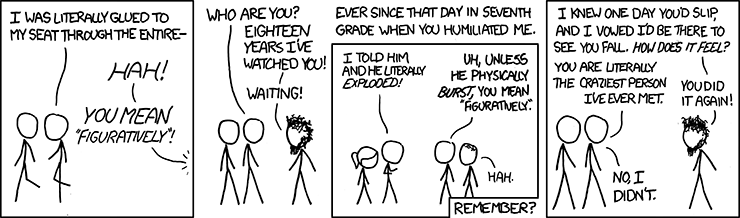
I would describe it myself, but why do that when xkcd did it for me?

Kevon Daye
Smoking Crater
That reminds me of the frequent nonsensical use of the word 'literally.'
I would describe it myself, but why do that when xkcd did it for me?
That literally split my sides!:rofl:, irregardless of what anyone else says.
Last edited:

Pyromaniac605
Toast! :D
Someone call a medic!That literally split my sides!:rofl:, irregardless of what anyone else says.
Also, in regards to the discussion of the use of "u" earlier, what exactly happened that made US English not use u in cases that UK English would use it?
Darren

English grammar is a mess. Latin was much more logical, aside from the unnecessary declensions and conjugations. I mean really, three declensions will do. Five is not necessary.
Linguofreak
Well-known member
Time for my pet peeve: People who, for whatever reason, use Shakespearean / King James constructions rather than using perfectly fine modern English forms, but can't get the Shakespearean forms right. There's nothing sacred about the old forms, but if you're going to go to the trouble of using them, you may as well use them in a historically accurate fashion.
For example: If thou sayest "he hast", "thou has", or "thou hath", thou shalt be flogged. Or if thou sayest "he wilt", or "thou will". And he who sayeth "an 'istoric", but droppeth not the "h", and thus sayeth "an historic", shall feel my wrath. The man who randomly doth add "eth" to the ends of words (as in "I randomethly addeth 'eth' to the endeths of wordeths") shall be most brutally slain.
There shall also be punishments for them who address more than one person as "thou". "Thou all hast abused the English language" and "At the border they will search all of thee" are forbidden sentences. One must say "Ye all have abused the English language" and "At the border they will search all of you". (Also remember that in Shakespearean English "ye" is the nominative and "you" is the accusative form of "ye". "You" is to "ye" as "me" is to "I"). I will not personally punish the man who addresseth his boss as "thou", but if his boss objecteth, I will not protect him. Remember that "thou" meaneth "you buddy", and "ye" meaneth "y'all" or "you sir".
Also a pet peeve, though not as bad as it is an error of understanding and not of trying to use something one does not know how to use, is when people interpret "wherefore art thou Romeo?" as "Where are you Romeo?". The actual meaning is closer to "What the heck did you have to be called Romeo for?"
For example: If thou sayest "he hast", "thou has", or "thou hath", thou shalt be flogged. Or if thou sayest "he wilt", or "thou will". And he who sayeth "an 'istoric", but droppeth not the "h", and thus sayeth "an historic", shall feel my wrath. The man who randomly doth add "eth" to the ends of words (as in "I randomethly addeth 'eth' to the endeths of wordeths") shall be most brutally slain.
There shall also be punishments for them who address more than one person as "thou". "Thou all hast abused the English language" and "At the border they will search all of thee" are forbidden sentences. One must say "Ye all have abused the English language" and "At the border they will search all of you". (Also remember that in Shakespearean English "ye" is the nominative and "you" is the accusative form of "ye". "You" is to "ye" as "me" is to "I"). I will not personally punish the man who addresseth his boss as "thou", but if his boss objecteth, I will not protect him. Remember that "thou" meaneth "you buddy", and "ye" meaneth "y'all" or "you sir".
Also a pet peeve, though not as bad as it is an error of understanding and not of trying to use something one does not know how to use, is when people interpret "wherefore art thou Romeo?" as "Where are you Romeo?". The actual meaning is closer to "What the heck did you have to be called Romeo for?"
Lucy
in the sky, with diamonds.
Administrator
Moderator
Orbiter Contributor
Addon Developer
Webmaster
GFX Staff
Beta Tester
- Joined
- Aug 9, 2009
- Messages
- 7,110
- Reaction score
- 1,304
- Points
- 203
- Location
- 10.0.0.1
- Website
- www.orbiter-radio.co.uk
- Preferred Pronouns
- she/her
That literally split my sides!:rofl:, irregardless of what anyone else says.
I believe you mean figuratively. Had your sides literally split you would have been incapable of informing us of the no doubt hilariously messy event.
Similar threads


- Replies
- 0
- Views
- 5K

- Replies
- 1
- Views
- 9K


- Replies
- 13
- Views
- 5K

- Replies
- 7
- Views
- 5K