

- Joined
- Oct 30, 2009
- Messages
- 14,019
- Reaction score
- 4
- Points
- 0
The United Launch Alliance Delta 4-Heavy rocket will launch a classified spy satellite cargo for the U.S. National Reconnaissance Office. The largest of the Delta 4 family, the Heavy version features three Common Booster Cores mounted together to form a triple-body rocket.
 |
|
{colsp=2}
This is the third operational flight of the Delta IV Heavy. A successful demonstration flight was flown on Dec. 21, 2004. The first operational mission was flown Nov. 10, 2007 and the second operational flight was flown Jan. 17, 2009. Delta IV Heavy launches are the most spectacular night launches of an all-liquid-fueled booster since the Apollo era with nearly two million pounds of thrust. This is the eighth and final launch for ULA in 2010 and will be the 45th launch since ULA's inception Dec. 1. 2006.
There is O-F Calendar event created for this launch. And here you can request a reminder for it, that will be sent via e-mail.
Scrubbed on Nov. 18 due to launch pad pyrotechnics issue. Scrubbed on Nov. 19 due to due to anomalous temperature data signatures detected on the port and starboard strap-on common core boosters during cryogenic fueling.
Mission Description:
Launch Vehicle:
 |
|
{colsp=2}
Viewing the Launch Live:
Links:
Launch Updates:
|
Launch date:
|
November 21, 2010
Window open:
|
22:58 UTC (5:58 p.m. EST)
Launch site:
|
SLC-37B, CCAFS, Florida
{colsp=2}
[highlight]L[eventtimer]2010-11-21 22:58;%c%%ddd%/%hh%:%mm%:%ss%[/eventtimer][/highlight]
This is the third operational flight of the Delta IV Heavy. A successful demonstration flight was flown on Dec. 21, 2004. The first operational mission was flown Nov. 10, 2007 and the second operational flight was flown Jan. 17, 2009. Delta IV Heavy launches are the most spectacular night launches of an all-liquid-fueled booster since the Apollo era with nearly two million pounds of thrust. This is the eighth and final launch for ULA in 2010 and will be the 45th launch since ULA's inception Dec. 1. 2006.
There is O-F Calendar event created for this launch. And here you can request a reminder for it, that will be sent via e-mail.
Scrubbed on Nov. 18 due to launch pad pyrotechnics issue. Scrubbed on Nov. 19 due to due to anomalous temperature data signatures detected on the port and starboard strap-on common core boosters during cryogenic fueling.
Mission Description:
This launch supports the military's national defense mission. The payload is confidential and is designated as National Reconnaissance Office L-32 (NROL-32). The flow of official information about this mission will cease at the point of payload fairing separation. No further comment about the status of the mission will be made after this milestone.
[table="head"]{colsp=2}
 |[table="head"]
 |
| [/table][/table]
[table="head"]{colsp=2}
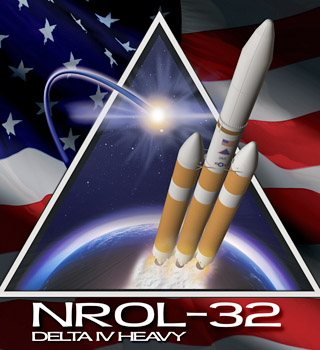
Mission Insignia (clickable)
 |[table="head"]
Mission patch
|Launch patch
 |
| [/table][/table]
Launch Vehicle:
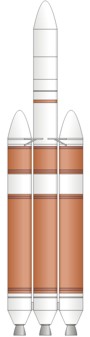
Delta IV Heavy is comprised of a common booster core (CBC), two additional CBCs as strap-on liquid rocket boosters (LRBs) to augment the first-stage CBC, a cryogenic upper stage, and 5-m-diameter payload fairing (PLF).
The Delta 4 CBC design is optimized for balanced performance over a wide range of payloads using the high-performance RS-68 main engine powered by liquid hydrogen (LH2) and liquid oxygen (LO2). The RS-68 is throttleable to serve various mission profiles operating at 102% and 58% thrust level. Two separate 5-m-dia. LO2 and LH2 tanks provide the majority of the first stage structure. These two tanks are integrated wih a composite cylinder, called the centerbody. At the forward end of the CBC, another composite cylinder, the interstage, provides the interface between the CBC and the cryogenic second stage. For the port and starboard strap-on CBCs of the Heavy configuration the interstage structure is replaced with a composite nose cone.
At the aft end of the CBC, an engine section provides the thrust structure and thermal shield that integrates the RS-68 main engine to the CBC. The RS-68 requirements were balanced to enable operational thrust at lower chamber pressures. This design trade increase engine reliability, while reducing complexity. Compared with the SSME, the RS-68 has an 80% reduction in unique part count. Even with lower performance than comparable LO2/LH2 engines, the RS-68 develops a world record 2949 kN (663000 lb) of sea-level thrust with a specific impulse (Isp) of 359 seconds at sea level.
The second stage comprises a 5-m-diameter fuel tank, a composite intertank structure, a liquid oxygen tank, avionics equipment shelf, avionics suite, attitude control system and is powered by a Pratt & Whitney RL10B-2 liquid rocket engine that produces 100kN (24750 lb.) of thrust. The RL10B-2, with its high expansion, carbon-carbon nozzle provides an Isp of 465.5 seconds.
{colsp=2}

Viewing the Launch Live:
A live simulcast of the launch will be available 25 minutes prior to launch. You can watch the launch live via satellite TV (where applicable): SATELLITE: Galaxy 3; TRANSPONDER - G3C-8c; BAND - C-band Analog; ORBITAL POSITION - 95 degrees W; CARRIER - INTELSAT; BANDWIDTH - 36 MHz; UPLINK FREQ - 6085 MHz (Horizontal); DOWNLINK FREQ - 3860 MHz (Vertical).
You can watch the launch via Internet webcast. A live simulcast of the TV broadcast will be available 25 minutes prior to launch on the ULA Web site.
The broadcast [eventtimer]2010-11-19 22:41?will start in|started;%c% %h% hours, %m%[/eventtimer] minutes[eventtimer]2010-11-18 22:45?.| ago.;%c%[/eventtimer]
You can watch the launch via Internet webcast. A live simulcast of the TV broadcast will be available 25 minutes prior to launch on the ULA Web site.
The broadcast [eventtimer]2010-11-19 22:41?will start in|started;%c% %h% hours, %m%[/eventtimer] minutes[eventtimer]2010-11-18 22:45?.| ago.;%c%[/eventtimer]
Links:
- Patrick AFB:
- United Launch Alliance NROL-32 page
- Florida Today, Nov. 15, 2010: Forecast good for spy satellite launch atop massive Delta IV Heavy
 Launch Hazard Area
Launch Updates:
- Spaceflight Now's Mission Status Center
- United Launch Alliance Twitter
- ULA launch hotline - dial at: 1-877-852-4321
Weather report:
The early weather projections for Thursday night's launch of the Delta 4-Heavy rocket carrying a clandestine spy satellite calls for good conditions at Cape Canaveral Air Force Station.
Meteorologists issued their initial forecast this morning and put the odds of acceptable launch weather at 80 percent. Gusty winds at pad 37B will pose only a slight concern.
"Conditions aloft will feature a relatively flat, progressive pattern with low pressure trough moving across the northern tier of the U.S. and off the eastern seaboard. At the surface, a low pressure center will develop along the northwestern Gulf Coast states on Monday and quickly move northeastward. An accompanying weak cold front will move through central Florida during the day on Wednesday. Surface high pressure will build in across Florida behind the front and be the main feature on launch day, and remainder of week," forecasters say.
"On Thursday local conditions will consist of north-northwest winds, post frontal stratocumulus clouds mainly over the ocean, and temperatures near normal for mid-November. The only item of interest will be the strength of the post frontal ground level winds as they will approach but remain below the 20-knot liftoff constraint."
The forecast calls for a few low clouds at 3,000 feet and a few high clouds at 25,000 feet, 7 miles of visibility, a temperature between 68-70 degrees F and north-northwesterly winds from 340 degrees at 12 peaking to 18 knots.
Last edited:


