Launch News NROL-32 atop Delta IV Heavy on Nov. 21, 2010

orb

New member
News Reporter
Joined
Oct 30, 2009
Messages
14,019
Reaction score
4
Points
0
The United Launch Alliance Delta 4-Heavy rocket will launch a classified spy satellite cargo for the U.S. National Reconnaissance Office. The largest of the Delta 4 family, the Heavy version features three Common Booster Cores mounted together to form a triple-body rocket.

|
Launch date:​
November 21, 2010
Window open:​
22:58 UTC (5:58 p.m. EST)
Launch site:​
SLC-37B, CCAFS, Florida

{colsp=2}
[highlight]L[eventtimer]2010-11-21 22:58;%c%%ddd%/%hh%:%mm%:%ss%[/eventtimer][/highlight]​

This is the third operational flight of the Delta IV Heavy. A successful demonstration flight was flown on Dec. 21, 2004. The first operational mission was flown Nov. 10, 2007 and the second operational flight was flown Jan. 17, 2009. Delta IV Heavy launches are the most spectacular night launches of an all-liquid-fueled booster since the Apollo era with nearly two million pounds of thrust. This is the eighth and final launch for ULA in 2010 and will be the 45th launch since ULA's inception Dec. 1. 2006.

There is O-F Calendar event created for this launch. And here you can request a reminder for it, that will be sent via e-mail.

Scrubbed on Nov. 18 due to launch pad pyrotechnics issue. Scrubbed on Nov. 19 due to due to anomalous temperature data signatures detected on the port and starboard strap-on common core boosters during cryogenic fueling.


Mission Description:
This launch supports the military's national defense mission. The payload is confidential and is designated as National Reconnaissance Office L-32 (NROL-32). The flow of official information about this mission will cease at the point of payload fairing separation. No further comment about the status of the mission will be made after this milestone.

[table="head"]{colsp=2}
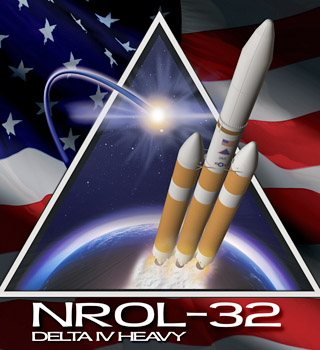
Mission Insignia (clickable)
|[table="head"]
Mission patch
|
Launch patch

|[/table][/table]​


Launch Vehicle:
Delta-4H.jpg
|
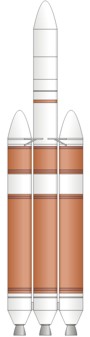
Delta IV Heavy is comprised of a common booster core (CBC), two additional CBCs as strap-on liquid rocket boosters (LRBs) to augment the first-stage CBC, a cryogenic upper stage, and 5-m-diameter payload fairing (PLF).​
The Delta 4 CBC design is optimized for balanced performance over a wide range of payloads using the high-performance RS-68 main engine powered by liquid hydrogen (LH2) and liquid oxygen (LO2). The RS-68 is throttleable to serve various mission profiles operating at 102% and 58% thrust level. Two separate 5-m-dia. LO2 and LH2 tanks provide the majority of the first stage structure. These two tanks are integrated wih a composite cylinder, called the centerbody. At the forward end of the CBC, another composite cylinder, the interstage, provides the interface between the CBC and the cryogenic second stage. For the port and starboard strap-on CBCs of the Heavy configuration the interstage structure is replaced with a composite nose cone.​
At the aft end of the CBC, an engine section provides the thrust structure and thermal shield that integrates the RS-68 main engine to the CBC. The RS-68 requirements were balanced to enable operational thrust at lower chamber pressures. This design trade increase engine reliability, while reducing complexity. Compared with the SSME, the RS-68 has an 80% reduction in unique part count. Even with lower performance than comparable LO2/LH2 engines, the RS-68 develops a world record 2949 kN (663000 lb) of sea-level thrust with a specific impulse (Isp) of 359 seconds at sea level.​
The second stage comprises a 5-m-diameter fuel tank, a composite intertank structure, a liquid oxygen tank, avionics equipment shelf, avionics suite, attitude control system and is powered by a Pratt & Whitney RL10B-2 liquid rocket engine that produces 100kN (24750 lb.) of thrust. The RL10B-2, with its high expansion, carbon-carbon nozzle provides an Isp of 465.5 seconds.​


{colsp=2}


Viewing the Launch Live:
A live simulcast of the launch will be available 25 minutes prior to launch. You can watch the launch live via satellite TV (where applicable): SATELLITE: Galaxy 3; TRANSPONDER - G3C-8c; BAND - C-band Analog; ORBITAL POSITION - 95 degrees W; CARRIER - INTELSAT; BANDWIDTH - 36 MHz; UPLINK FREQ - 6085 MHz (Horizontal); DOWNLINK FREQ - 3860 MHz (Vertical).

You can watch the launch via Internet webcast. A live simulcast of the TV broadcast will be available 25 minutes prior to launch on the ULA Web site.

The broadcast [eventtimer]2010-11-19 22:41?will start in|started;%c% %h% hours, %m%[/eventtimer] minutes[eventtimer]2010-11-18 22:45?.| ago.;%c%[/eventtimer]​


Links:

Launch Updates:
Weather report:
The early weather projections for Thursday night's launch of the Delta 4-Heavy rocket carrying a clandestine spy satellite calls for good conditions at Cape Canaveral Air Force Station.

Meteorologists issued their initial forecast this morning and put the odds of acceptable launch weather at 80 percent. Gusty winds at pad 37B will pose only a slight concern.

"Conditions aloft will feature a relatively flat, progressive pattern with low pressure trough moving across the northern tier of the U.S. and off the eastern seaboard. At the surface, a low pressure center will develop along the northwestern Gulf Coast states on Monday and quickly move northeastward. An accompanying weak cold front will move through central Florida during the day on Wednesday. Surface high pressure will build in across Florida behind the front and be the main feature on launch day, and remainder of week," forecasters say.

"On Thursday local conditions will consist of north-northwest winds, post frontal stratocumulus clouds mainly over the ocean, and temperatures near normal for mid-November. The only item of interest will be the strength of the post frontal ground level winds as they will approach but remain below the 20-knot liftoff constraint."

The forecast calls for a few low clouds at 3,000 feet and a few high clouds at 25,000 feet, 7 miles of visibility, a temperature between 68-70 degrees F and north-northwesterly winds from 340 degrees at 12 peaking to 18 knots.
 
Last edited:
Launch Hazard Area map: http://www.patrick.af.mil/shared/media/document/AFD-061109-038.doc (folks, please take care not to sail there)

And search elements for various stages of flight published by Ted Molczan, together with his notes:

NROL-32 is scheduled for launch on a Delta IV-Heavy, from Cape Canaveral, on 2010 Nov 18, at 23:10
UTC, the opening of a launch window of several hours duration.

I believe the payload is the fifth in the series of what we call Mentor spacecraft, aka Advanced
Orion, which gather signals intelligence from inclined geosynchronous orbits. They are among the
largest satellites ever deployed, with a main antenna generally believed to span ~100 m.

I offer the following search elements, which should be considered to be very approximate. They are
based on launch at 23:10 UTC.

1. Launch and GTO

The LEO and GTO orbits are the same as the ones I posted prior to NROL-26, rotated to the start of
the launch window of NROL-32. Mission elapsed times are approximate.

Code:
LEO park T+00:12:48 to T+00:20:30                        259 X 272 km
1 78901U          10322.98275464  .00000000  00000-0  00000-0 0    01
2 78901  27.2800 223.3769 0010000 183.0000 359.3500 16.05000000    08

GTO T+00:28:30 to T+05:24:30                           278 X 36398 km
1 78902U          10323.19115508  .00000000  00000-0  00000-0 0    08
2 78902  27.2800 223.2969 7307000 182.9000 167.5000  2.23480000    05

2. GEO Insertion

The ~3 min burn to insert into GEO will occur about 5h24m after launch, near the first ascending
node and apogee of the GTO, near 96 E. I believe that the payload's initial inclination will be
between 5 and 7 deg, and have adopted 6 deg as my guess. The 78903 elset is derived from that of
Mentor 4, which initially drifted westward, at nearly 0.5 deg/d.

Code:
Payload GEO - westward drift                         35705 X 35943 km
1 78903U          10323.19652778  .00000000  00000-0  00000-0 0    04
2 78903   6.0000 222.9192 0028124 186.2394 175.8683  1.00142488    08

In the event that the payload drifts eastward at the same rate, its orbit could be something like
this:

Code:
Payload GEO - eastward drift                         35557 X 35944 km
1 78904U          10323.19652779  .00000000  00000-0  00000-0 0    06
2 78904   6.0000 222.9192 0046000 186.2394 175.8683  1.00405000    04

3. CCAM and Propellant Dump

About 10 min after the GEO insertion manoeuvre, the now separated 2nd stage will perform the CCAM
(contamination and collision avoidance manoeuvre), followed shortly by the propellant dump,
resulting in approximately the following orbit, which is derived from that of NROL-26.

Code:
Delta IV 5 m 2nd stage                               35940 X 38084 km
1 78905U          10323.22430556  .00000000  00000-0  00000-0 0    08
2 78905   6.0000 219.6655 0247122  13.9414   1.8017  0.96057559    04

Since the inclination change at GEO insertion would be less than that of NROL-26, there may be
additional propellant to dispose of, which could result in some combination of lower RAAN and
greater apogee, which I have not attempted to estimate.

4. Visibility Prospects

The launch phase will be an entirely Eastern Hemisphere show, but there won't be much to see, due to
daylight. Depending on the time of launch, the GTO may be briefly visible from South Africa,
beginning about half an hour after launch.

GEO insertion will occur ~36000 km over the equator near 96 E, but it will be day-time over that
hemisphere, so I doubt anyone will see the rocket burns or cloud formed by the propellant dump, but
I will leave it to prospective observers in adjacent areas to evaluate potential visibility, bearing
in mind that the launch could occur up to several hours later than the launch time used as the basis
for the above elements.

On the nights following the launch, the payload and its upper stage may be found near the above
orbits. I do not know the payload's destination, but would not be surprised if it heads east, to
replace Mentor 1 (95022A / 23567), located at 127 E (as of the latest elements, on 2010 Jan 01). In
that case, it may be near the 78904 orbit, visible from Asia and Australia. If it heads west, the
78903 orbit puts it initially within range of Asia and Australia, and South Africa by the second
week of December.

Mentor is by far the brightest satellite in GEO, normally reaching magnitude 8 - without benefit of
flaring due to favourable sun angle.

The upper stage should drift within range of Eastern Europe and South Africa by the night following
launch, and within range of Western Europe a couple of nights after that. It will reach mag 10-11,
when well placed for observation.

Happy hunting!
Ted Molczan

(from SeeSat-l mailing list)
 
The reason I stopped starting these threads is because you guys do such a really good job setting it up and organizing the page. Better to leave these things to the pros, so thank you very much!
 
Last edited:
Spaceflight Now: Essential eavesdropping satellite launching Thursday.

Florida Today - The Flame Trench: Huge Delta IV Heavy Rocket Ready For Thursday Night Launch.


Weather report:
As pre-flight preparations continue as planned for Thursday's countdown, meteorologists at the 45th Weather Squadron have bumped up the odds of favorable launch conditions to 90 percent.

The forecast continues to call for just a few clouds, good visibility, a temperature around 67 degrees F and north-northwesterly winds of 12 peaking to 18 knots. The limit is 20 knots, and that's what the weather team will be watching.

If the launch should slip to Friday night, the outlook will be much of the same. The forecast for Saturday brings the change of rain into the equation.


Larger version of the sticker:

NROL32_STICKER_forprint.jpg
 
http://spaceflightnow.com/delta/d351/preview.html

Essential eavesdropping satellite launching Friday

...

Countdown clocks are targeting a liftoff time of 6:06 p.m. EST (2306 GMT) from the Florida spaceport's Complex 37. The evening's available launch opportunity likely extends upwards of four hours.

The original launch date of Thursday was delayed by 24 hours to fix an issue with ground pyrotechnics that release the big booster at liftoff.

...
 
Florida Today - The Flame Trench: Delta IV Heavy Rocket On Track For Friday Night Spectacular


Speculations about the spacecraft per www.zarya.info:
Payload details unknown but possibly a SIGINT satellite aimed at a Molniya-type HEO or inclined gossynchronous orbit, may be similar in purpose to USA 184 (2006-27A/29249).

Previous announced launch times were Nov 15, 23:21 UTC, Nov 18, 23:10 UTC, and 2010 Nov 19, 23:06 [time for Nov. 18 corrected and Nov. 19 opportunity added - orb]. The window moves earlier by 3.75 minutes per day, as would be expected if the objective is to match an existing satellite constellation in Molniya-type HEO.

{...}

Frequencies: 2232.5 and 2277.5 MHz.


Weather report (Spaceflight Now MSC):
Air Force meteorologists are predicting good weather conditions for a Friday liftoff of the Delta 4-Heavy rocket from Cape Canaveral. There is a 90 percent chance of acceptable conditions, with ground-level winds posing only a slight concern.

Today's weather: "Stalled cold frontal boundary over southern Florida. Widespread low level cloudiness and chance for an isolated shower will decrease during the day as drier air moves in from the north," the weather team says.

The outlook: "Surface high pressure center located north of the area will move eastward providing a northeast onshore wind on launch day, and remainder of week. On Friday, local conditions will consist of northeast winds, post frontal stratocumulus clouds, and temperatures near normal for mid-November. The only item of interest will be the strength of the onshore winds as they will approach but remain below the 20-knot liftoff constraint."

The forecast for Friday night's launch window includes some scattered clouds at 3,000 feet, 7 miles of visibility, a temperature between 66-68 degrees F and northeasterly winds from 030 degrees at 12 peaking to 18 knots.

The odds of acceptable weather on Saturday and Sunday, if the launch should be delayed, are 90 percent favorable both nights.
 
Currently still at T-minus 5 hours, 15 minutes and holding. The Terminal Countdown will begin begin at 12:36 p.m. EST / 17:36 UTC with countdown resume.

Weather report (Spaceflight Now MSC):
Weather continues to look beautiful for the Delta 4-Heavy rocket's launch. There's just a few scattered clouds, light winds and temperatures in the low 70s F right now.


Either of the images below, that are being updated automatically (as also ELV Countdown Portal page), may show sometimes Delta IV with NROL-32 on the launch pad (or weather maps/graphs/status):
chan11large.jpg
chan15large.jpg

Live video stream from the SLC-37B pad is also on Spaceflight Now 2 livestream channel.

---------- Post added at 18:39 ---------- Previous post was at 18:31 ----------

The terminal countdown is underway now.

The multi-step process of loading all eight cryogenic propellant tanks in the rocket is scheduled to begin in the next half hour and continue into the late afternoon.
 
The launch will be around 00:15 AM here, if there isn't any delays... I'm gonna to have another short night ! Don't want to miss a Delta4H launch, so... :coffee:
 
Filling of the tanks with liquid hydrogen has begun.

SFN MSC said:
The cold gas chilldown for the hydrogen side has been completed and the launch team is beginning the slow pumping of liquid hydrogen propellant into the three Common Booster Core stages. This "slow-fill" will be sped up to "fast-fill" after a small portion of each tank is loaded.


---------- Post added at 20:05 ---------- Previous post was at 19:35 ----------

After LOX chilldown filling tanks with liquid oxygen has begun. The liquid oxygen tanks in all three Common Booster Cores will be filled over the next hour or so.

---------- Post added at 20:13 ---------- Previous post was at 20:05 ----------

Some nice photos from Spaceflight Now in the gallery linked below -
Spaceflight Now: Delta 4-Heavy stands ready for launch (PHOTO GALLERY).​


---------- Post added at 20:17 ---------- Previous post was at 20:13 ----------

Some problems. Filling of LOX stopped:
SFN MSC said:
1912 GMT (2:12 p.m. EST)

Flow of liquid oxygen to the rocket has stopped and technicians are starting to offload the commodity.


---------- Post added at 20:30 ---------- Previous post was at 20:17 ----------

Now the LH2 is being offloaded:
SFN MSC said:
1925 GMT (2:25 p.m. EST)

The team is proceeding into liquid hydrogen offloading.
There might be possible scrub for this launch tonight.

---------- Post added at 21:01 ---------- Previous post was at 20:30 ----------

The launch may still occur tonight, later than at the beginning of the window:
SFN MSC said:
2000 GMT (3:00 p.m. EST)

The troubleshooting and go-forward plans continue to be worked. Launch still can happen tonight, albeit a little later than 6:06 p.m. EST. The rocket's available liftoff window extends a few hours, which could enable the problem to be fixed, fuels reloaded and the launch to occur this evening.


---------- Post added at 21:33 ---------- Previous post was at 21:01 ----------

The liftoff is being retargeted for tonight at 8:30 p.m. EST / 01:30 UTC.

---------- Post added at 21:46 ---------- Previous post was at 21:33 ----------

TODAY'S LAUNCH ATTEMPT SCRUBBED.

Today's launch attempt for the Delta 4-Heavy rocket has been called off due to a problem that arose during fueling operations.

---------- Post added at 23:51 ---------- Previous post was at 21:46 ----------

NASASpaceFlight: Delta IV Heavy launch with NROL-32 scrubbed:
The United Launch Alliance (ULA) Delta IV Heavy launch vehicle mission to loft classified payload for the United States National Reconnaissance Office from Space Launch Complex 37B at the Cape Canaveral Air Force Station has been scrubbed for 48 hours due to issues suffered during fueling - relating to anomalous temperature data signatures detected on the port and starboard strap-on common core boosters during cryogenic fueling.


---------- Post added 20th Nov 2010 at 02:10 ---------- Previous post was 19th Nov 2010 at 23:51 ----------

Another nice photo gallery this time by Pat Corkery/United Launch Alliance -
Spaceflight Now: Delta 4-Heavy rocket revealed for launch (PHOTO GALLERY).​


---------- Post added at 23:15 ---------- Previous post was at 02:10 ----------

The launch is targeted now for Sunday at 5:58 p.m. EST / 22:58 UTC. The weather outlook is 90 percent favorable.

Launch Hazard Area period is 3:45-11 p.m. EST / 20:45-04:00 UTC.
 
Now at T-15 minutes and counting / L-30 minutes. The launch team reports no problems are being worked and liftoff remains on schedule. Currently cumulus clouds are violating the launch constraints, but the weather should be "go" just before the launch.

You can watch the launch live via:

Here are some stats for today's launch:
  • The 351st Delta rocket launch since 1960
  • The 14th Delta 4 rocket mission since 2002
  • The 12th Delta 4 rocket launch from Cape Canaveral
  • The 4th Heavy configuration to fly
  • The 7th Delta 4 under the ULA banner
  • The 3rd Delta 4 launch this year
  • The 10th use of Delta 4 by the Air Force
  • The 3rd classified Delta 4 for the NRO


---------- Post added at 23:47 ---------- Previous post was at 23:25 ----------

Final poll: All ready for the launch. Weather is "Green".

---------- Post added at 23:50 ---------- Previous post was at 23:47 ----------

T-5 minutes and counting.
 
Last edited:
A Delta-IV's ignition looks scary... Like if the vehicle catches on fire.

---------- Post added at 02:00 ---------- Previous post was at 01:57 ----------

Liftoff, btw.

---------- Post added at 02:02 ---------- Previous post was at 02:00 ----------

1st stage separation, fairing separation.

---------- Post added at 02:03 ---------- Previous post was at 02:02 ----------

And that's it with the webcast.
 
Nice liftoff & ascent ! I guess the future developpements of the mission will be kept secret, since the payload is a huge spy satellite :salute:

And yeah, the flames at liftoff are quite impressive, especially by night ! :cool:
 
Which Orbiter version are they using for flight animation? It looks pretty outdated:rofl:
 
The ULA's official launch video! :thumbup:


---------- Post added at 18:41 ---------- Previous post was at 15:59 ----------

BTW, a speculative draft of a Mentor/Advanced Orion satellite design:

sigintadvancedoriontrum.jpg
 
Back
Top