Updates MRO (Mars Reconnaissance Orbiter) Updates

tblaxland

O-F Administrator
Administrator
Addon Developer
Webmaster
Joined
Jan 1, 2008
Messages
7,325
Reaction score
31
Points
123
Location
Sydney, Australia
http://www.spaceref.com/news/viewsr.html?pid=33010
NASA's Mars Reconnaissance Orbiter today has been taken out of the precautionary "safe mode" it had been in since August[...]Engineers plan to resume science operations once they conclude a check of all the science instruments. Normal science operations may resume next week.

The mission flight team successfully uploaded new software last week that provided a patch to prevent the orbiter from an unlikely scenario of back-to-back computer resets that could potentially jeopardize the mission.
Those "back-to-back computer resets" they mention had the potential to reset MRO so that it thought it was back on the pad and had to communicate via umbilicals rather than its antennas.
 
I think the lowest reset stage a spacecraft should be able to achieve is an on-mission mode. But then again, if you scare me enough, I'll be lying on the floor crying: "I just want to go home" too. :D
 
Scary thing is it might try the umbilical connection and get a response...

N.
 
Fresh crater caught on camera aboard Mars orbiter

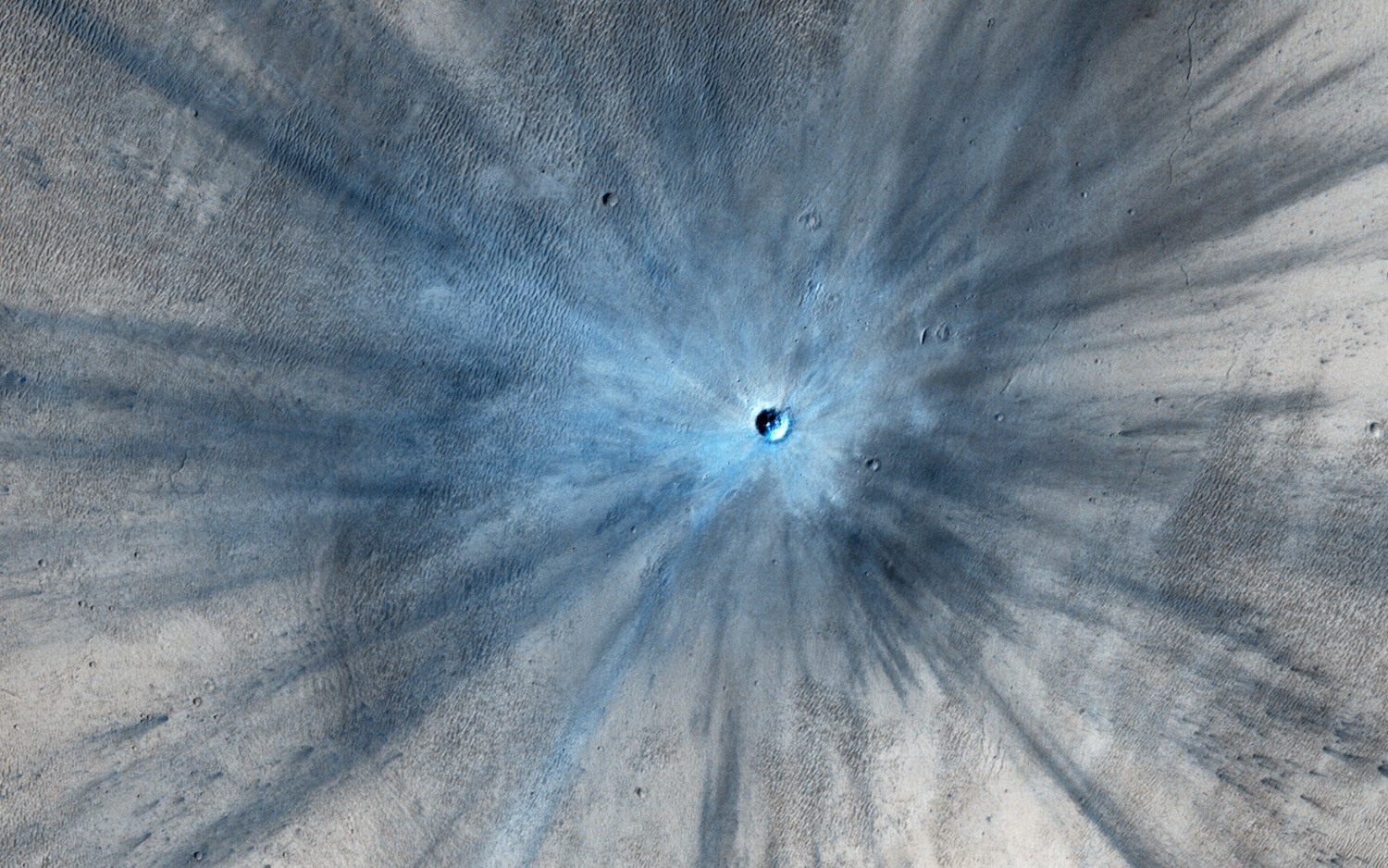
The high-resolution mapping telescope on NASA's Mars Reconnaissance Orbiter has monitored the changing Martian landscape for more nearly eight years, but a fresh impact crater seen in an image released Wednesday is one of the most dramatic scientists have ever discovered.
The crater spans about 30 meters, or 100 feet, across and formed some time between July 2010 and May 2012. Researchers looking at pictures from the orbiter's context camera, a wide-angle imager used to complement MRO's main mapping instrument, noticed a new surface feature appearing in 2012 not there two years before.

Scientists requested MRO's High-Resolution Imaging Science Experiment, or HiRISE, to take a closer look. The camera captures the sharpest views of Mars ever taken from orbit, and it turned its aperture toward the crater site to image the region Nov. 19, 2013.

What they saw was a dazzling crater with ejecta rays extending outward in all directions up to 15 kilometers, or 9.3 miles, from the impact site. Whatever carved the bowl-shaped pit in the Martian bedrock caused one of the biggest explosive events ever seen on Mars since spacecraft began visiting the red planet.

Alfred McEwen, HiRISE's chief scientist at the University of Arizona in Tucson, said the estimated 30-meter diameter of the new crater puts it among the largest recent impacts seen by the eagle-eyed camera.

The biggest new crater previously found by HiRISE was 33.8 meters across, or about 111 feet in diameter.

"But this one is more spectacular looking with prominent dark rays," says McEwen, a professor of planetary sciences. "Most new craters found are smaller than 10 meters (33 feet)."

From the orbiter's altitude, the HiRISE camera has a pixel size of about one-quarter meter, or 10 inches.

Scientists say incoming rocks and small asteroids generate about 200 fresh craters per year, but few are as eye-catching as the one seen in November.

crater_large.jpg


Source:
http://www.spaceflightnow.com/news/n1402/06crater/#.UvTSV02YY-U
 
Just goes to show: You change just one variable in astronomy, and it's "light's out" in a big way. :blink:
 
Well, Mars is closer to the Asteroid belt so there should be more Mars crossers than Earth crossers, right? Aditionally the atmosphere compared to Earth? You could say nearly none.
I wonder if something of the size and speed of the Chelyabinsk meteor would result on this when going to Mars instead of Earth.:hmm:
 
Small Troughs Growing on Mars May Become 'Spiders'

NASA Press Statement: https://www.nasa.gov/feature/jpl/small-troughs-growing-on-mars-may-become-spiders

new_spider2_closeup_repeat_web.gif


This sequence of three HiRISE images from NASA's Mars Reconnaissance Orbiter shows the growth of a branching network of troughs carved by thawing carbon dioxide over the span of three Martian years. This process may also form larger radially patterned channel features known as Martian "spiders."
Credits: NASA/JPL-Caltech/Univ. of Arizona

Erosion-carved troughs that grow and branch during multiple Martian years may be infant versions of larger features known as Martian "spiders," which are radially patterned channels found only in the south polar region of Mars.

Researchers using NASA's Mars Reconnaissance Orbiter (MRO) report the first detection of cumulative growth, from one Martian spring to another, of channels resulting from the same thawing-carbon-dioxide process believed to form the spider-like features.

The spiders range in size from tens to hundreds of yards (or meters). Multiple channels typically converge at a central pit, resembling the legs and body of a spider. For the past decade, researchers have checked in vain with MRO's High Resolution Imaging Science Experiment (HiRISE) camera to see year-to-year changes in them.

pia21258_araneiforms-with-fans.jpg


These five images from the HiRISE camera on NASA's Mars Reconnaissance Orbiter show different Martian features of progressively greater size and complexity, all thought to result from thawing of seasonal carbon dioxide ice that covers large areas near Mars' south pole during winter.
Credits: NASA/JPL-Caltech/Univ. of Arizona
 
MRO is in trouble!

NASA: Diagnostic Work is Focus for Resuming Service and Exiting Safe Standby Status

MARS RECONNAISSANCE ORBITER MISSION STATUS REPORT​

NASA's Mars Reconnaissance Orbiter (MRO), at Mars since 2006, put itself into a precautionary standby mode on Feb. 15 in response to sensing an unexpectedly low battery voltage.

The orbiter is solar-powered but relies on a pair of nickel-hydrogen batteries during periods when it is in the shadow of Mars for a portion of each orbit. The two are used together, maintaining almost identical charge during normal operations.

The spacecraft remains in communication with Earth and has been maintaining safe, stable temperatures and power, but has suspended its science observations and its service as a communications relay for Mars rovers. Normal voltage has been restored, and the spacecraft is being monitored continuously until the troubleshooting is complete.

"We're in the diagnostic stage, to better understand the behavior of the batteries and ways to give ourselves more options for managing them in the future," said MRO Project Manager Dan Johnston of NASA's Jet Propulsion Laboratory, Pasadena, California. "We will restore MRO's service as a relay for other missions as soon as we can do so with confidence in spacecraft safety -- likely in about one week. After that, we will resume science observations."

About MRO:

pia05490_hiresb.jpg

NASA's Mars Reconnaissance Orbiter entered orbit around the Red Planet on March 10, 2006. Since then, it has returned more data than all other past and current interplanetary missions combined, with a tally of more than 317 terabits so far.

The mission met all its science goals in a two-year primary science phase. Five extensions, the latest beginning in 2016, have added to the science returns. The longevity of the mission has given researchers tools to study seasonal and longer-term changes on Mars. Among other current activities, the orbiter is examining possible landing sites for future missions to Mars and relaying communications to Earth from NASA's two active Mars rovers.
 
Last edited:
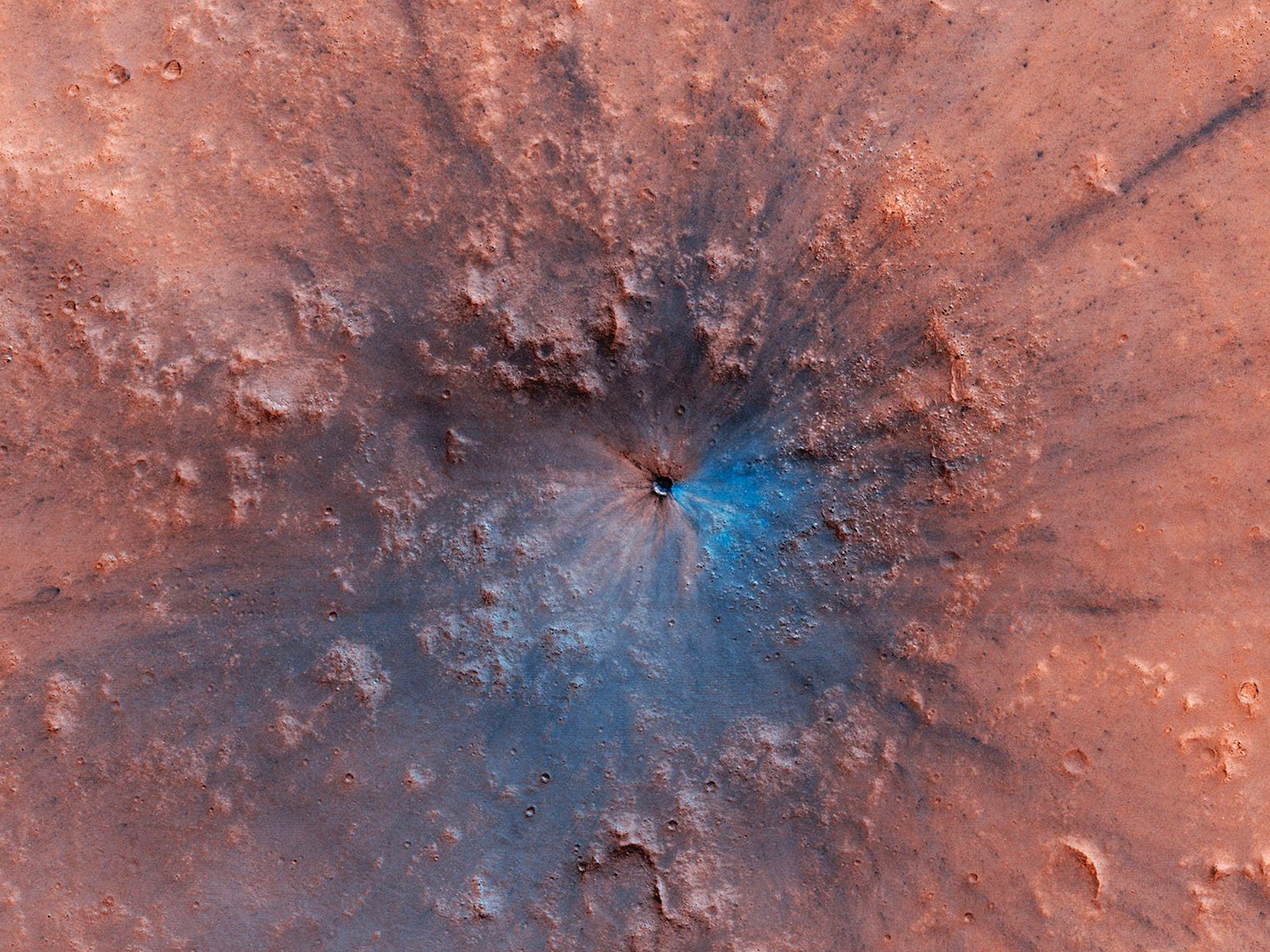
space.com : Bam! Fresh Crater Spied on Mars — and It Looks Spectacular
{...}
A color image from HiRISE, posted June 6 and taken in April, shows a large black-and-blue bruise on the landscape amid an otherwise flat area of red Martian dirt.

Because MRO cannot look everywhere at once, it's unclear exactly when the new crater formed; the best estimate is somewhere between September 2016 and February 2019, scientists said.
{...}

RAeUhyS64SomeDaDiozbtR.jpg

A new crater on Mars, which appeared sometime between September 2016 and February 2019, shows up as a dark smudge on the landscape in this high-resolution photo. A new crater on Mars, which appeared sometime between September 2016 and February 2019, shows up as a dark smudge on the landscape in this high-resolution photo. Image: © NASA/JPL/University of Arizona​
 
Back
Top