Moon.cfg in orbiter beta

Hi guys, just checking in to this thread again. I apologise for having let this slip for a bit - I got distracted by other stuff.

I appreciate all the work you have put into this topic. I am just going through the thread and try to distill the latest state of the discussion.

The most important question for my part is whether the orbiter interface for the precession implementation is workable in its current state, or if I need to change anything in the interface.

And secondly, I see that the cfg parameters are currently being worked on. Is there consensus about the correct parameters for the various solar bodies, or is this still under investigation? I want to upload a new beta soon, and I want to make sure to include the best current estimates for the parameters, so we are not unnecessarily hampered with obsolete data.
 
The most important question for my part is whether the orbiter interface for the precession implementation is workable in its current state, or if I need to change anything in the interface.
Just this part pertaining to Eq 7 in precession.pdf: http://www.orbiter-forum.com/showthread.php?p=104425#post104425. I think we all agree that needs changing. As far as the data goes, I have been assuming that Ts will still be specified in the cfg file.

And secondly, I see that the cfg parameters are currently being worked on. Is there consensus about the correct parameters for the various solar bodies, or is this still under investigation? I want to upload a new beta soon, and I want to make sure to include the best current estimates for the parameters, so we are not unnecessarily hampered with obsolete data.
I will summarise the current best estimates below. No-one has disputed my updated Earth data and it is just slightly refined from what we had agreed was reasonable earlier (comes from here in the discussion). The Moon data is also pretty well agreed upon (see here). And Chode backs my Mars, Phobos and Deimos data (see here, here and here).
Code:
Earth
-----
PrecessionLAN = 0
PrecessionObliquity = 0
PrecessionPeriod = -9413040.4
LAN = 0
LAN_MJD = 51544.5
SidRotOffset = 4.88948754
SidRotPeriod = 86164.10132
Obliquity = 0.4090928023
;SidRotPeriod (days): 0.99726969
;SidRotPeriod (days - node to node): 0.99726959
;Precession Period (years): -25771.5
;Obliquity (deg): 23.439291
;Ecliptic Obliquity (deg): 23.439291

Moon
----
PrecessionLAN = 0
PrecessionObliquity = 0
LAN = 2.181328
LAN_MJD = 51544.5
SidRotOffset = 4.770748
SidRotPeriod = 2360588.2
PrecessionPeriod = -6792.9076
Obliquity = 0.02694055
;RMS Error (deg): 0.03151955

Mars
----
PrecessionLAN = 4.0050811
PrecessionObliquity = 0.032243695
LAN = 0.62105324
LAN_MJD = 51544.5
SidRotOffset = 5.469524816
SidRotPeriod = 88642.66435
PrecessionPeriod = -63346658
Obliquity = 0.43974159
;SidRotPeriod (days): 1.0259568
;SidRotPeriod (days - node to node): 1.0259567
;Precession Period (years): -173433.7
;Obliquity (deg): 25.195337
;Ecliptic Obliquity (deg): 26.717951

Phobos
------
PrecessionLAN = 4.5887315
PrecessionObliquity = 0.46604845
LAN = 2.2436597
LAN_MJD = 51544.5
SidRotOffset = 0.79970825
SidRotPeriod = 27553.835
PrecessionPeriod = -825.91847
Obliquity = 0.018846906
;SidRotPeriod (days): 0.31891012
;SidRotPeriod (days - node to node): 0.31878705
;Precession Period (years): -2.2612415
;Obliquity (deg): 1.0798482
;Ecliptic Obliquity (rad): 0.4545171
;Ecliptic LAN (rad): 4.6223284
;RMS Error (deg): 1.0173299

Deimos
------
PrecessionLAN = 4.5710171
PrecessionObliquity = 0.45879969
LAN = 0.24013303
LAN_MJD = 51544.5
SidRotOffset = 3.5745962
SidRotPeriod = 109074.88
PrecessionPeriod = -19833.996
Obliquity = 0.031112612
;SidRotPeriod (days): 1.2624408
;SidRotPeriod (days - node to node): 1.2623604
;Precession Period (years): -54.302523
;Obliquity (deg): 1.7826214
;Ecliptic Obliquity (rad): 0.48963607
;Ecliptic LAN (rad): 4.5870416
;RMS Error (deg): 0.19599449
 
I think we have a consensus on what calculations need to be changed in the latest beta release, namely equation 7 should be what jarmonik posted in post #39:

theta = SidRotOffset+2*PI*86400*d/SidRotPeriod+cos(Obliquity)*(LAN-L_rel).

This is also backward compatable with pre-precession Orbiter config files.

As for parameters, I am in agreement with what tblaxland's program has churned out so far, and also think that jarmoniks numbers are at least as good. So far, this includes Earth, Moon, Mars, Deimos, and Phobos.

I've made models for Mercury, Jupiter, Neptune, Callisto, Io, Ganymede, Europa, Enceladus, Mimas, and Triton. I'd like to see what tblaxland's program generates for these bodies, since his method seems to give more accurate results than my method.

Regards
 
I think we have a consensus on what calculations need to be changed in the latest beta release, namely equation 7 should be what jarmonik posted in post #39:

theta = SidRotOffset+2*PI*86400*d/SidRotPeriod+cos(Obliquity)*(LAN-L_rel).
I agree. This is equivalent to what I have posted except that I had assumed that SidRotOffset was measured at the same epoch as LAN (it is for all the data we have posted thus far).

I'll see if I can make any progress on those other bodies. No promises, as my week is about to get busy...

---------- Post added at 13:53 ---------- Previous post was at 10:44 ----------

For now I am having a looking at the IAU SOFA library to see if I can use it to validate my proposed Earth cfg.
I did that and got a lower value for the Earth rotation rate of 86164.10074s (TT). This rate is based on integrating the SOFA Earth rotation angle output over the period 1962-2009 (it relies on knowing the difference between TT and UT1, which I got from IERS). Also, I get 86164.10016 for the period J2000 +/- 9 years (this makes sense when you consider leap seconds have been added at a lower rate in recent decades - see the changes in the length of day here, it is much shorter near 2000).

On reflection the last value I presented of 86164.10132s was too high because I had miscalculated the precession rate in the IAU/IAG data. The value I estimated earlier from IAU/IAG data of 86164.10044s (TT), lies between both values from SOFA.

Any thoughts on which value should be used? I am tempted to use the SOFA mean value from 1962-2009 (86164.10074s) for greater accuracy with historical missions.

---------- Post added at 17:13 ---------- Previous post was at 13:53 ----------

I've made models for Mercury, Jupiter, Neptune, Callisto, Io, Ganymede, Europa, Enceladus, Mimas, and Triton. I'd like to see what tblaxland's program generates for these bodies, since his method seems to give more accurate results than my method.
Here is Mercury. These match well with both the existing cfg files. The precession period is shorter than predicted by this element set (2680 years vs 2872)*, but given I am only integrating J2000 -40/+60, and that set is for 1800 to 2050, I am happy to call it close enough. Let me know what you think.
Code:
Mercury
-------
PrecessionLAN = 3.9814633
PrecessionObliquity = 0.12240241
LAN = 1.6677206
LAN_MJD = 51544.5
SidRotOffset = 0.2754700469
SidRotPeriod = 5067034.512
PrecessionPeriod = 978955.51
Obliquity = 0.00059319734
;SidRotPeriod (days): 58.646233
;SidRotPeriod (days - node to node): 58.649746
;Precession Period (years): 2680.2341
;Obliquity (deg): 0.033987704
;Ecliptic Obliquity (rad): 0.12234417
;Ecliptic LAN (rad): 3.986501

* That is for a Cassini state, which one might expect for Mercury.
 
Any thoughts on which value should be used? I am tempted to use the SOFA mean value from 1962-2009 (86164.10074s) for greater accuracy with historical missions.


The period of the Earth's rotation is basically unpredictable at the 0.001 sec level from year to year, and has historically changed by 0.001 to 0.005 sec from year to year in recent times. Since Orbiter's model assumes that this value is fixed, it comes down to what time-frame do you want to model best. I agree that the spaceflight historical timeframe would be best, but recognize that even during that time, the Earth rotation period was changing by more than 0.001 seconds year to year.

Regards
 
The period of the Earth's rotation is basically unpredictable at the 0.001 sec level from year to year, and has historically changed by 0.001 to 0.005 sec from year to year in recent times. Since Orbiter's model assumes that this value is fixed, it comes down to what time-frame do you want to model best. I agree that the spaceflight historical timeframe would be best, but recognize that even during that time, the Earth rotation period was changing by more than 0.001 seconds year to year.
That much is readily visible in the graph I posted. Doing some back of the envelope calculations, even if you used the mean period over the past two decades, extrapolating back to the Apollo period the mean error would only be about 0.02 degrees in longitude.

---------- Post added at 17:47 ---------- Previous post was at 17:33 ----------

And here is Venus (doesn't precess by any discernible amount):
Code:
LAN = 5.2392469
LAN_MJD = 51544.5
SidRotOffset = 3.88425353
SidRotPeriod = -20996797.02
Obliquity = 0.021624781
;SidRotPeriod (days): -243.01848
;SidRotPeriod (days - node to node): -243.01848
;Precession Period (years): N/A
;Obliquity (deg): 1.2390087
 
Here are my estimates for Juptier. The SidRotPeriod comes from the IAU/IAG data but I notice in the cfg that a rate for a lower cloud layer is used. I'm not sure what value I should be using there. Does anyone have any historical background as to where the value in the cfg comes from?

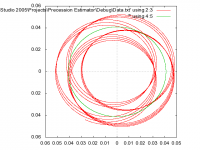
I've also attached a plot showing the position of the Jupiter's axis projected into a plane normal to the precession pole. The red is the path by IAU/IAG and the green is the path by the Orbiter model. The units are the sin of obliquity wrt the precession pole. The period shown is J2000 -40/+60 years.
Code:
Jupiter
-------
PrecessionLAN = 2.754662303
PrecessionObliquity = 0.03867459948
LAN = 4.811265964
LAN_MJD = 51544.5
SidRotOffset = 3.659705301
SidRotPeriod = 35729.685
PrecessionPeriod = -74119.968
Obliquity = 1.805607893e-005
;SidRotPeriod (days): 0.4135380209
;SidRotPeriod (days - node to node): 0.4135357136
;Precession Period (years): -202.9294127
;Obliquity (deg): 0.001034537117
;Ecliptic Obliquity (rad): 0.03867533801
;Ecliptic LAN (rad): 2.754469947
 

Attachments

  • Jupiter.png
    Jupiter.png
    8.5 KB · Views: 22
Here are my estimates for Juptier. The SidRotPeriod comes from the IAU/IAG data but I notice in the cfg that a rate for a lower cloud layer is used. I'm not sure what value I should be using there. Does anyone have any historical background as to where the value in the cfg comes from?

I suppose the orientation of the great red spot would matter most but it's not critical issue. Does the rotation of the other gas giants matter at all ? There's probably no need to alter the configuration files since there is no fixed/solid surface.
 
I'm happy to leave the SidRotPeriods as they are, I was just curious.
 
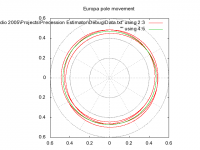
Data for Io below. This matches pretty well with the current cfg. Graph of pole motion attached, units are degrees of obliquity.
Code:
PrecessionLAN = 2.751940721
PrecessionObliquity = 0.03863102727
LAN = 4.585274277
LAN_MJD = 51544.5
SidRotOffset = 5.963111194
SidRotPeriod = 152853.506
PrecessionPeriod = -2713.045101
Obliquity = 0.0007155478077
;SidRotPeriod (days): 1.769137801
;SidRotPeriod (days - node to node): 1.767984924
;Precession Period (years): -7.427912665
;Obliquity (deg): 0.04099786942
;Ecliptic Obliquity (rad): 0.03854152788
;Ecliptic LAN (rad): 2.732249495
;Ecliptic SidRotOffset (rad): 0.7342211474
;RMS Error (deg): 0.01433453665
 

Attachments

  • Io.png
    Io.png
    13 KB · Views: 14
Last edited:
And here is Europa. Again matches well with current cfg data.
Code:
Europa
------
PrecessionLAN = 2.755889851
PrecessionObliquity = 0.03842310919
LAN = 3.530265134
LAN_MJD = 51544.5
SidRotOffset = 4.218624875
SidRotPeriod = 306822.0427
PrecessionPeriod = -11087.08861
Obliquity = 0.00821823229
;SidRotPeriod (days): 3.55118105
;SidRotPeriod (days - node to node): 3.550044013
;Precession Period (years): -30.35479428
;Obliquity (deg): 0.4708700253
;Ecliptic Obliquity (rad): 0.03124666289
;Ecliptic LAN (rad): 2.659788256
;Ecliptic SidRotOffset (rad): 4.221541374
;RMS Error (deg): 0.03093246191
 

Attachments

  • Europa.png
    Europa.png
    11 KB · Views: 9
I have been plugging away improving my algorithms and I have come up with some better data for the Moon:
Code:
Moon
----
PrecessionLAN = 0.7984763718
PrecessionObliquity = 7.19274513e-005
LAN = 1.384023245
LAN_MJD = 51544.5
Obliquity = 0.02692290984
PrecessionPeriod = -6793.239436
SidRotOffset = 4.769488926
SidRotPeriod = 2360588.15
;SidRotPeriod (days): 27.32162211
;SidRotPeriod (days - node to node): 27.21221738
;Precession Period (years): -18.59887594
;Obliquity (deg): 1.542569106
[COLOR=Red][B];RMS Error (deg): 0.03100325188[/B][/COLOR]
Compare with the values published by jarmonik:
Code:
Moon
----
PrecessionLAN = 0
PrecessionObliquity = 0
LAN = 2.181328
LAN_MJD = 51544.5
SidRotOffset = 4.770748
SidRotPeriod = 2360588.2
PrecessionPeriod = -6792.9076
Obliquity = 0.02694055
[B][COLOR=Red];RMS Error (deg): 0.03151955[/COLOR][/B]


Some slight improvement but a word of warning: the above data is optimised to minimise the errors over the period J2000 -40/+60 and the numbers for longer time periods are slightly different.

Now to implement those algorithms for the other bodies...
 
The data looks good.
 
Last edited:
I have just uploaded a new public beta (090722) to http://orbitervis.wiki.sourceforge.net/OrbiterPublicBeta which includes updates to the precession code. The rotation angle (phi) now includes the cos(eps) term as discussed above (see Technotes/precession.pdf). The planet config files have been updated with the precession and rotation parameters suggested in this thread.

Please let me know if this behaves correctly, or if more work is needed.
 
The data looks good.

Wow... data.

I have just uploaded a new public beta (090722) to http://orbitervis.wiki.sourceforge.net/OrbiterPublicBeta which includes updates to the precession code. The rotation angle (phi) now includes the cos(eps) term as discussed above (see Technotes/precession.pdf). The planet config files have been updated with the precession and rotation parameters suggested in this thread.

Please let me know if this behaves correctly, or if more work is needed.

I will go give it a look.
 
Wow... data.
It may not look much to you but it is music to my ears to hear such compliments as "the data looks good", after working for many hours to produce that data (which is aimed squarely at improving the accuracy, and hence enjoyment, of your simulation experience).
 
In the world of science and engineering, it's all about the data!
Damn right! So here is a whole bunch more...

After much restructuring and tweaking of my code, I have some new values to present. They are listed below with issues noted for your consideration, mostly related to errors between the 2006P1 config files SidRotOffset values and my calculated Ecliptic SidRotOffset values. The Ecliptic SidRotOffset values are calculated directly from the Orbiter precession model as the angle between the prime meridian and the longitude of ascending node of the ecliptic plane through the equatorial plane at J2000. To be honest, I can't see where my calculations are in error and they are significantly improved in accuracy from what I had presented before. They also return very low errors with respect to the IAU/IAG models so I am reluctant to change them further. Any comments/criticisms/rotten tomatoes/etc would be appreciated.

The metrics "Axis RMS Error" and "Lat/Lon RMS Error" are measures of the errors between Orbiter's precession model and the IAU/IAG precession/nutation models. Note that the "Axis RMS Error" value is quite high in some cases despite a low "Lat/Lon RMS Error". Typically this is because of a combination of a low obliquity and large nutations combining to form large errors in LAN even though the actual prescribed angle between the Orbiter model axis and the IAU/IAG model axis is still quite small. Since the "Axis RMS Error" metric combines both LAN and obliquity errors into a single number, the LAN error tends to dominate in those cases.

For eye candy, I've also done 3D graphs of the Lat/Lon errors for each body (they are largely useless as a source of real information though). The graphs are here: http://www.orbiter-forum.com/album.php?albumid=179

Mercury:
Difference in Ecliptic SidRotOffset of 0.255 rad.
Code:
Mercury
-------
PrecessionLAN = 3.981463274
PrecessionObliquity = 0.1224024085
PrecessionPeriod = 995828.2664
LAN = 1.674482844
LAN_MJD = 51544.5
Obliquity = 0.0005931973805
SidRotOffset = 0.2687078469
SidRotPeriod = 5067034.512
;SidRotPeriod (days): 58.64623278
;SidRotPeriod (days - node to node): 58.64968677
;Precession Period (years): 2726.429203
;Obliquity (deg): 0.03398770632
;Ecliptic LAN (rad): 3.986297968
;Ecliptic Obliquity (rad): 0.1223424276
;Ecliptic SidRotOffset (rad): 1.614667355
;Axis RMS Error (deg): 0.304377661
;Lat/Lon RMS Error (deg): 0.00299152648
Venus:
Difference in Ecliptic SidRotOffset of 0.473 rad.
Code:
Venus
-----
PrecessionLAN = 4.479140224
PrecessionObliquity = 0.05902012865
PrecessionPeriod = -2.347412561e+014
LAN = 2.810406394
LAN_MJD = 51544.5
Obliquity = 0.04583365568
SidRotOffset = 1.833514066
SidRotPeriod = -20996797.02
;SidRotPeriod (days): -243.018484
;SidRotPeriod (days - node to node): -243.018484
;Precession Period (years): -6.426865327e+011
;Obliquity (deg): 2.62607503
;Ecliptic LAN (rad): 5.23924688
;Ecliptic Obliquity (rad): 0.02162478054
;Ecliptic SidRotOffset (rad): 4.696459183
;Axis RMS Error (deg): 1.319209661e-008
;Lat/Lon RMS Error (deg): 6.533131969e-008
Moon:
No issues of note.
Code:
Moon
----
PrecessionLAN = 0.4643456618
PrecessionObliquity = 7.259562816e-005
PrecessionPeriod = -6793.219721
LAN = 1.71817749
LAN_MJD = 51544.5
Obliquity = 0.02692416821
SidRotOffset = 4.769465382
SidRotPeriod = 2360588.15
;SidRotPeriod (days): 27.3216221
;SidRotPeriod (days - node to node): 27.21221707
;Precession Period (years): -18.59882196
;Obliquity (deg): 1.542641205
;Ecliptic LAN (rad): 2.179855677
;Ecliptic Obliquity (rad): 0.02691360345
;Ecliptic SidRotOffset (rad): 4.71399578
;Axis RMS Error (deg): 0.5398940276
;Lat/Lon RMS Error (deg): 0.03098881956
Mars:
Difference in Ecliptic SidRotOffset of 0.486 rad.
Code:
Mars
----
PrecessionLAN = 4.005081124
PrecessionObliquity = 0.03224369545
PrecessionPeriod = -63346652.48
LAN = 0.6210531483
LAN_MJD = 51544.5
Obliquity = 0.4397415938
SidRotOffset = 5.469523488
SidRotPeriod = 88642.66435
;SidRotPeriod (days): 1.025956763
;SidRotPeriod (days - node to node): 1.025956748
;Precession Period (years): -173433.6824
;Obliquity (deg): 25.1953374
;Ecliptic LAN (rad): 4.588603922
;Ecliptic Obliquity (rad): 0.4663171564
;Ecliptic SidRotOffset (rad): 5.040408866
;Axis RMS Error (deg): 3.596520014e-006
;Lat/Lon RMS Error (deg): 0.000228792323
Phobos:
Difference in Ecliptic SidRotOffset of 1.021 rad.
Code:
Phobos
------
PrecessionLAN = 4.588488707
PrecessionObliquity = 0.4661704238
PrecessionPeriod = -826.1311277
LAN = 2.245404188
LAN_MJD = 51544.5
Obliquity = 0.01884736041
SidRotOffset = 0.8064220017
SidRotPeriod = 27553.83426
;SidRotPeriod (days): 0.3189101187
;SidRotPeriod (days - node to node): 0.3187870797
;Precession Period (years): -2.261823758
;Obliquity (deg): 1.079874207
;Ecliptic LAN (rad): 4.622012017
;Ecliptic Obliquity (rad): 0.4546193651
;Ecliptic SidRotOffset (rad): 2.021915467
;Axis RMS Error (deg): 0.8684982418
;Lat/Lon RMS Error (deg): 0.8608715885
Deimos:
Difference in Ecliptic SidRotOffset of 0.521 rad.
Code:
Deimos
------
PrecessionLAN = 4.569919137
PrecessionObliquity = 0.4589623041
PrecessionPeriod = -19884.23365
LAN = 0.2163181082
LAN_MJD = 51544.5
Obliquity = 0.03115720981
SidRotOffset = 3.599771213
SidRotPeriod = 109074.8814
;SidRotPeriod (days): 1.262440757
;SidRotPeriod (days - node to node): 1.262360649
;Precession Period (years): -54.44006476
;Obliquity (deg): 1.785176624
;Ecliptic LAN (rad): 4.584142011
;Ecliptic Obliquity (rad): 0.4894357966
;Ecliptic SidRotOffset (rad): 4.33244764
;Axis RMS Error (deg): 0.7903839043
;Lat/Lon RMS Error (deg): 0.193171207
Jupiter:
Significant difference in precession period from other published values (approx 470,000 years). My algorithms approach that value for large integration periods (>1000 years) but the value presented below is more accurate for J2000 +60/-40 years. (Note rotation period and SidRotOffset have been copied from original cfg - refer our earlier discussion on this).
Code:
Jupiter
-------
PrecessionLAN = 4.89539507
PrecessionObliquity = 0.02276340837
PrecessionPeriod = -307703725.6
LAN = 3.782814532
LAN_MJD = 51544.5
Obliquity = 0.05443758224
SidRotPeriod = 13500.3         ; NOT 9.92425 hours. Note refers to lower cloud layer.
SidRotOffset = 2.547801285
;SidRotPeriod = 35729.685
;SidRotPeriod (days): 0.4135380209
;SidRotPeriod (days - node to node): 0.4135380203
;Precession Period (years): -842446.8874
;Obliquity (deg): 3.119043709
;Ecliptic LAN (rad): 2.754551892
;Ecliptic Obliquity (rad): 0.03866988492
;Ecliptic SidRotOffset (rad): 1.593170027
;Axis RMS Error (deg): 0.006098322755
;Lat/Lon RMS Error (deg): 0.0009169054057
Callisto:
Difference in Ecliptic SidRotOffset of 0.202 rad.
Code:
Callisto
--------
PrecessionLAN = 2.753487439
PrecessionObliquity = 0.03484245943
PrecessionPeriod = -46835.47552
LAN = 5.710093035
LAN_MJD = 51544.5
Obliquity = 0.001338326951
SidRotOffset = 2.328487678
SidRotPeriod = 1441931.166
;SidRotPeriod (days): 16.68901812
;SidRotPeriod (days - node to node): 16.6830734
;Precession Period (years): -128.2285435
;Obliquity (deg): 0.07668048589
;Ecliptic LAN (rad): 2.733309398
;Ecliptic Obliquity (rad): 0.03597427672
;Ecliptic SidRotOffset (rad): 1.5781097
;Axis RMS Error (deg): 20.03826052
;Lat/Lon RMS Error (deg): 0.03641802168
Europa:
Difference in Ecliptic SidRotOffset of 0.825 rad. Difference in Ecliptic LAN of 0.103 rad.
Code:
Europa
------
PrecessionLAN = 2.757292625
PrecessionObliquity = 0.03850569528
PrecessionPeriod = -11039.37946
LAN = 3.563591024
LAN_MJD = 51544.5
Obliquity = 0.008222590226
SidRotOffset = 0.5605039539
SidRotPeriod = 306822.0426
;SidRotPeriod (days): 3.551181049
;SidRotPeriod (days - node to node): 3.5500391
;Precession Period (years): -30.22417373
;Obliquity (deg): 0.4711197166
;Ecliptic LAN (rad): 2.649075633
;Ecliptic Obliquity (rad): 0.03118674325
;Ecliptic SidRotOffset (rad): 4.697985505
;Axis RMS Error (deg): 1.500580146
;Lat/Lon RMS Error (deg): 0.01750929662
Ganymede:
Difference in Ecliptic SidRotOffset of 0.500 rad. Difference in Ecliptic LAN of 0.091 rad.
Code:
Ganymede
--------
PrecessionLAN = 2.756178785
PrecessionObliquity = 0.0364452334
PrecessionPeriod = -59680.16005
LAN = 1.158827505
LAN_MJD = 51544.5
Obliquity = 0.003586356781
SidRotOffset = 3.108625682
SidRotPeriod = 618153.392
;SidRotPeriod (days): 7.154553148
;SidRotPeriod (days - node to node): 7.153695557
;Precession Period (years): -163.3953732
;Obliquity (deg): 0.2054831074
;Ecliptic LAN (rad): 2.842735689
;Ecliptic Obliquity (rad): 0.03802347927
;Ecliptic SidRotOffset (rad): 4.693123309
;Axis RMS Error (deg): 2.945199722
;Lat/Lon RMS Error (deg): 0.03342442199
Io:
Difference in Ecliptic SidRotOffset of 0.825 rad.
Code:
Io
--
PrecessionLAN = 2.752126974
PrecessionObliquity = 0.03862112021
PrecessionPeriod = -2709.88714
LAN = 4.827733947
LAN_MJD = 51544.5
Obliquity = 0.0007158076383
SidRotOffset = 2.169807268
SidRotPeriod = 152853.506
;SidRotPeriod (days): 1.769137801
;SidRotPeriod (days - node to node): 1.767983581
;Precession Period (years): -7.41926664
;Obliquity (deg): 0.04101275662
;Ecliptic LAN (rad): 2.733752698
;Ecliptic Obliquity (rad): 0.03871002989
;Ecliptic SidRotOffset (rad): 1.54202405
;Axis RMS Error (deg): 7.708987966
;Lat/Lon RMS Error (deg): 0.007591421737
Earth:
The Earth parameters have been calculated from the IAU SOFA library (more accurate than the IAU/IAG report model). I have not conducted an error analysis on these but there are no issues of note:
Code:
Earth
-----
PrecessionLAN = 0
PrecessionObliquity = 0
PrecessionPeriod = -9413040.4
LAN = 0
LAN_MJD = 51544.5
SidRotOffset = 4.88948754
SidRotPeriod = 86164.10074
Obliquity = 0.4090928023
;SidRotPeriod (days): 0.99726968
;SidRotPeriod (SI seconds - node to node): 86164.092
;Precession Period (years): -25771.5
;Obliquity (deg): 23.439291
;Ecliptic Obliquity (deg): 23.439291
 
I finally managed to get back to this project. Some more data:
Code:
Saturn
------
PrecessionLAN = 5.125198679
PrecessionObliquity = 0.04338756247
 PrecessionPeriod = -1038685047
LAN = 1.046172688
LAN_MJD = 51544.5
Obliquity = 0.4665349048
SidRotOffset = 3.043083327
SidRotPeriod = 38362.40004
;SidRotPeriod (days): 0.4440092598
;SidRotPeriod (days - node to node): 0.4440092596
;Precession Period (years): -2843764.675
;Obliquity (deg): 26.73048104
;Ecliptic LAN (rad): 6.100405924
;Ecliptic Obliquity (rad): 0.4896028032
;Ecliptic SidRotOffset (rad): 2.060306985
 ;Axis RMS Error (deg): 9.561289836e-008
 ;Lat/Lon RMS Error (deg): 3.346335441e-005
Working on Titan...

---------- Post added at 17:24 ---------- Previous post was at 16:27 ----------

And here is Titan now:
Code:
Titan
-----
PrecessionLAN = 6.09722072
PrecessionObliquity = 0.4791409942
PrecessionPeriod = -242410.2823
LAN = 6.076172269
LAN_MJD = 51544.5
Obliquity = 0.005036124126
SidRotOffset = 5.891272887
SidRotPeriod = 1377686.736
;SidRotPeriod (days): 15.94544833
;SidRotPeriod (days - node to node): 15.94439954
;Precession Period (years): -663.6831823
;Obliquity (deg): 0.2885486575
;Ecliptic LAN (rad): 6.094996524
;Ecliptic Obliquity (rad): 0.4840706138
;Ecliptic SidRotOffset (rad): 5.107486471
;Axis RMS Error (deg): 0.008960204995
;Lat/Lon RMS Error (deg): 0.000125720235
 
Mimas:
Difference in SidRotOffset of 0.8 rad. Mimas obviously has some significantly different moments of inertia on its principle axes, the precession errors against Orbiter's simple model are quite large.
Code:
Mimas
-----
PrecessionLAN = 6.098767912
PrecessionObliquity = 0.4907328363
PrecessionPeriod = -360.1925111
LAN = 2.40081579
LAN_MJD = 51544.5
Obliquity = 0.02675924911
SidRotOffset = 5.964398744
SidRotPeriod = 81425.19448
;SidRotPeriod (days): 0.9424212324
;SidRotPeriod (days - node to node): 0.939962759
;Precession Period (years): -0.9861533501
;Obliquity (deg): 1.533192037
;Ecliptic LAN (rad): 6.138546469
;Ecliptic Obliquity (rad): 0.4713039227
;Ecliptic SidRotOffset (rad): 1.780370692
;Axis RMS Error (deg): 5.398868983
;Lat/Lon RMS Error (deg): 30.68059765

Enceladus:
Difference in SidRotOffset of 0.54 rad.
Code:
Enceladus
---------
PrecessionLAN = 6.100028102
PrecessionObliquity = 0.4896074646
PrecessionPeriod = -764016.6292
LAN = 0.2921766171
LAN_MJD = 51544.5
Obliquity = 0.0003257287259
SidRotOffset = 2.20266978
SidRotPeriod = 118386.8429
;SidRotPeriod (days): 1.370218089
;SidRotPeriod (days - node to node): 1.370215631
;Precession Period (years): -2091.76353
;Obliquity (deg): 0.01866288126
;Ecliptic LAN (rad): 6.100227488
;Ecliptic Obliquity (rad): 0.4899193969
;Ecliptic SidRotOffset (rad): 1.95570633
;Axis RMS Error (deg): 0.05005917557
;Lat/Lon RMS Error (deg): 0.0002639671402

Tethys:
Difference in SidRotOffset of 0.58 rad.
Code:
Tethys
------
PrecessionLAN = 6.099574885
PrecessionObliquity = 0.4902760331
PrecessionPeriod = -1819.770128
LAN = 4.539459438
LAN_MJD = 51544.5
Obliquity = 0.01904221653
SidRotOffset = 4.370713573
SidRotPeriod = 163106.1062
;SidRotPeriod (days): 1.887802155
;SidRotPeriod (days - node to node): 1.885846161
;Precession Period (years): -4.982259078
;Obliquity (deg): 1.091038639
;Ecliptic LAN (rad): 6.059508025
;Ecliptic Obliquity (rad): 0.4873312013
;Ecliptic SidRotOffset (rad): 1.999309877
;Axis RMS Error (deg): 3.745438057
;Lat/Lon RMS Error (deg): 1.527177945
 
Back
Top