Math needed for 5-week flight from Earth to Mars

Mmm - you've given me the idea for another subculture - thanks! :thumbup:

Huh - it seems you've not just given me the idea for a new sub-culture in my Solar System, Dgat, you've given me a whole damn book. I've spent the last few hours drawing out a new draft: establishing the environment, working out the crime, the reasoning, Wilson's response. I now have a story in draft that takes Kylie so far from her comfortable home in space she can barely deal with the pressure - and the strain shows; nearly making her crack. (She has been completely psychologically calm throughout her adventures; except when she nearly went insane in Midnight Rose. I've begun to realize - based upon my own history - that if she is to be accepted as a real, powerful but flawed policewoman, I had better show those flaws. Doing so is painful; but the hellish surface of Venus provides a good excuse for Kylie to cut her inner animal loose.)
I also have a story that places her twice - once for learning, one other time with vicious intent - inside a powersuit onto the horrible surface of Venus itself.

I've tentatively titled it The Hellrunners. I'll let you know how the story progresses.
Cheers! :cheers:
 
Beautifully explained, thanks. My thinking is based around my own real-world experience: however engineers, theoreticians and dreamers imagine a worker's job can be safer or easier due through the application of technology; the worker still has to go out and bust his backside in order to earn his paycheque. Even if we can develop plastic armour/ships/equipment, even if we can build robots to do much of the work, there will still - at least in 200 or so years; a relatively short span - be a need for tough guys and gals to go out and work the Venusian mines and suffer through too-long hours for too-small paycheques.

The technical problems for your entire inner solar system colonization plot do not seem too difficult to require a 200+ year setting in the future. Unless there was a specific reason you set it that far in the future, perhaps you could consider setting it in this century.

Bob Clark
 
The technical problems for your entire inner solar system colonization plot do not seem too difficult to require a 200+ year setting in the future. Unless there was a specific reason you set it that far in the future, perhaps you could consider setting it in this century.

Given the great progresss we have made during the last 40 years since Apollo... Oh wait.
 
The technical problems for your entire inner solar system colonization plot do not seem too difficult to require a 200+ year setting in the future. Unless there was a specific reason you set it that far in the future, perhaps you could consider setting it in this century.

Bob Clark

Good thoughts, Bob. I set it in the era discussed - the 2260's - because that was the era, given the political and economic upheaval I can anticipate in the near future, that I guessed both the technology and the infrastructure would be in place; allowing Humanity's expansion. I must stress it is a guess only - how does one predict happening on this scale?

For example; consider High Heaven itself - the central environment of the Kylie Wilson arc. The Habitat is fifteen kilometers long; it's massive Main Ring almost 10 across. I can't even begin to imagine its mass. A character says it's "six billion tonnes" but that's just a wild guess.
She was built in orbit around the Moon, transported in pieces to geosynchronous orbit and assembled. Her construction took one hundred years - the single largest construction project ever undertaken by Humanity. In order have her built though, there needs to be a whole lot of other infrastructure in place. First, Earth must be stable enough politically and economically to undertake such a project. The first thing to be created had been moon colonies; built with expansion, farming and mining in mind. The Moon was ideal as a first project for the IODC - the International Offworld Development Consortium. It was close and easy to reach; had vast resources both in mineral wealth and place of position. Once the lunar colonies reached critical mass and began to explode in size and population (which didn't take long; only a few decades. Earth wasn't a nice place to live, there were plenty of volunteers to colonize and once they were established - as Humans will, to quote Heinlein they promptly began reproducing like yeast.) they began to have the economic strength to be able to take on massive projects. The first was the Sunbeam - a vast belt of solar collectors and transmitters which take in the Sun's energy and beams it to Earth; providing for much of her energy needs. (Part of the Earth's collapse had been - of course - the collapse of the fossil fuels industry.) Now with a much more stable Earth and huge economic and political leverage thanks to the needed Sunbeam, The Moon could expand still further, setting up huge construction and engineering facilities and much larger dedication to mass-mining and fuel production. Now with vast supplies of fuel available, a good port of call and heavy orbital construction yards in place Humanity stood on the brink of expanding out into the Solar System. One thing was left: the ability to service, fuel and load ships from Earth in orbit. The IODC concieved an astoundingly visionary project: the construction of a vast orbiting city in space; a way-station and port for deep-space vessels. With its own orbital program in place; the Moon was soon able to take on the gigantic construction project, and High Heaven's keel was laid. 97 years later - 11 before the first story takes place - primary construction was finally finished. During that time the Lunar Yards became better at building and built other projects. Their own Habitat, Lunar Haven. A third, Nouvelle Paris over Mars. Angelhome over Venus; to oversee what would become Humanity's primary mineral and metals source. Each of these Habitats provide shelter, fuel, population, trade (both legal and black market), economy and occasionally military support for the colonies outbound of them. Humanity could never have expanded so fast and so far without the Habitats.

So to sum up, It might seem that the technology is not as hugely advanced from our own as it could be 250 years in the future; that is deliberate. You'll never see a ray gun, a ship's energy shields, artificial gravity or extraterrestrial aliens (Lots of Aliens, but they're different ;) ) in the stories. Post Collapse Earth is simpler, less divided, less crushed than our modern world. The pace of progress has slowed somewhat; the insane need for 'better, faster' has mellowed a bit. With the IODC overseeing all off-world development (its monopoly becomes an important point in future stories) corporate interest is strong, but rampant capitalism tightly controlled.

So to my own best guess; 250 years in the future seemed like a good realistic era to put Kylie in. Far enough in the future when we can have these things; but not too far away to make the technology overwhelm the very Human stories I'm trying to write. :)

Cheers! :cheers:
 
Good thoughts, Bob. I set it in the era discussed - the 2260's - because that was the era, given the political and economic upheaval I can anticipate in the near future, that I guessed both the technology and the infrastructure would be in place; allowing Humanity's expansion. I must stress it is a guess only - how does one predict happening on this scale?
For example; consider High Heaven itself - the central environment of the Kylie Wilson arc. The Habitat is fifteen kilometers long; it's massive Main Ring almost 10 across. I can't even begin to imagine its mass. A character says it's "six billion tonnes" but that's just a wild guess.
...

Thanks. That would be a true homage to Gerald K. O'Neill.

Bob Clark
 
Thanks. That would be a true homage to Gerald K. O'Neill.

Bob Clark

I'd known about the 'O'neill Cylinder' of course; but only in image, not in name - nice to put a name to such a lovly image, thank you! :)
FWIW High Heaven isn't - and can't be - a cylinder; it is a series of giant rings on a central rotating shaft - the classic image of a space station but scaled up to vast proportions. Lunar Haven and Nouvelle Paris have not been positively described however, and would be ideal candidates to be Cylinders. Particularly New Paris - as the self-styled cultural center of the Outer Terrestrial Worlds; a Cylinder's rolling greens and open skies would provide the perfect backdrop for Kylie's adventures in that artistic but rather self-important Habitat. Thanks!

Just to let you all know; I'm not sure why it hooked me so solidly but Dgatsoulis's assistance in understanding Venus's conditions helped me sketch out a fully-realized novella-sized mystery and I'm deeply involved in writing it at the moment.

Here's the thing: I've tried to make Kylie Wilson's universe as realistic as possible and in that frame; walking on the surface of Venus would be utterly impossible without 'Star Trek'-style magical technology, something I've resisted. I came up with a few options but they were unsatisfying. The first was some kind of energy shield - I rejected THAT out of hand. I absolutely refuse to have shields of any kind in my universe; especially in this context. But how to create a mechanical means of surviving the surface of Venus - an environment so impossibly hostile the mind can scarcely imagine it?

The second option was to treat Venus as a sort of mini gas giant - the surface is inaccessible; any Human activity takes place in dirigible factories far up in the atmosphere - still horribly deadly; but just surviveable enough. That's probably the more realistic option if we're choosing between unlikely scenarios but...well, it was unsatisfying. One of the core parts of Kylies personality is that she hates going into unnatural, dangerous environments. "Unnatural" to her is anything that isn't the closely-regulated, comfortable and safe environment of High Heaven. She had enough difficulty going to Earth; which she regarded as dirty, chaotic, dangerous and unpredictable. With lots of mosquitos - a terrifying alien predator she has an unreasoning fear of; at least until actually goes there and realizes the things are at least a thousand times smaller than she expected. (It's quite a funny series of scenes in Midnight Rose.) Can you imagine what she will be feeling going to Venus, the most hostile place in the Solar System? She is also extraordinarily gregarious. Growing up in a Habitat cheek-to-jowl with hundreds of thousands of other people; the very concept of being alone frightens her. For that reason, I realized instantly after reading the excellent posts on this thread I needed to place her in the most terrifying situation possible: lost and alone, with a failing life-support system, on the featureless surface of Venus itself. It almost sounds cruel; considering how much loving attention I've given to her in the past five years - and believe me, I do love her; she is by far the most detailed and human character I've ever created. But I need a situation that will take her so far out of herself; drive her so deeply into panic and terror she forgets her deeply-ingrained professionalism and acts purely on instinct. And in her case; 'instinct' includes insane violence and rage; unleashing an animal in her psyche so powerful she will do anything at all to survive.

I created the climax of the novella first - the day after we talked about Venus. I originally intended it as one of two scenarios to offer you for review; to let you decide which is the more scientifically realistic and enjoyable from a reader's perspective. But I scrapped that idea; and am going with this one alone. I'm not happy about creating a magic technology that will help Humans survive Venus but I remembered that I already have a magic technology; one that forms the very core of the Wilson Arc: Synthis. Synthis (Synthetic Human Tissue) is an unexplained, incredibly useful - and dangerous - material; I've written about it in other excerpts I've offered here.
So if I'm willing to use Synthis; I don't see a problem with using the Field - the technology that allows Humans to survive Venus. It's not a shield - I'm not willing to go that far. I hate shields - or at least their implications in Kylie's world. It's a "Just enough" magic technology that allows the story to take place.
And - I must admit to a certain satisfaction - for the "Bad Guy" to get whacked in a particularly gruesome and horrifying way. (Hey believe me - he had it coming. In spades. Heh heh heh.) Given that Kylie - for all her force and potential for violence - never lets her animal desires get in the way of her professional duty and has never killed an opponent (though she has beaten the daylights out of a few...dozen); I decided that this was the time to let the Bad Guy get his just desserts in truly hideous fashion.

So instead of determining the accurate science and deriving the story from that - which I have tried to do up until now - I'm going the opposite way: writing the story and trying to find the science that will support it.

Cheers!

 
Sounds well thought out and very interesting. Back in the day, scifi authors such as Asimov and others, would first write short stories that they would then flesh out into novels. Would be cool to see a short story prelude to this character and setting.
BTW, just saw this on another forum:

British Think Tank Revives 40-year-old Plan to Build Space Colonies

ku-xlarge.jpg

The esteemed British Interplanetary Society is resurrecting an ambitious idea for creating giant orbiting homes in space. But to make it economically and technically feasible, it will have to rely on a plan devised by Gerard O'Neill back in the 1970s.
http://io9.com/british-think-tank-revives-40-year-old-plan-to-build-sp-1475755769

Bob Clark
 
Great article, Bob, thanks.

I've been doing some reading on Venus and am a little dismayed. According to Wikipedia it is a little bit (chuckle) less deadly than I planned for in my story outline. Which means a large component of the story outline is rendered impossible. Rats.

I knew that the clouds of Venus are almost pure sulphuric acid - it is almost impossible for the Human mind to imagine a deadlier, more hostile place. But the surface of the planet is almost benign compared to her atmosphere; the surface atmosphere is apparently 95% CO2 and 5% nitrogen and trace gases. Ands lots of sulphur dioxide - I haven't seen a percentage on that compound.

My initial story outline dealt with the horrible conditions of the Venusian surface and the great lengths Human miners go to to survive it but it seems I may have been overstating the case. Wikipedia tells me the Venusian sulphuric acid clouds disperse at around 25K above the surface. It does rain H2SO4; but the droplets evaporate before hitting the surface.

So I have a couple of very precise questions. If the story is to be realistic I need to know these facts and you are the best folks to describe and explain them in a way I can understand.

1. - Just how corrosive is the surface environment of Venus? IOW the sulphuric acid clouds are deadly, but if they don't reach right to the surface is there an envelope of safety close to the ground where the lethal corrosion cannot affect a Human surface settlement? How dangerous is sulphur dioxide present in the ground-level Venusian atmosphere?

2. - What would standing on Venus actually look like? I have imagined - and have written the outline to reflect - that visibility would be almost zero, perhaps four or five meters - and that it would be dark; no sunlight penetrating the ultra-dense clouds. After all, think of Earth: During a really big rainstorm the cloud mass can blot out the sun, making it seem almost like night and our heaviest cloud cover doesn't come close to the perpetual shroud Venus has. In my mind; no light gets to the surface at all; though at mid-day the clouds may diffuse enough light to cast a low, weird and menacing glow over the surrounding area. How accurate is that?

3. - The Venusian lightning storms are well known. I've written the outline so that Kylie is both aided and terrified by the ceaseless bolts of lightning that ripple through the atmosphere when she is stranded on the surface. Just how common is the electrical activity on the surface of Venus?

All these questions might be dependant upon geography; I'm looking at Venus ground charts, looking for an ideal place to set my story in. I need a low place near a high feature - a place where mineral deposits are close to the surface - and given Venus's extreme conditions, where I choose to place the story might influence the questions I've asked.

I'd appreciate hearing your views. Depending on the results, I can easily rewrite the climax; the Bad Guy can still get it in equally horrible fashion though it might be a bit less satisfying if high-pressure jets of boiling hot sulphuric acid don't pour into his exposed suit. (chuckle) I got quite colourful writing that bit; it'd be a shame if I had to delete it. ;)

Cheers!
 
IMO this series did a good job on showing the surface of Venus. These two videos should help answer some of your questions.


Highly recommend the whole thing, its on YT , "BBC Voyage to the planets"
two, hour-long videos.

We also have an addon replicating the spacecrafts and the journey on O-H.

[ame="http://www.orbithangar.com/searchid.php?ID=5922"]ISV Pegasus[/ame]
 
(Edit to my last)

MAGNIFICENT!!!!

Thank you Dgat; that was utterly wonderful.
I've always loved the BBC; it is superb at providing thoughtful, entertaining and educational docudramas - much like our own (Canadian) CBC; who shares many artistic traits with her British cousin.

I'm not sure how accurately the images presented show the surface of Venus but whoever directed this piece was VERY good; and I am willing to accept his/her judgement. I am pleased that my outline proves to be quite accurate; using this piece as a guidestone. The only really solid place I failed is in my assumption of the darkness of Venus (no problem; it's an easy rewrite) and the visibility range - which I assumed to be less than ten meters. Again, no problem - all I need is to provide a little wind to make my story work.

The destruction of the camera and the impending threat to Orpheus fully supports the assumptions I wrote into the outline regarding the dangers of the Venusian surface. As a result if this video is in any way realistic; I'm prepared to use it as a guidestone. Thanks again! :)
 
Last edited:
Hi Staiduk,

You may want to take a look at the images from Soviet Venera landers, reprocessed with modern technology:

http://mentallandscape.com/C_CatalogVenus.htm
http://www.strykfoto.org/venera.htm

You can probably find some more stuff at the Venus section at UMSF: http://www.unmannedspaceflight.com/index.php?showforum=31

If you need maps:

http://www.lpi.usra.edu/resources/venus_maps/
http://www.unmannedspaceflight.com/index.php?showforum=31

Also, since your protagonist is female, the following may be useful: all terrain features on Venus (except 3: Alpha & Beta Regio and Maxwell Montes) are named after goddesses or famous women. Go to http://planetarynames.wr.usgs.gov/ and click on Venus to explore the database.

One more thing:

wikipedia said:
Thermal inertia and the transfer of heat by winds in the lower atmosphere mean that the temperature of the Venusian surface does not vary significantly between the night and day sides, despite the planet's extremely slow rotation. Winds at the surface are slow, moving at a few kilometres per hour, but because of the high density of the atmosphere at the Venusian surface, they exert a significant amount of force against obstructions, and transport dust and small stones across the surface. This alone would make it difficult for a human to walk through, even if the heat, pressure and lack of oxygen were not a problem.
 
Last edited:
Thanks Kamaz; the information helps greatly. I've chosen to place the time of the story during Venusian Night; doing so I can accomplish two things. First; I can get rid of the rather hokey title I initially chose - it was only a place holder - and choose the title I was using for another text: The Burning Dark.


The maps are extremely useful; I haven't selected a precise spot for the Shady Groves strip-mining complex yet; I haven't found information regarding where large natural iron and titanium sources may be found. I suspect the information doesn't exist; I'll therefore choose a visually pleasing spot. Thanks!
The quote's description matches exactly with what I imagined; during the course of my writing I've been personifying the atmosphere as a deadly preadator curled around the armoured Center; slithering hungry and waiting.

I'm not really sure what you mean when you point out my protagonist is female though. It is true the majority of Venus surface features are named for mythical women, but why should Kylie - who is horrified, stressed and frightened at being required to travel to Venus - in any way relate to that hell planet just because the given names are female? Sorry, I think I missed your point.

Thanks so much for the help and support. :)

---------- Post added at 02:26 ---------- Previous post was at 02:19 ----------

Oh - just to be clear here; everyone should know by now I want my stories to be as realistic as possible. But I am well aware too-precise accuracy can limit the needs of a cracking good story so if there are questionable facts; in other words if we're not currently sure what a given situation may be, I'm willing to take a little lisence with the facts. NOT if the facts are well known; only if the facts are uncertain. Therefore I've written the Venusian surface to be not only hot enough to melt lead and crushing, but corrosive enough to quickly dissolve a frail Human body. This is a murder mystery. See where we're going here? ;)
If this decision is not realistic given our current knowledge, please let me know.
Thanks!

---------- Post added at 02:29 ---------- Previous post was at 02:26 ----------

Sorry - one last quick question. One fact I've added is a pure guess on my part. I've written in that when Kylie and her companions are standing in suits on the blasted dirt of Venus itself, all sounds appear unnaturally loud. The atmosphere is 93 times dense than Earth's, so I suggest that even quiet sounds will sound unnaturally loud. Is that an accurate assumption? I based the Screamer - an audible distess signal - around that. Thanks. :)
 
Last edited by a moderator:
Sorry - one last quick question. One fact I've added is a pure guess on my part. I've written in that when Kylie and her companions are standing in suits on the blasted dirt of Venus itself, all sounds appear unnaturally loud. The atmosphere is 93 times dense than Earth's, so I suggest that even quiet sounds will sound unnaturally loud. Is that an accurate assumption? I based the Screamer - an audible distess signal - around that. Thanks. :)

Sound waves would travel faster and have more range, but louder? I am not so sure. Also you would need direct contact with the medium, otherwise, you are still listening to them through breathable air.

Here, this link should help: The Physics of Diving, Sound and Hearing.
 
It is true the majority of Venus surface features are named for mythical women, but why should Kylie - who is horrified, stressed and frightened at being required to travel to Venus - in any way relate to that hell planet just because the given names are female? Sorry, I think I missed your point.

Finally, manhunt was coming to the end. The spacecraft was now descending over Artemis Chasma. "Now, how do I appease a goddess who rules over this piece of hell..." She checked her weapon. "I think that a bow would be more appropriate here... but obviously not practical" -- Artemis, goddesss of hunt, was usually depicted with a bow.

A consistenly female-themed planet has a lot of potential if you want to do Umberto Eco -- i.e. use cultural references to give clues to the reader. Some other examples:

In Aphrodite's land, love was a very rare and expensive commodity -- social commentary on inhabitants of Aphrodite Terra while subverting a mythological trope

Women of Ishtar Terra were prudes. -- This is delightfully subversive when you recall that the cult of Ishtar involved ritual prostitution. Alternatively, the same trope can be played straight: Bro, what did you expect from a girl coming from the land of Ishtar...
 
OK I get you Kamaz; thanks. That isn't my style of writing. Perhaps I'm not good enough to take subtle advantage of the references; the Great Prophet Pratchett would certainly do better. The major focus of the story - beyond the murder investigation - is the utter hostility of the planet and how Kylie - who is tough and extremely professional - is gradually forced to strip her professionalism away; giving into her basest emotions in order to survive. She would never consider killing an opponent; she's a police officer. Here, she is forced to deliberately do so; forced to make the choice between her duty and her life.

Venus is an environment in this context, not a metaphor. Thanks though; now that I understand your point I can appreciate it. :)
:cheers:
 
Further on fast travel times to Mars.

The New Horizons mission gives an example of fast travel times possible with chemical propulsion:

Pluto-Bound Probe Passes Mars’ Orbit.
by Tariq Malik, Staff Writer | April 07, 2006 01:45pm ET
"It's pretty amazing," New Horizons principal investigator Alan Stern told SPACE.com. "It's a straight line across the Solar System. There are hardly any curves because this is so fast."
New Horizons sped past Mars' orbit some 151 million miles (243 million kilometers) from the Sun at a rate of about 13 miles (21 kilometers) per second. The red planet, however, trailed behind the spacecraft at a distance of about 186 million miles (299 million kilometers), mission managers said, adding that New Horizons was closer to Earth than Mars.
http://www.space.com/2263-pluto-bound-probe-passes-mars-orbit.html

This was a distance between the Earth and Mars orbits of 243 million km - 150 million km = 93 million km. The time to traverse that distance was the 78 days between the launch on January 19, 2006 to April 7, 2006. This however is not the shortest distance between Earth and Mars. A shorter distance occurs during the 2018 opposition at 58 million km. For the shorter distance, we may estimate the travel time to be (58/93)*78 days = 48.6 days.

However, since the New Horizon mission was to get to Pluto rather than Mars the angle of departure may not have been optimal for a Mars mission. So it's possible the travel time could be less. For instance you want to optimize the angle of departure to make use of the approx. 30 km/s Earth velocity around the Sun.

The speed at which New Horizons departed Earth was approx. 16.2 km/s according to this page:

New Horizons.
The injection stage is an Alliant (Thiokol) Star 48B solid motor, the same motor used on Delta 2 third stages and on the old Shuttle PAM-D flights. Solid kick motors like to be spinning when they fire to even out any misalignment of the thrust direction, hence the spin table - although the Star 48B also has a set of small hydrazine rockets to correct any unwanted nutation. After the Star 48B burn, the payload had reached escape velocity not only with respect to the Earth but also relative to the Sun (The velocity was 16.2 km/s relative to the Earth and I estimate an asymptotic velocity of 12.3 km/s, corresponding to 42.6 km/s relative to the Sun and leading to a heliocentric eccentricity of around 1.05).
http://weebau.com/satplan/new horizons.htm

So the question is how long would the travel time be for a 16.2 km/s departure speed during the 2018 close opposition?

Note in regards to this 16.2 km/s departure speed being achieved for larger payloads, this speed includes the 7.8 km/s orbital speed the spacecraft already had at LEO. Then an additional delta-v of 8.4 km/s at LEO was required to reach 16.2 km/s.

A delta-v of 8.4 km/s is achievable for a Centaur stage carrying a 2 metric ton payload. The exhaust velocity of the Centaur is about 4600 m/s with a propellant load of 21 mT and dry mass of 2 mT. Then carrying a 2 mT payload this can reach 4600ln(1 + 21/(2 + 2)) = 8,430 m/s.

This 25 mT total mass can be carried to LEO by a Delta IV Heavy which has a payload capacity to LEO of 28 mT. Or using two Centaurs together carried to LEO by a Falcon Heavy you could transport 4 mT to 8.4 km/s.


Bob Clark
 
For the shorter distance, we may estimate the travel time to be (58/93)*78 days = 48.6 days.

Your estimation is correct.

So the question is how long would the travel time be for a 16.2 km/s departure speed during the 2018 close opposition?

Note in regards to this 16.2 km/s departure speed being achieved for larger payloads, this speed includes the 7.8 km/s orbital speed the spacecraft already had at LEO. Then an additional delta-v of 8.4 km/s at LEO was required to reach 16.2 km/s.

An 8.4 km/s injection burn from a 200x200 km parking orbit corresponds to a hyperbolic excess velocity of V∞ = 11.86 km/s, not 12.3 km/s. But that doesn't take into account gravitational losses for the burn duration.

Loading the scenario on IMFD's Lambert solver and here are the results for the 2018 window:

Untitled-1_zps230abdd6.jpg


Launch date: 20 Jun 2018
Arrival date: 7 Aug 2018
Travel time: 48.778 days

V∞ @ arrival: 16.15 km/s
Periapsis velocity @ arrival (100 km alt) : 16.89 km/s
Capture delta-V (100 km alt) : 11.94 km/s
Circ delta-V (100 km alt) : 13.39 km/s
 
Space advocates from different organizations have come together to promote manned spaceflight beyond low Earth orbit:

Space Declaration 2015.
http://www.spacedeclaration.org/

With orbital propellant depots, such flights become scarcely more expensive than flights to LEO. That is, spaceflight to the Moon, Mars, Venus, asteroids could become as routine as flights to the ISS are now just by having propellant depots in place at departure and arrival points.

For instance, rather than the 1,000 metric tons(mT) estimated needed to be launched to orbit for a manned Mars mission, a single empty Falcon 9 first stage at ca. 15 mT dry mass could do ALL the propulsion stages by itself, when you have propellant depots at Earth orbit and Mars orbit. No huge, and hugely expensive, Mars Colonial Transport, SLS, or even Falcon Heavy required.

And it's not just the Falcon 9 first stage. It would also work for the first stages for the Atlas V, the Delta IV, the Ariane 5, the Soyuz, etc., with the empty stages lofted to orbit and refueled in orbit at both departure and arrival points. This means every space faring nation could do Mars missions for little more than currently used to send flights to the ISS.

Here is the calculation the Falcon 9 first stage could to the round trip flight with orbital refueling:

The Coming SSTO's: Applications to interplanetary flight.
http://exoscientist.blogspot.com/2012/08/the-coming-sstos-applications-to.html

This was focusing on single-stage-to-orbit(SSTO) vehicles but this is not a requirement. Any currently in use medium-size launcher's first stage would work. You would though need low cost propellant delivered to orbit. Fully reusable launchers bringing the price to orbit down to ca. $100 per kilo would do it.

But it could also be done with the propellant obtained off-Earth. Some Mars advocates have been opposed to propellant depots since it was thought the propellant had to be obtained from the Moon, requiring giga-dollar expenditures. But it doesn't have to be from the Moon. For instance there are near Earth comets that experience outgassing, as has been observed by the Rosetta spacecraft:

Dust Whirls, Swirls and Twirls at Rosetta’s Comet.
by BOB KING on MARCH 9, 2015
67P-multi-jet_edited-1.jpg

http://www.universetoday.com/119296/dust-whirls-swirls-and-twirls-at-rosettas-comet/

In such a case no landing or mining would be required. You would just collect the released H2O, and CO2, CO for hydrocarbon fuel, from orbit.


Bob Clark
 
Last edited:
Your estimation is correct.

An 8.4 km/s injection burn from a 200x200 km parking orbit corresponds to a hyperbolic excess velocity of V∞ = 11.86 km/s, not 12.3 km/s. But that doesn't take into account gravitational losses for the burn duration.

Loading the scenario on IMFD's Lambert solver and here are the results for the 2018 window:

Untitled-1_zps230abdd6.jpg


Launch date: 20 Jun 2018
Arrival date: 7 Aug 2018
Travel time: 48.778 days

V∞ @ arrival: 16.15 km/s
Periapsis velocity @ arrival (100 km alt) : 16.89 km/s
Capture delta-V (100 km alt) : 11.94 km/s
Circ delta-V (100 km alt) : 13.39 km/s

The calculation for getting to Mars at 35 days resulted in a very high reentry velocity, i.e., periapsis velocity, of ca. 20 km/s. So I wondered what kind of vehicle could get us to Mars in 48 days, using New Horizons type speed during the Mars 2018 close opposition. I was surprised to find that leaving from L2, an existing 30 metric ton(mT) upper stage could get a pretty sizable habitat of size 8.6 mT to Mars in the required time frame.

First, by the Oberth effect to get a V∞ = 11.86 km/s, you only need about 5.2 km/s when departing from cislunar space:

V∞ = sqrt((11.1 + 5.2)^2-11.1^2) = 11.9 km/s.

Now use the upper stage of the Delta IV Heavy. It's specifications are:

2391309_orig.jpg

===============================
Type Delta Cryogenic Upper Stage
Diameter 5m
Length 13.7m
Inert Mass 3,490kg
Propellant Liquid Hydrogen
Oxidizer Liquid Oxygen
Fuel&Oxidizer Mass 27,220kg
Tank Structure Al-Isogrid, Separate Bulkheads
LOX Tank Length 4.0m
LH2 Tank Length 4.8m
Tank Pressurization Gasified Propellants
Guidance Inertial from RIFCA
Propulsion 1 RL-10B-2
Thrust 110kN
Engine Length 4.14m
Engine Diameter 2.21m
Engine Dry Weight 277kg
Specific Impulse 464s
===========================

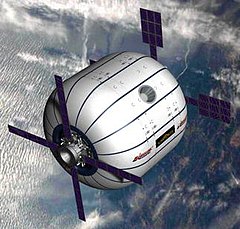
Now use Bigelow's proposed Sundancer habitat:

240px-Sundancer_in_orbit.jpg

=========================
Station statistics
Crew 3 (1)
Launch never launched(2,3)
Mission status Cancelled
Mass 8,618.4 kg (19,000 lb) (1)
Length 8.7 m (28.5 ft) (4)
Diameter 6.3 m (20.7 ft) (4)
Pressurised volume 180 m3 (6,357 cu ft) (1)
Orbital inclination 40.0 degrees (1)
Typical orbit altitude 463 km (288 mi)
==========================

Then the Delta IV Heavy upper stage could get this habitat to the needed 5.2 km/s delta-v:

464*9.81ln(1 + 27.2/(3.5 + 8.6)) = 5.4 km/s.


Bob Clark
 
Last edited:
Back
Top