

- Joined
- Feb 13, 2008
- Messages
- 5,398
- Reaction score
- 8
- Points
- 0
- Location
- Khimki
- Website
- tigerofsiberia.livejournal.com


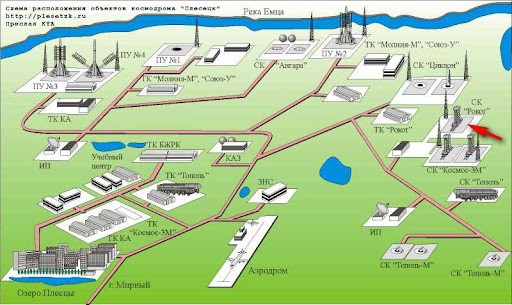
Launch site: Plesetsk Launch pad no. 133/3 62°53'13.35"N, 40°50'48.30"E
Launch date: September 7/8, 2010
The launch time is:
7:30:00 Moscow Summer 08.09.2010
3:30:00 UTC September 8, 2010
11:30:00 p.m. EDT September 7, 2010
[eventTimer]2010-09-08 3:30:00?before|after;%dd% Days %hh% Hours %mm% Minutes %ss% Seconds %c%[/eventTimer] satellite triplet launch on Rokot
Payload: One Gonets-M communications satellite and Possibly 2 Rodnik military comms satellites
Spacecraft 1: Gonets-M (meaning Courier, Staffette) System #12

Manufacturer: JSC "Information Satellite Systems Reshetnev Company"

Operator: Gonets SatCom (http://www.gonets.ru/english.php)
Gonets SatCom is a telecommunications company operating in russian market for over 8 years as a unique data relay service provider which designs builds and operates a Russian LEO system Gonets.
Gonets LEO (Low-Earth Orbiting) System is global data relay system comprised of LEO satellites, low-cost gateway stations and a fleet of highly portable subscriber terminals.
Applications
- Corporate networks for industry and government use
- Asset management (position reporting and tracking of movable and fixed objects)
- Environmental monitoring, geodesy, hydrogy, meterology, etc data gathering
- Control of electric grid, oil-wells, pipe-lines, etc
- Remote, disaster-stricken, isolated area communications
The current system ground infrastructure includes NCC/TT&C in Moscow, three Gateway Stations in Moscow, Krasnoyarsk (Syberia) and Sakhalin (Far East), reional SCC in Alma-Aty (Kazakhstan). Another relay station is being deployed in Murmansk (Far North).
Watch the video presentation of Gonets SatCom displaying the spacecraft in detail and explaining how the system works (although the narration is in Russian):
Gonets-M is a current generation spacecraft, replacing older Gonets-D1 design.
Comparison table:
Mass, kg|240|270
Uplink/Downlink channels|1/1|16/2
Onboard memory, Mb|1.5|8
Electric Power, W|120|?
Service Life, years|1.5-2|5-7
Can adjust orbit|no|yes

Inclination|82.5°
Orbital Period|113 min
One satellite covers a circular zone with diameter|5000 km
Spacecraft 2,3: Rodnik (meaning Creek)

Manufacturer: JSC "Information Satellite Systems Reshetnev Company"
Less is publicly known about the Gonets' military counterpart. Rodnik is probably an improved version of the Strela-3 military communication satellites. The spacecraft had a cylindrical body with a gravity-gradient boom, which was extended on-orbit to provide passive attitude stabilization. These satellites had a single simultaneous earth-space and space-earth channel.
Spacecraft mass: 225 kg
Typical Operating Orbit: 1400 km x 1414 km, 82.6°
Launch vehicle: Rokot (meaning Rumble)

Manufacturer: Khrunichev State Research And Production Space Centre, Moscow

The Rockot lightweight launch vehicle designed subject to Governmental Decree 925-r consists of three stages. The first two stages are essentially the booster stack of the RS 18 (or, equivalently, SS 19 Stiletto) strategic missile and the Breeze KM is employed as the third stage. A payload fairing has been designed for this launcher to accommodate one or more spacecraft in addition to Breeze KM.
Rockot has a good performance largely due two the Breeze KM upper stage having broad capabilities as far as injection of spacecraft into orbits with different altitudes and/or inclinations is concerned. The Breeze KM equipment can control the spacecraft attitude to a high precision and supply spacecraft with enough power during both ascent and orbital flight lasting up to 7 hrs. A special-purpose system can separate the spacecraft and the upper stage with the minimum possible disturbances.


Rockot Performance
LV configuration|Three stages Stages 1 & 2: based on SS 19 (RS 18) ICBM booosters Stage 3: Breeze KM upper stage
Lift-off mass (kg)|107,500
Payload parking orbit mass (kg) ( H circ = 200 km , i = 63 ° )|1950 (Breeze KM) 2300 (Breeze KC)
Injection error by Orbit height (%)|+ 1 to 2
Injection error by Inclination (%)|+ 0.03 to 0.05
Payload Fairing diameter/length (m)|2.5 x 2.62 / 6.74
Starting date of flight tests|May 2000 (3 successful missions of close prototypes performed in 1990-1994)
- Stage 1|15D95 liquid engines/3 ea. + 15D96 /1 ea. / (180,000 kgf / 212,700 kgf)
- Stage 2|15D113 liquid engine /1 ea./ (- / 23,980 kgf) (main) 15D114 liquid engine/(- /1580 kgf) (steering)
- Stage 3|S5.98 liquid engine /1 ea./(-/2000 kgf) (main) 11D458 liquid engines /4 ea./ 40 kgf (vernier) 17D58E liquid engines /12 ea. /1.3 kgf (attitude control and stabilization)
Code:
================================================================
Vehicle     Successes/Tries Realzd Pred  Consc. Last     Dates
                             Rate  Rate* Succes Fail
================================================================
Rokot/Briz/K(M) 13 14 .93 .88 6 10/8/05 1994-The launch will be performed off LC 3 at site 133.
Weather forecast for Plesetsk, Russia on September 8, 2010

Hi: 11°
Lo: 7°
Scattered showers. There is a 40% chance of precipitation. Cloudy. Mild. Temperature of 11°C. Winds WNW 13km/h. Humidity will be 94% with a dewpoint of 11° and feels-like temperature of 11°C.
Sunrise/Sunset and associated twilight times for Plesetsk on Wednesday, September 8, 2010
Times are local.
Astronomical twilight begins|03:19
Nautical twilight begins|04:38
Civil twilight begins|05:39
Sunrise|06:24
Transit (sun is at its highest)|13:17
Sunset|20:09
Civil twilight ends|20:55
Nautical twilight ends|21:56
Astronomical twilight ends|23:15
Not available this time, sorry.
References
http://www.novosti-kosmonavtiki.ru
http://forum.nasaspaceflight.com
http://www.gonets.ru/
http://ru.wikipedia.org/
http://www.iss-reshetnev.ru/
http://www.niitp.ru/
http://www.eurockot.com
http://www.plesetzk.ru
http://www.spacelaunchreport.com
http://weatherbug.com
http://www.good-stuff.co.uk/suntimes/sunmap.php
Last edited:


