Question General Spaceflight Q&A

STS=Space Transportation System
 
hatchq.jpg


Whats is that thing in the red circle? a plug where they can put an handle in to open the station from the outside?
 
hatchq.jpg


Whats is that thing in the red circle? a plug where they can put an handle in to open the station from the outside?

It is called an Androgynous Peripheral Attach System (APAS) hatch Pressure Equalization Valve (PEV). It is a two position manually actuated valve that is used during ingress of the ISS from the shuttle. It is manually operable from either side of the hatch and is used to balance pressures between the shuttle and the ISS before opening the APAS hatch. The APAS hatches are located on PMA2 and PMA3. The APAS hatch PEV is located on the corner of the APAS hatch.
 
Zoom onto the cockpit in these RPM images:
http://www.spaceflight.nasa.gov/gallery/images/shuttle/sts-132/hires/iss023e041593.jpg
http://www.spaceflight.nasa.gov/gallery/images/shuttle/sts-132/hires/iss023e041601.jpg

I can't seem to see a pilot (or anyone) in the cockpit windows, is that normal or where to look?
Normal. During the RPM and other prox ops, the orbiter is flown from the aft flightdeck station. See this photo: http://spaceflight.nasa.gov/gallery/images/shuttle/sts-121/hires/iss013e47481.jpg
 
457217main_sts132_ksc186_long.gif


What is represented by the red area and yellow cross in the above plot?
 
1.Why does it take so long between undocking ISS and landing compared to other vehicles like Soyuz?
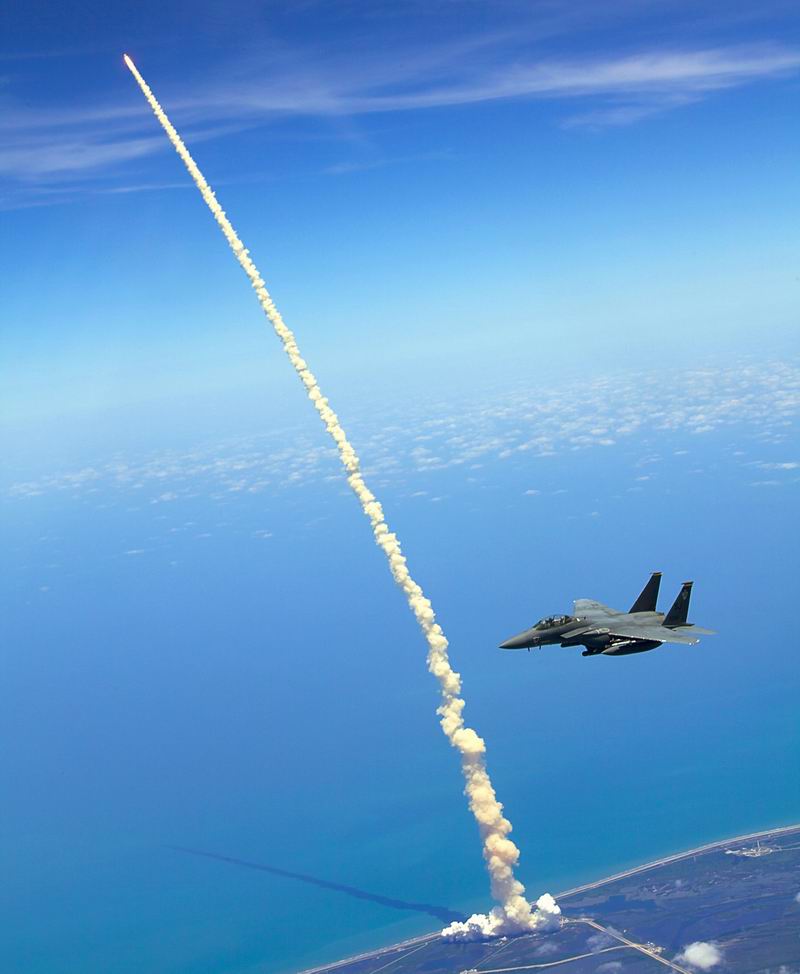
2.What are the rules for air traffic during launch?

redim122.jpg
 
1.Why does it take so long between undocking ISS and landing compared to other vehicles like Soyuz?
Because Russia is HUGE, any time you are over land and in a high inclination orbit, you almost always orbit over Russia.
2.What are the rules for air traffic during launch?
Only military over the Cape, and they can only go so close.
 
Because Russia is HUGE, any time you are over land and in a high inclination orbit, you almost always orbit over Russia.
Still, you typically get a couple of opportunities per day that they can use for emergencies.

Some reasons that I can think of:
1. Late inspection of the TPS.
2. Crew off duty time since they have been working pretty well flat out for 11 or 12 days straight. ISS crews returning on a Soyuz would have that off duty time as part of their typical weekly cycle.
3. Shuttle RCS and FCS checkouts are done after undocking, compared to Soyuz which does them whilst docked.
 
Smells aboard the ISS

So I have a unusual question:
Even with the filters aboard and the ventilation...
Is there any smell in the air of the ISS? i imagine 6 people living in close quarters, generators, experiments adn food must leave a certain odour aboard..
 
So I have a unusual question:
Even with the filters aboard and the ventilation...
Is there any smell in the air of the ISS? i imagine 6 people living in close quarters, generators, experiments adn food must leave a certain odour aboard..

According to stories from astronauts, this depends a lot on the expedition that is currently there. Odor is generally filtered out by the ECLSS, but this doesn't work near the astronauts. ;)
 
If the human civilization would disappear, how long the ISS crew and the station would survive? What would finish first?
Also; could the crew reenter with the Souyz modules independently without flight control and recovery?
 
hatchq.jpg


Whats is that thing in the red circle? a plug where they can put an handle in to open the station from the outside?

The socket where they insert the tool to open the hatch is visible in the top of the image. A Russian tool is inserted into that socket and rotated, which retracts the hatch's latches.
 
I hope posting to a Q/A topic after 30 days isn't considered necroposting. I'll hail the Probe just in case. :hail::probe:

As far as I know, most of the things happening on the flight are requested and confirmed by the flight control. This may be a stupid question but what's the shuttle commander actually doing? Is he the main communication guy or what?
 
As far as I know, most of the things happening on the flight are requested and confirmed by the flight control. This may be a stupid question but what's the shuttle commander actually doing? Is he the main communication guy or what?

It is like the captain of an airliner. He has the final and ultimate responsibility for crew and mission. He does most of the piloting, including landing the Shuttle, he decides if the crew reports go or no-go, he has even enough authority to overrule flight director decisions, since the commander is at the front-line, so to say.

Look for example at Neil Armstrongs manual landing decision, which is one such case.

The pilot of the Shuttle is actually, like in all manned spacecraft, usually not piloting the spacecraft at all. He is responsible for maintaining subsystems and assist the commander. For example monitor instruments during RTLS and give call-outs to the commander.
 
Last edited:
Why are the ACESs orange? Is it so the astronauts can be found easily in the event of bailout?
 
Why are the ACESs orange? Is it so the astronauts can be found easily in the event of bailout?

Exactly. It is the standard signal orange, that is used for all Rescue equipment, eg also for lifeboats or swimming vests.
 
I noticed that the Discovery's heat shield in this panorama (posted to the STS-133 thread by Orbinaut Pete) looks very worn and gray. While it hasn't been brought up as a problem for the flight, I want to ask what is the type of schedule NASA had for replacing the tiles, because they look near the end of their service life. Given that the Discovery is on her last flight, I guess they won't be replaced, however I don't know this for certain and I would like to see if anyone can set me straight.
 
Back
Top
