Question General Spaceflight Q&A

Where are these hardlines? Also, how are they broken at launch?
They go through one of the T0 umbilical carrier plates that extend from the MLP Tail Service Masts(TSMs). They're retracted at lift-off by the use of a drop-weight.
 
NASA seems to call the Space Shuttle "the most complex machine ever built."

Would you agree? I'm inclined to after reading articles on it (and this thread...I think I've learned more here than I did last year in school), but after taking a look at some of the newer aircraft out there (particularly current-generation airliners) I'm not completely sure.
Impressive title for a machine from 1980.
 
Last edited:
newer aircraft still can't do the things the shuttle does at the speeds or environments it has to handle. So yes, the shuttle is still the most complex machine ever built.
 
1.After ET SEP shuttle, crew takes photos of ET.
What maneuver is performed? Pitch maneuver or roll maneuver?

2.How does orbiter keeps an AoA of 40 degrees (how control surfaces are positioned)? How are S-Turns performed (what happens to control surfaces)? Is it fully automated?

3.Is roll maneuver automated?
 
1.After ET SEP shuttle, crew takes photos of ET.
What maneuver is performed? Pitch maneuver or roll maneuver?

2.How does orbiter keeps an AoA of 40 degrees (how control surfaces are positioned)? How are S-Turns performed (what happens to control surfaces)? Is it fully automated?

3.Is roll maneuver automated?
1: Pitch maneuver. During the ascent the CapCom calls up a GO/NO-GO for the pitch maneuver.

2: Elevons, the aerodynamic control surfaces at the back part of the wings with the yaw RCS jets firing as required to aid stability. And yes, the entire entry is flown by the GPCs.

3: Yes, the entire launch is flown by the GPCs.
 
It should be added that there is absolutely no complete manual control over the Shuttle, at least one GPC is needed every time.
 
What are the main differences between the (real) orbiters?
 
Their names ! :lol:
 
1: Pitch maneuver. During the ascent the CapCom calls up a GO/NO-GO for the pitch maneuver.
Before the pitch manoeuvre, there is also a short (12 s?) +X linear RCS firing. I've always assumed that the purpose of this is to match the orbital angular velocity of the orbiter to that of the tank at the lower altitude to help keep the tank below the orbiter while the photos are taken. Is that correct?
 
When berthing an MPLM to the ISS, I understand that they can use a centreline camera and target to assist with getting the alignment of the CBMs correct. When reberthing the MPLM back into the payload bay, what do they use to ensure the alignment is correct? I can conceive that they can use the payload bay cameras for port/starboard and rotational alignment but do they use those for fore/aft alignment also?
 
When berthing an MPLM to the ISS, I understand that they can use a centreline camera and target to assist with getting the alignment of the CBMs correct. When reberthing the MPLM back into the payload bay, what do they use to ensure the alignment is correct? I can conceive that they can use the payload bay cameras for port/starboard and rotational alignment but do they use those for fore/aft alignment also?
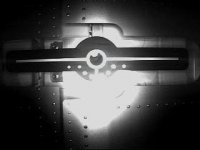
When berthing a payload, the orbiter is usually equipped with a keel camera which looks at a alignment target on the payload. I have attached screenshot of the MPLM keel alignment target as seen from the keel camera.
 

Attachments

  • MPLM_Keel_alignment_target.jpg
    MPLM_Keel_alignment_target.jpg
    9.1 KB · Views: 16
When berthing a payload, the orbiter is usually equipped with a keel camera which looks at a alignment target on the payload. I have attached screenshot of the MPLM keel alignment target as seen from the keel camera.
Ah, I glimpsed that in the coverage today but I didn't know where it was being taken from. Thanks for clearing it up :tiphat:
 
Their names ! :lol:
So, are you saying that all the shuttles are identical? I doubt it. I've read somewhere that one shuttle relies in GPS for landing, while the others uses some pre-GPS system I can't recall right now. Also, I think only Endeavour can share electrical energy with ISS, thus Endeavour's missions to ISS can be longer than others. I was hoping to find out more differences between the other shuttles.
 
no shuttle relies on GPS for landing. They can all "take GPS" for assisting with landing but GPS is used along with other systems for ensuring that the orbiter arrives in the right spot at the right energy state.

Both Endeavour and Discovery can use SSPTS. Atlantis does not and will not have it fitted. The reason for this is due to Atlantis not entering OMDP.

There are a few differences between the shuttles, Discovery has a couple of extra black tiles under the forward windows for example but the differences between shuttles are very minor.
 
I do know that Discovery was a little bit heavier than later shuttles (especially Endeavour) because of slightly different, more-advanced materials being used.
 
How does the shuttle do the roll program, during launch? Using main engine's gimbal? I think the RCS system is not very efficient for this and I saw no movement on shuttle's wings that would suggest some aerodynamic maneuvers. Also, while climbing to orbit, how does it pitch?
 
How does the shuttle do the roll program, during launch? Using main engine's gimbal? I think the RCS system is not very efficient for this and I saw no movement on shuttle's wings that would suggest some aerodynamic maneuvers. Also, while climbing to orbit, how does it pitch?
Using the MPS and SRB TVC systems.
 
It should be added that there is absolutely no complete manual control over the Shuttle, at least one GPC is needed every time.

This being the case, what functions are GPS-critical and which can be completed by the crew? I'm sure the lists are extensive, I'm just curious about the major items.
 
Back
Top