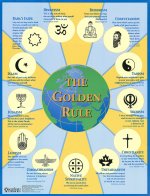
Are you implying that's a bad thing? The bible makes perfect sense once you disregard the parts that don't make sense. And the parts that make sense basically boil down to the golden rule.
Well, let's say I consider it better than ethics based on completely different origins, but from a believers point of view, the gospel without jesus doesn't make any sense. As such, I'm very glad we had the humanists, but I think their fatal flaw was indeed to ignore the human problem: That humans generally tend to do bad things, and are not the enlightened, inherently moral beings the humanists perceived them to be.
Since Jesus and the concept of "new birth" was the new testament answer to that problem, they didn't need it, but we can see pretty clearly nowadays that the generous humanist assumptions about human nature were rather misguided.
As for parts that make sense and parts that don't, well... once you believe in the basic premises (meet God, receive the holy spirit, get born anew, whatever...), most of it makes pretty good sense. Not all of it makes sense to me yet, but then again I'm hardly any adequate measure. I have some grudges with some parts, but I can live with those, because my faith is not in the book, but in the one that lives in me.
Sadly, it is not the case. Otherwise, it would have been much simpler to arrive at them. Tolerance is from the new testament, but even ethics like political freedom, equality of men and women or free movement of labor are not part of them. Even freedom of opinion was not written in the Bible. And how would Jesus think about the common human right to be treated equal before the law?
Since Jesus was a strog friend of the lower "classes" (not to suggest that they already had marxist theory back then, so don't interpret classes too much in that context, please), I think he would have welcomed your last mentioned point. Indeed there can't be no doubt that he cosnidered all people equal before the divine law, so there's no reason not to assume that he would not also think the same way about the earthly law.
Anyways, I agree, "directly derived from the new testament" was carrying it too far. The reformation and other historical circumstances were very important, but the major parts of equality and dignity can be found in the new testament.
There's always the point of cultural context, of course. The new testament has neglected to go up against culture in general, because it's more or less irrelevant to the kingdom of God. Paul is interesting in that he clearly states equallity of the rich, the poor and even the slave, yet does not see the need tell slave to revolt (indeed the opposite), and doesn't coerce Philemon for having slaves. He never neglects to mention that they are equal before God, however, and reminds slave holders that they be fair and just with their slaves. There's a whole lesson about the kingdom of god and wordly power structures in this, but it would go a bit too far.
And as far as womens rights go, Jesus could be considered a radical for his time. "Don't divorce your wife lest for adultery" was the stance of the most extreme proponents of woman rights at that time, while the other extreme saw no problem in divorcing their wife because they didn't like the supper she cooked (don't forgett that in case of a divorce, in the circumstances at the times, the woman always was at a huge disadvantage). He also said that "dirty thoughts" were the problem of the man having them, and could not be blamed on the woman allegedly causing them, as was usually the practice.
Isn't it funny how religious people always take the credit for the good stuff that's happened, while the bad things are blamed on individuals?
Apologies, that was not my intent. To be honest, I'm not too fond of religion as an institution myself. Religions have done some pretty despicable things, there's no debate about that. What becomes problematic here is distinguishing religion from faith. I.E. how much is the actual underlying faith instrumentalised in order to accomplish completely different goals, to as far as the religion becomes actually totally disasociated with the faith. We have a nice example of that here in Bosnia, where you're considered a better muslim or catholic or orthodox based on what parties you vote instead of how strong your faith is (and I'm afraid a similiar thing is going on among many US churches). Up to the point that people have no idea what their religion is actually about, but proudly boast with it. Can the religious institution be blamed for that? it certainly can. Can the underlying faith be blamed? hardly, since almost no-one seems to actually know about it.
Also, Pointing out that religions were helpfull for some things is just as problematic. I know I came off sounding like it, but it really wasn't my intent. In generall, what I want to say is: It's people that do things, not religions. They do it based on faith (read: personal convictions), whatever the exact faith might be ("all ur warez r us" seems to be a pretty common "faith", or conviction, for example, and has been used by the christian religion a lot, although the actual faith christianity was based on would be more like "all my warez r urs").
Pretty much any conceivable thing gets used by people to justify what they are doing. Wheather or not what they are using was actually intended to be used that way can only be determined if you compare it to the underlying source material. As such, I'd say that the humanists didn't hit the actual intent of the new testament any better than the medieval church did, they just chose to rip of the more usefull passages.
Do you really believe that murder and theft was perfectly acceptable until Moses got that heavy note book?
No, of course not. Do you think that therefore Moses shouldn't have put it there?
EDIT: I got a bit carried away there and completely forgott about this one:
Why then, is there talk of "God-fearing" people?
I've never liked the term "God-fearing"...
It's a fair point to make, of course, however "fear of God" can be a bit a misleading term. Fear here doesn't mean to be constantly afraid of, but rather to take seriously. One that "fears God" is aware that God is real, and that whatever he is doing he will have to justify before him, not before people (as in "fear of people", a term also used by the bible). It basically means one thing: I am aware that what I'm doing here is not cossplay, it is real and dead serious. The commandements of God are here for my guidance, not for exploitation. If I abuse the commandements of God to pursue personal gain, the punishement will be real, and terrible. However, if I'm honest with myself and God and try following his commandements to my best abilities, there WON'T be punishement, even if I can't keep them. That's what Jesus died for. So "Fear of God" does imply a certain fear of punishement, but not in the panicky "don't do this, don't do that"-manner, but more in a constant awareness that what I'm doing here is not for self-indulgence, and is not to be misused. I may and will commit the one sin or the other, but that's not the problem. The problem is if I don't take God seriously and think that his words would be a nice tool to manipulate people and get something out of it. Consequently, The bible ties punishement to knowledge. Paul actually writes that there is no sin if there is no knowledge of the commandement (in this, the bible is actually more forgiving than our jurisdical system). Leaders and teacher will be judged harsher and with less tolerance for error than the common man, because they have more responsibility. The people that knew Jesus during their lifetime will be judged harder than those who have never heared of him, etc etc.
So, in a nutshell, fearing God means taking god for full and being aware that he's the major player on the field, and that he will not allow me to instrumentalise him for my purposes.