For your (facepalming) amusement

I second the idea that the evangelical church is heading in a very bad direction. As a former insider, I can attest. The scariest thing is the bizarre desire to marry everything to Jesus, guns, money, business, war, etc. This pushed me to the precipace, but what really did it for me was epistomology and empiricism. This is what Billy boy here misses. Everything Hawkings claims is falsifiable at some point. To claim God is not. You cannot say "we don't know what triggered the Big bang, therefore God". That violates logic. Hawkings and that bad british guy are also under no obligation to prove a negative. You Mr. O'reilly, are under the obligation to prove God. I also very much agree it is ludicrous to say that a creator would have changed the speed of light or made the universe or Earth falsely appear older than it is. Why?

I myself have moved toward agnosticism. I am willing to entertain the notion that there might be more to existence than meets the eye, but to claim that any one group has the lock on it, ridiculous. think of this, the ultimate game changer, the moment other life is discovered elsewhere. I think it's safe to say that most in this forum would agree at this point that life elsewhere is simply a mathematical probability that remains to be proven. Once one is found, that means another, and another, and so on. Once it is, wow. It's one thing to claim your religion is right for a few billion people, but for countless hundreds of trillions of others?

Pride in ignorance. Yep. Billy boy isn't the only one. There are quite a few others who have pride in their ignorance that want power in my country. There was a time when a person would cover up the shame of their ignorance until they learned something. Now, it's cool.

By the way, as for crazy leaps, aguy living for three days in a whale?

---------- Post added at 01:15 PM ---------- Previous post was at 01:09 PM ----------

I would disagree about the creation myth not being as important as other doctrines. Most evangelicals believe that to claim any part of the bible in error is a slippery slope that attempts to invalidate it all. No "salad bowling" as they call it. Every keystroke is accurate or it renders everything open to evil. You cannot question any of the divine, inspired word. Trust me, they get VERY bitterly angry about questioning the creation myth.
 
I'm not annexed at all, my dear, that's why I don't believe in almost anything. Objectivity? Do religions have any objectivity when they state all that bunch of ##? Oh, I'm sorry, respect, yes, respect is always called when it's not possible to justify or give proofs of absurd statements...
Your flooding paternalistic and politically correct "speech" is revealing that you're not living a real world, but only a would-like-to-see image of it.
And for the guy trying to convince me that Hawkings theories are less worthy than the bible...:rofl:
 

I would disagree about the creation myth not being as important as other doctrines. Most evangelicals believe that to claim any part of the bible in error is a slippery slope that attempts to invalidate it all. No "salad bowling" as they call it. Every keystroke is accurate or it renders everything open to evil. You cannot question any of the divine, inspired word. Trust me, they get VERY bitterly angry about questioning the creation myth.

If you approach it theologically, the creation myth has never been anything done in days. It was a unspecified period of time, with only the order representing the best that people knew about the creation. There is nothing at all in it, that God claimed that it had been done that way, in that order. It could have been in a completely different order taking many billion years, and still, things would be as the Bible in its early versions said.

The problem is: Every translation of the Bible eventually took more freedom. The Bible most people get indoctrinated in religious schools has very little in common with the Bible that was once assembled from many oral traditions and different kinds of literature.

If you translate a word with "years" you have Methuselah living over 900 years. If you translate the Hebrew word for "times" with the more accurate "months", as it was the way to count long periods of time in the time when the legends of the first books of the Bible had their origin, he lived to a more modest 72 years.

I see little problems if you say, you need to take the Bible literally. That is, at first glance, a good idea, since it gives you a solid standard. But if you base your standard on the 19th translation and the 50th reinterpretation of a phrase that was common 3000 years ago and back then had a very clearly defined meaning, but that you couldn't intuitively understand today, the book that you read has not more divine wisdom as the yellow pages of New York. What you read, is not the same book, that Jesus did know when he referred to the old laws still being valid for him. You can read the letters, but no longer the semantics.

And that makes taking the Bible literally suddenly a very dangerous path, because it permits you to let any religious group define their own Bible from it, from every contradiction, that had not been as grave as it was in the early version.

If you want to give credit to the Bible and base your faith on it, you have to really study it. Not just read it superficially. You need to dive into it, research it, find out what was meant and how the meaning got translated into the modern times and modern culture.

Essentially, you have to research your own truth. Regardless if your truth is based on science, or the Bible or the Qur'an.
 
Last edited:
Do religions have any objectivity when they state all that bunch of ##?

They usually don't, for which you critizice them. Rightly. However, what good is your critique if you have the same log in your eye? So if you criticize someone for being unobjective, you should do so objectively. Which you didn't. Claiming that Religion is guilty that we haven't had a manned mission to Jupiter yet is silly. You can blame that majorly on economic reasons.

Religion is in fact a major excuse for wars.

Shall we generalise this a bit and replace "Religion" with "Ideology"? I know very well of the destructive thrall a religion can have on a populace (hell, I'm living in Bosnia. Ain't no better place in europe to see it at work first hand!), but let's be honest, Hitler and Stalins Socialism didn't need dieties to have the same effect (a bit unsure here... did I just invoke Godwins law? I don't think so, but maybe I should check the rules again...). Any ideological system has the potential of enthralling a population and make them blind to anything else. Religion just happens to be a fairly widespread form of ideology.

But even if we replace religion with ideology, I'd still not blame all the wars through history on it. There's things like population pressure, other economic reasons, and even profane greed...

I would disagree about the creation myth not being as important as other doctrines. Most evangelicals believe that to claim any part of the bible in error is a slippery slope that attempts to invalidate it all. No "salad bowling" as they call it. Every keystroke is accurate or it renders everything open to evil. You cannot question any of the divine, inspired word. Trust me, they get VERY bitterly angry about questioning the creation myth.

How important a literal interpretation of Genesis is depends entirely on the theological framework you're working with. It so happens that it seems to be pretty important in the theology in evangelical churches. It is a lot less important in evangelical scholarly theology. Still less important in general protestant mainstream theology. Utterly abolished in catholic theology. And so on...
Theology is a field in its own right, and a field where I find churches (also in europe) often lacking in understanding and knowledge. Which is a shame, because it seems to be the only tool that offers a chance to make some coherent sense out of scriptures.
 
Claiming that Religion is guilty that we haven't had a manned mission to Jupiter yet is silly. You can blame that majorly on economic reasons.

And interest reasons. Most people just don't care, sadly enough.

Which has nothing to do with religion either, rather the fact that people tend not to be interested in "irrelevant" stuff millions of kilometers away, and they don't really understand. That and the space program(s) might not have the best PR in the world...

a bit unsure here... did I just invoke Godwins law? I don't think so, but maybe I should check the rules again...

I wouldn't classify it as such, considering that it's pretty on-topic (fervant ideology causing war) and you mentioned a similar example, that of Stalin's regime.

You can take any ideology, and make people do terrible things with it. Even atheism, as the entirely unethical actions in the former USSR demonstrate.
 
Last edited:
But even if we replace religion with ideology, I'd still not blame all the wars through history on it. There's things like population pressure, other economic reasons, and even profane greed...

That doesn't prevent it being used as an excuse.
 
I would disagree about the creation myth not being as important as other doctrines. Most evangelicals believe that to claim any part of the bible in error is a slippery slope that attempts to invalidate it all. No "salad bowling" as they call it. Every keystroke is accurate or it renders everything open to evil. You cannot question any of the divine, inspired word. Trust me, they get VERY bitterly angry about questioning the creation myth.

Sorry to quote the same thing twice, but I forgott to add something here that seems relevant in retrospective. You are of course correct that Genesis 1 plays a pretty important role for many evangelicals I think the importance comes majorly from the pretty literal aproach they take on exegesis, and moving the creation into the realm of the metaphorical would force them to pretty much overhaul their complete set of hermeneutics. As such, Genesis 1 is a very vital concern for their theology.
However, I have yet to hear about an evangelical church that claims that the literal interpretation of the creation is a prerequisite for salvation. I, and every evangelical I know, would consider that a grave heresy.

That doesn't prevent it being used as an excuse.

I hearby suggest that we abolish nation states. They are waaaay too easy to use as an excuse for war. While we're at it, let's throw love, righteousness, freedom, pride and honor into the garbage bin. Seriously, my knowledge of history is pretty limited when compared to some here, but even I can think of an example for almost anything being used as an excuse for war. But it's not excuses that create war. It's people. Not even the noble Ideas of humanism could change that little, uggly fact.
 
Last edited:
You can take any ideology, and make people do terrible things with it. Even atheism, as the entirely unethical actions in the former USSR demonstrate.

Stalin was indeed an atheist, but his practices were no more atheistic, than Hitler's were anti-christianic.

Ethnic cleansing practices, have nothing to do with religion, or the lack of it...
If you think about it, it's just economics and eugenics.

Atheists in general are much more ethical than Christians/Muslims/(your religion here).

To "love thy neighbour" or "do not do to others, what you wouldn't want to be done upon you" (Modern Greek translation), for the sole reason that "If i do the wrong thing... i'll burn in hell for ever" is a VERY egotistic way to live your life.

The reason that you do good to the others around you, is the "promise" of eternal life!?

Do you REALLY understand the concept of "eternal"/infinity?
That means that your "soul" will still be around for EVER! (a million, billion, trillion, quadrillion years, multiplied by infinity!)

The very thing that drives us to want to do ANYTHING that "touches" the lifes of others, is our limited life-span. If you are immortal, then why bother?
 
Last edited:
Well, the cool thing about a Dyson Sphere would of course be that you could dedicate a comparatively small fraction of the surface to living space. It'll still be as large as a few hundred planets...

I'd consider that as a sole motivation rather... disturbing. The motivation of a believer is love, not fear (incidentally, the one single command the bible repeats most throughout the whole book is "fear not!" It's usually the clerus that finds fear a most potent means of control that can make their lives easier.

Atheists in general are much more ethical than Christians/Muslims/(your religion here).

You do know that western humanist ethics are derived directly from the new testament, do you? It's basically the gospel with Jesus taken out (which of course isn't the gospel at all, but you get my meaning. Somehow I feel like I wrote that same sentence not too long ago somewhere...??)
 
Last edited:
God doesn't micromanage.
 
If you approach it theologically, the creation myth has never been anything done in days. It was a unspecified period of time, with only the order representing the best that people knew about the creation. There is nothing at all in it, that God claimed that it had been done that way, in that order. It could have been in a completely different order taking many billion years, and still, things would be as the Bible in its early versions said.

Generally I agree, but one does have to be careful with that as there is the phrase "There was evening and there was morning, the nth day". In my view that's quite likely poetic, but it has to be dealt with, and a fairly good argument can be made from the use of the terms "evening" and "morning" that the term now translated "day" was in fact meant to mean a literal, 24 hour day.

The problem is: Every translation of the Bible eventually took more freedom. The Bible most people get indoctrinated in religious schools has very little in common with the Bible that was once assembled from many oral traditions and different kinds of literature.

If you translate a word with "years" you have Methuselah living over 900 years. If you translate the Hebrew word for "times" with the more accurate "months", as it was the way to count long periods of time in the time when the legends of the first books of the Bible had their origin, he lived to a more modest 72 years.

That's a claim I've heard before, and it doesn't work: By this count, Methuselah would have fathered his son, Lamech, at about 15 years of age, which is certainly possible, but his father, Enoch, would have fathered him at the tender age of 65 months ~= 5 years. The average age at which "X became the father of Y" in Genesis five is 117 years, which if we translate "year" as "month" comes out to just short of 10 years.

It makes more sense to claim that the ages given were totally made up by the author than to try and claim that they were meant to be in months.

The "all these ages are in months" trick also falls apart beginning in Chapter 11 where we start to see a smooth decay in ages, from the typical 900-or-so seen in Chapter 5 to the 600 we see for Shem to the 400 or so we see for a few generations after Shem to the 200 we see for a few generations after that, to the 175, 180, and 130 we see for Abraham, Isaac, and Jacob.

I see little problems if you say, you need to take the Bible literally. That is, at first glance, a good idea, since it gives you a solid standard. But if you base your standard on the 19th translation

Versions like the King James were translated out of the Latin, which was itself a translation, but modern translations (Such as the NIV) tend to be tranlated out of the Hebrew and Greek. You may argue about the possibility of scribal errors or interpretative bias, but the translations are pretty much direct from the original languages.
 
It's basically the gospel with Jesus taken out

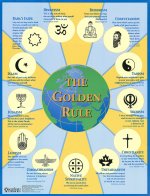
Are you implying that's a bad thing? The bible makes perfect sense once you disregard the parts that don't make sense. And the parts that make sense basically boil down to the golden rule.
 

Attachments

  • golden rule.jpg
    golden rule.jpg
    267.2 KB · Views: 16
You do know that western humanist ethics are derived directly from the new testament, do you? It's basically the gospel with Jesus taken out (which of course isn't the gospel at all, but you get my meaning. Somehow I feel like I wrote that same sentence not too long ago somewhere...??)

Isn't it funny how religious people always take the credit for the good stuff that's happened, while the bad things are blamed on individuals?
Do you really believe that murder and theft was perfectly acceptable until Moses got that heavy note book?
 
You do know that western humanist ethics are derived directly from the new testament, do you?

Sadly, it is not the case. Otherwise, it would have been much simpler to arrive at them. Tolerance is from the new testament, but even ethics like political freedom, equality of men and women or free movement of labor are not part of them. Even freedom of opinion was not written in the Bible. And how would Jesus think about the common human right to be treated equal before the law?

What had a big impact was actually not the Bible itself, but the protestant revolution - because its wake created many concepts that make our current ethics. Most clerical figures of this revolution did not go so far, even wanted arrangements with kings and church, but the (free) citizens and farmers took the momentum for their own course and interpretations.

And the free unlimited printing of the Bible also had of course influences on the freedom of press. Not directly, but by the feeling of power that was for the first time visible by the printed word alone.
 
Atheists in general are much more ethical than Christians/Muslims/(your religion here).

I don't think one can that easily determine the ethical competancy of millions or even billions of people...

Stalin was indeed an atheist, but his practices were no more atheistic, than Hitler's were anti-christianic.

That is totally wrong. Hitler was no anti-christian in particular, but the anti-religious sentiment in the USSR was pretty bad. See [ame="http://en.wikipedia.org/wiki/Religion_in_the_Soviet_Union"]Religion in the Soviet Union[/ame], for example.

Among other things that occured, churches were demolished, and "un-historic" murals in (the at one time planned to be demolished) St. Basil's cathedral were painted over. Jehovah's Witnesses are now eligible for compensation identical to that of war veterans due to the actions regarding them committed by the Soviet government...

To "love thy neighbour" or "do not do to others, what you wouldn't want to be done upon you" (Modern Greek translation), for the sole reason that "If i do the wrong thing... i'll burn in hell for ever" is a VERY egotistic way to live your life.

I'm sure some people think like that, and that is really sad. I think it's more importantly a moral message; i.e, bad people are punished. Therefore, don't do bad things. I hope- at least- that the majority of people commit their lives based on ethics rather than whether they think they're going to eternal damnation...

Is killing a person bad? Would you refuse to kill someone because it would land you in prison? Or would you refuse to kill someone because you know it's immoral?

I'd consider that as a sole motivation rather... disturbing. The motivation of a believer is love, not fear (incidentally, the one single command the bible repeats most throughout the whole book is "fear not!" It's usually the clerus that finds fear a most potent means of control that can make their lives easier.

Why then, is there talk of "God-fearing" people?

I've never liked the term "God-fearing"...

Tolerance is from the new testament, but even ethics like political freedom, equality of men and women or free movement of labor are not part of them. Even freedom of opinion was not written in the Bible. And how would Jesus think about the common human right to be treated equal before the law?

Considering the era in which the New Testament comes from, I'm not very surprised that those ethics are missing...
 
Are you implying that's a bad thing? The bible makes perfect sense once you disregard the parts that don't make sense. And the parts that make sense basically boil down to the golden rule.

Well, let's say I consider it better than ethics based on completely different origins, but from a believers point of view, the gospel without jesus doesn't make any sense. As such, I'm very glad we had the humanists, but I think their fatal flaw was indeed to ignore the human problem: That humans generally tend to do bad things, and are not the enlightened, inherently moral beings the humanists perceived them to be.

Since Jesus and the concept of "new birth" was the new testament answer to that problem, they didn't need it, but we can see pretty clearly nowadays that the generous humanist assumptions about human nature were rather misguided.

As for parts that make sense and parts that don't, well... once you believe in the basic premises (meet God, receive the holy spirit, get born anew, whatever...), most of it makes pretty good sense. Not all of it makes sense to me yet, but then again I'm hardly any adequate measure. I have some grudges with some parts, but I can live with those, because my faith is not in the book, but in the one that lives in me.

Sadly, it is not the case. Otherwise, it would have been much simpler to arrive at them. Tolerance is from the new testament, but even ethics like political freedom, equality of men and women or free movement of labor are not part of them. Even freedom of opinion was not written in the Bible. And how would Jesus think about the common human right to be treated equal before the law?

Since Jesus was a strog friend of the lower "classes" (not to suggest that they already had marxist theory back then, so don't interpret classes too much in that context, please), I think he would have welcomed your last mentioned point. Indeed there can't be no doubt that he cosnidered all people equal before the divine law, so there's no reason not to assume that he would not also think the same way about the earthly law.

Anyways, I agree, "directly derived from the new testament" was carrying it too far. The reformation and other historical circumstances were very important, but the major parts of equality and dignity can be found in the new testament.
There's always the point of cultural context, of course. The new testament has neglected to go up against culture in general, because it's more or less irrelevant to the kingdom of God. Paul is interesting in that he clearly states equallity of the rich, the poor and even the slave, yet does not see the need tell slave to revolt (indeed the opposite), and doesn't coerce Philemon for having slaves. He never neglects to mention that they are equal before God, however, and reminds slave holders that they be fair and just with their slaves. There's a whole lesson about the kingdom of god and wordly power structures in this, but it would go a bit too far.

And as far as womens rights go, Jesus could be considered a radical for his time. "Don't divorce your wife lest for adultery" was the stance of the most extreme proponents of woman rights at that time, while the other extreme saw no problem in divorcing their wife because they didn't like the supper she cooked (don't forgett that in case of a divorce, in the circumstances at the times, the woman always was at a huge disadvantage). He also said that "dirty thoughts" were the problem of the man having them, and could not be blamed on the woman allegedly causing them, as was usually the practice.

Isn't it funny how religious people always take the credit for the good stuff that's happened, while the bad things are blamed on individuals?

Apologies, that was not my intent. To be honest, I'm not too fond of religion as an institution myself. Religions have done some pretty despicable things, there's no debate about that. What becomes problematic here is distinguishing religion from faith. I.E. how much is the actual underlying faith instrumentalised in order to accomplish completely different goals, to as far as the religion becomes actually totally disasociated with the faith. We have a nice example of that here in Bosnia, where you're considered a better muslim or catholic or orthodox based on what parties you vote instead of how strong your faith is (and I'm afraid a similiar thing is going on among many US churches). Up to the point that people have no idea what their religion is actually about, but proudly boast with it. Can the religious institution be blamed for that? it certainly can. Can the underlying faith be blamed? hardly, since almost no-one seems to actually know about it.

Also, Pointing out that religions were helpfull for some things is just as problematic. I know I came off sounding like it, but it really wasn't my intent. In generall, what I want to say is: It's people that do things, not religions. They do it based on faith (read: personal convictions), whatever the exact faith might be ("all ur warez r us" seems to be a pretty common "faith", or conviction, for example, and has been used by the christian religion a lot, although the actual faith christianity was based on would be more like "all my warez r urs").
Pretty much any conceivable thing gets used by people to justify what they are doing. Wheather or not what they are using was actually intended to be used that way can only be determined if you compare it to the underlying source material. As such, I'd say that the humanists didn't hit the actual intent of the new testament any better than the medieval church did, they just chose to rip of the more usefull passages.

Do you really believe that murder and theft was perfectly acceptable until Moses got that heavy note book?

No, of course not. Do you think that therefore Moses shouldn't have put it there?

EDIT: I got a bit carried away there and completely forgott about this one:

Why then, is there talk of "God-fearing" people?

I've never liked the term "God-fearing"...

It's a fair point to make, of course, however "fear of God" can be a bit a misleading term. Fear here doesn't mean to be constantly afraid of, but rather to take seriously. One that "fears God" is aware that God is real, and that whatever he is doing he will have to justify before him, not before people (as in "fear of people", a term also used by the bible). It basically means one thing: I am aware that what I'm doing here is not cossplay, it is real and dead serious. The commandements of God are here for my guidance, not for exploitation. If I abuse the commandements of God to pursue personal gain, the punishement will be real, and terrible. However, if I'm honest with myself and God and try following his commandements to my best abilities, there WON'T be punishement, even if I can't keep them. That's what Jesus died for. So "Fear of God" does imply a certain fear of punishement, but not in the panicky "don't do this, don't do that"-manner, but more in a constant awareness that what I'm doing here is not for self-indulgence, and is not to be misused. I may and will commit the one sin or the other, but that's not the problem. The problem is if I don't take God seriously and think that his words would be a nice tool to manipulate people and get something out of it. Consequently, The bible ties punishement to knowledge. Paul actually writes that there is no sin if there is no knowledge of the commandement (in this, the bible is actually more forgiving than our jurisdical system). Leaders and teacher will be judged harsher and with less tolerance for error than the common man, because they have more responsibility. The people that knew Jesus during their lifetime will be judged harder than those who have never heared of him, etc etc.

So, in a nutshell, fearing God means taking god for full and being aware that he's the major player on the field, and that he will not allow me to instrumentalise him for my purposes.

 
Last edited:
Considering the era in which the New Testament comes from, I'm not very surprised that those ethics are missing...

Yes, but then, we learned to have such ethics, because we realized that the rules that organized our everyday life would not be complete without them, and would even contradict themselves, if such rules are not implicitly included by removing the many "exceptions" (which are a majority in traditional societies) from the ethics that define us.

If a omniscient god gave us our ethics in the Bible, why did we have to learn them in a slow and bloody process? Only because we had been unable to read the hidden scripture between the lines? Or maybe because the Bible was written by people who had a very simple view of ethics, which was essentially: You should embrace those ethics, that secure my power.

The most enlightened parts of the Bible had actually been attributed to a king, not a prophet. Which is a sign for me that prophets do it for profit.
 
Which is a sign for me that prophets do it for profit.

That'd be a very prophetic coincidence of words, then. :P
 
If a omniscient god gave us our ethics in the Bible, why did we have to learn them in a slow and bloody process? Only because we had been unable to read the hidden scripture between the lines? Or maybe because the Bible was written by people who had a very simple view of ethics, which was essentially: You should embrace those ethics, that secure my power.

There are rabinic interpretations of the old testament and the law of Moses that com pretty close to our ethics (Jesus didn't invent them either, you know. As mentioned in another thread, theologically he was driving the "liberal" rabbinic line that had been around long before him. It's the Messiah stuff that's exceptional). There are interpretations by several people throughout the middle ages that come pretty close. It was there all the time. But culture has a tremendous inertia. While some individuals might get it, the culture doesn't transform itself just like that.
And look at us today in the West, now that we have our humanist ethics, the only thing they can possibly help us realise is that we're still a hipocritical culture that only talks about them but doesn't care about them when the choice gets costly. How much have we really progressed in that regard? Our culture might have come to agree with the ethics, but still most people and nations as a whole will excuse them if there's something in it for them.
 
Back
Top