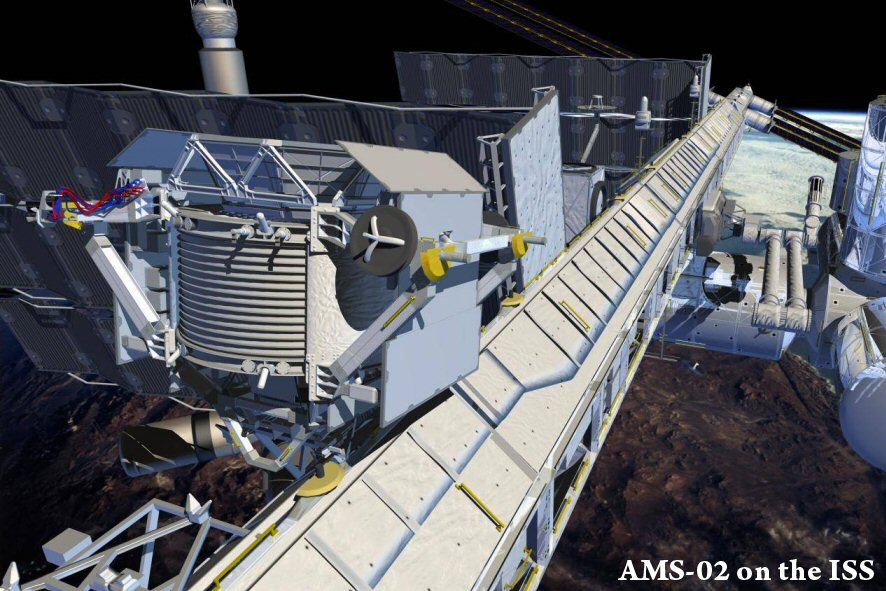
More info on the AMS (Alpha Magnetic Spectrometer)
The AMS:
Location on ISS:
It will attach to the S3 Truss:
Aims:
AMS will search for antihelium nuclei. Unlike elementary antiparticles, complex composite antiparticles such as antihelium are rarely created in ordinary collisions. Therefore the observation of antihelium would suggest that there exist regions of the universe dominated by antimatter. This is considered unlikely, because observed cosmic rays are dominated by matter. However current models of cosmology combined with estimates of CP violation based on the instanton gas approximation and the assumption that there was as much matter and antimatter at the moment of the big bang are inconsistent with the matter/antimatter asymettry necessary to describe our universe without large regions of antimatter.
AMS will probe the positron spectrum. In particular, a cold dark matter candidate in many supersymmetric models, called the neutralino, would decay into positrons which are almost entirely at high energies. This is in contrast with known positron sources, which emit positrons at low energies as well. Thus if neutralinos exist in large enough quantities to be a significant source of dark matter, then one expects the detection of disproportionately many high energy positrons.
AMS will search for strangelets. This is a variation of ordinary hadronic matter which contains disproportionately many strange quarks. As strange quarks are much heavier than the up and down quarks which are prevalent in ordinary matter, strangelets would be much denser then known atomic nuclei.
AMS will attempt to determine the age of cosmic rays, and thereby determine the distance of their sources. Beryllium 10 is radioactive, and so the age of a cosmic ray may be determined from the ratio of its beryllium 10 to beryllium 9 content.
AMS will search for gamma rays. These are high energy photons. When hitting the detector, they will produce electrons and positrons which will be detected.
AMS will look for cosmic rays that have scattered off of the Earth's geomagnetic field.
AMS will search for jets of high energy particles emitted from microquasars.
AMS will search for low energy antiprotons and antideuterons which are characteristic of decays via Hawking radiation of small primordial black holes.
Links:
AMS official web page:
http://ams.cern.ch/
AMS JSC page:
http://ams-02project.jsc.nasa.gov/
AMS on Wikipedia:
http://en.wikipedia.org/wiki/Alpha_Magnetic_Spectrometer