Saturn V Reborn?

BruceJohnJennerLawso

Dread Lord of the Idiots
Addon Developer
Joined
Apr 14, 2012
Messages
2,585
Reaction score
0
Points
36
Hello everyone,

So I was thinking...

Lately a lot of discussion has gone on considering the development of SLS, a heavy lift vehicle using Space Shuttle hardware. A lot of discussion has gone into whether the design makes sense, or whether HLVs are really a good idea to begin with. What I was wondering though, is this: how hard would it actually be to build a Saturn V, if NASA engineers started today?
 
I've heard that the actual plans were gone or incomplete or something like that. A quick search on the subject revealed this interesting answer from some other message board. Can't guarantee the validity, but the person sounds like they know a thing or two about it.

(Gary's answer)
quote:

The Saturn plans are still at Huntsville. However, the contractor infrastructure is gone, many subassemblies were farmed out to small shops that are either out of business or who have long since discarded the necessary tooling. It's estimated it would cost at least $16 billion to retool to produce Saturns to the old plans.

It should also be noted that Saturn didn't have very many flights, so reliability statistics are not available. This is a similar problem to that facing Energia. Many NASA and contractor engineers
believe we were incredibly lucky with the Apollo program and that if it had continued we would have inevitably lost missions. Also Saturn launches were expensive. They cost about $550 million in *1967* dollars. A 1993 dollar is worth 12.5 cents in 1967 dollars so multiply costs by 8 to get current pricing.

In reality you wouldn't want to reproduce Saturn in any event. There have been sufficient advances in most of the flight systems since Saturn was designed that a clean sheet of paper approach would be better. It wouldn't be possible to get the avionics components used, they are no longer made. So new flight systems would be required.
The F1 engine could be resurrected fairly cheaply, but better engine designs exist. And tankage is pretty much tankage, though the pogoing
problem of Saturn was never really solved. Saturn was designed in the days of slide rules and drafting boards. With today's advanced design tools, CAD and CADCAM, finite structural analysis, etc, a lighter, stronger version could be designed with considerable confidence that it would work to near spec.

(*snip)
Gary

http://msgboard.snopes.com/cgi-bin/ultimatebb.cgi?ubb=get_topic;f=104;t=000232;p=0
 
2 big problems with the Saturn V

1) It was too expensive to build/test/launch.

Even with the state of the art (in 1960's) automated testing, it still took years to build all the parts, and months of testing before the stack was assembled and then another 3+ months of testing once it got out on the pad. And they were very labor intensive to build and test. With today's automated constructing and state of the art automated testing, that might cut back on some of the time needed, but then there's problem #2

2) It was HUGE!!!!!!!!!!!!!!!!!!!!!!!!!!!!!!!!!!!!!!!!

Everything about the Saturn 5 was HUGE! If you've seen any of the Nova TV specials or the History Channel shows on the development of the Saturn 5, it simply dwarfed EVERYTHING else that was being built at the time (and pretty much since). And since it was a spacecraft, every component had to be build to exacting precision and accuracy. 10 meter diameter 1st stage to +/- 0.1 mm to give you some idea of what they were up against. Dealing with something that big that even the slightest imperfection would result in people possibly getting killed. It just boggles the mind that they got it to fly at all. The reaction of Walter Cronkite at the Apollo 4 launch says it all. When that baby took off, it made spectators wonder if maybe the earth had been pressed down instead of the rocket going up.
 
Hello everyone,

So I was thinking...

Lately a lot of discussion has gone on considering the development of SLS, a heavy lift vehicle using Space Shuttle hardware. A lot of discussion has gone into whether the design makes sense, or whether HLVs are really a good idea to begin with. What I was wondering though, is this: how hard would it actually be to build a Saturn V, if NASA engineers started today?

SpaceX is considering building a methane fueled heavy lift vehicle, reportedly in the 150 metric ton class.

Bob Clark
 
Interesting stuff. What exactly would "subassemblies" be in this case?

Assemblies are made of subassemblies, it is just another level of abstraction in engineering for the collections of parts that a vessel is made of.
 
It would make little sense to rebuild the Saturn V as it was at the time. Since then we learned a lot about rocket design, and a lot of the mass isn't needed any more. We don't need an IMU that takes up the whole circumference of the third stage's top, for instance. The fins at the base were already about to be cancelled in the proposed next block. Seeing the F-1 blast again would be, well, a blast but yes, there are better and more powerful designs now.
The Saturn V was a beauty and a great LV but it's the past, like the Spitfire, the great battleships and other awesome relics. It got men to the freakin' MOON, but today its function is mainly to:

A - as a valuable set of lessons in rocketry
B - as a an awe-inspiring Magnificent Machine
C - as a reminder of WHAT THE FREAK ARE WE STILL DOING IN LEO? HUNH?
 
Steam Locomotives are pretty much obsolete, why have them arround?

A) They work in Flooded areas where the track and road bed are still in tact
B) They are awsome and inspiring museum pieces, especially when they are living
C) They remind us of an era of advancement, a place in history, where "Why Not?" was the question of the day.
D) Dreaming and doing were synonomous, The Steam Locomotive is a perfect example.
E) They were simplistically complicated. New rockets are just complicated and expensive
 
Steam Locomotives are pretty much obsolete, why have them arround?

A) They work in Flooded areas where the track and road bed are still in tact
B) They are awsome and inspiring museum pieces, especially when they are living
C) They remind us of an era of advancement, a place in history, where "Why Not?" was the question of the day.
D) Dreaming and doing were synonomous, The Steam Locomotive is a perfect example.
E) They were simplistically complicated. New rockets are just complicated and expensive

None of the major railways still use them actively though.(BNSF, UP, CSX, NS, Amtrak) Some small railways may still use them in a limited operational capacity or for museums, but its not as if they're a common sight.
 
You would want to build more modern replacements for the F1, but I read somewhere that NASA still keeps unused bran new F1's in storage, just in case someone thinks of a good use for them...I guess these were units completed by Rocketdyne before the program got canceled. The F1A was already designed at the time, it was lighter and had 33% higher thrust.

According to wiki Rocketdyne is reportedly working on an F1B engine as late as the last few months, so the F1 family can't be counted out just yet.
 
Last edited:
Steam Locomotives are pretty much obsolete, why have them arround?

A) They work in Flooded areas where the track and road bed are still in tact

"A" would be reason enough to keep some handy, although a modern steam loco design would be more efficient and less smoke-y.

However, just like old cars, you can use them as much as you want (provided good maintenance and spare parts); a disposable LV like the Saturn V is gone the moment you launch it.
The Saturn V is a product of its era, it's a source of inspiration for any future heavy LV, but it makes no sense to build an exact replice. Moreover, we have lost the know-how even if we have the designs, to rebuild it would mean retraining a whole generation of engineers and skilled workers on technology that's decades old. We have better materials and more advanced stuff now, why go back?
 
Also, about the steam train anology: There is currently only one factory in Europe that is capable of producing state-of-the-art steam train boilers. And that is the [ame="http://en.wikipedia.org/wiki/Meiningen_Steam_Locomotive_Works"]Meiningen Steam Locomotive works[/ame] in Germany.

You might think that anybody who can weld steel can produce such a boiler, but it is quite contrary: The needed technologies have gone nearly extinct together with the boilers, because this kind of boiler is no longer used. The tools are almost completely gone.

It is plain luck that Germany still operates such a big steam locomotive works with the needed tools and skills, because of the work on steam trains never really ceased here - the east german railway still operated quite a few steam trains until 1988, when the reunification came, a lot of skills and tools had been there again - together with the steam locomotive works.
 
Last edited:
Agree with all views above, but I was just making a good argument for my second favorite hobby. Model Railroading and Railfanning.

China sold us Americans the last aquired steam locomotive to an east coast rail comapny. I knew an engineer/fireman(deceased now) of the now retired engine.
Urwumpe is right, its an art, not a skill to build and maintain Steam locos and equipment. Union Pacific still has a steam Loco program, its for Living Museum pieces like a nice 4-6-6-4 Challenger 3985 and a FEF 844 see this link

My hats off to the artisans, alive and deceased, of all great things that make this world tollerable.:tiphat:

None the less, I think keeping a legacy rocket system alive is a great idea, just like keeping legacy Steam locomotives alive is a great idea. It's just very expensive, and not very practical. Beautiful, but not very practical.
 
None the less, I think keeping a legacy rocket system alive is a great idea, just like keeping legacy Steam locomotives alive is a great idea. It's just very expensive, and not very practical. Beautiful, but not very practical.

Also a lot more expensive then steam trains, who still run well on the existing tracks (but the lack of water towers requires fire departments to assist. Also one fire department would love to get ahead warning before a steam train passes through a special tunnel, because citizens constantly alert them, that there is smoke coming out of the tunnel, resulting in the big expensive alert) and don't need to be rebuild completely after one "flight."

I would rather first love to see historic spacecraft preserved, maybe as accurate simulator museum, so you can sit in a Gemini capsule.
 
I would rather first love to see historic spacecraft preserved, maybe as accurate simulator museum, so you can sit in a Gemini capsule.

That would be a totaly cool experience.... I sat in the Enterprise, fully powered up, after its retirement before they powered her down for the last time. It was awesome, It felt like I was touching history, very sureal. A memory that will last a lifetime. I got the same feeling onboard the 3985, she was breathing, and spitting, and hissing, I can still feel the heat from the boiler, and hear the cab power generator spinning. I wish I could have rode the tour, but allas that ticket was too expensive, and the train was sold out. KC Union Station has hosted some great locos in the past, and they continue to be a nearly regular stop. Can't wait for the next visit, What ever it is.
 
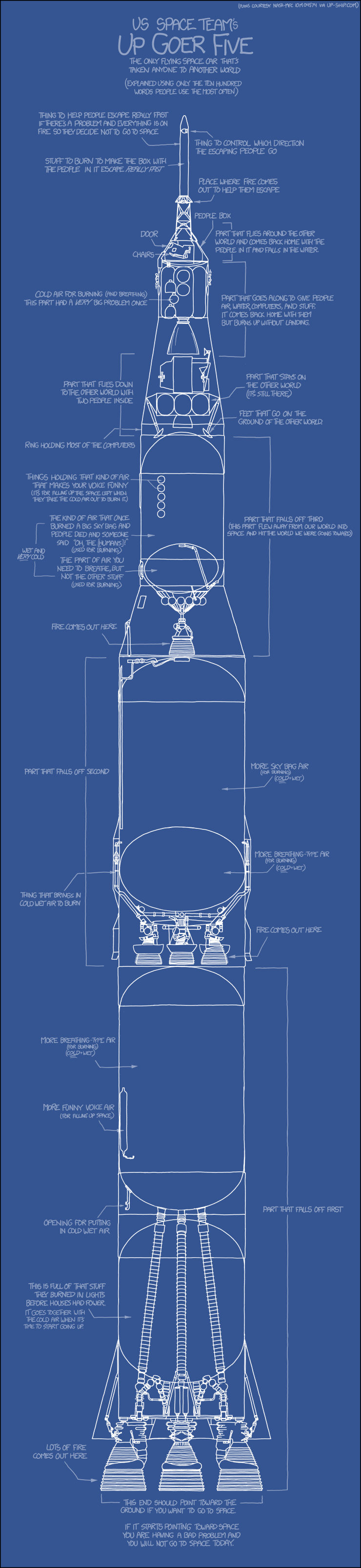
Obligatory XKCD: http://xkcd.com/1133/
up_goer_five.png
 
Back
Top