Why hasn't this been done yet (commercial airliner demo team) ??

Target entry speed for my most recent attempts of 290 kias (The Vno speed listed for the model in Plane-Maker). I've tried everything up from 270 kias to the listed Vne (365 kias). I've tried entry altitudes from 3000 to 5000 feet msl, giving peak altitudes around 8000-10000 ft msl with an entry speed of 290 kias. At the top of the loop the plane is traveling well below its level-flight stall speed. With the deployment of spoilers on the way down it is possible to come out about 500 ft below the entry altitude with a peak speed less than 10 kias above the entry speed.
Peak and average g-forces during the maneuver?
 
I have to say this is a bad idea, most if the reasons have all ready been pointed out but ill add one.

Cost...

Airbus A320: US$85.0 million (2011)
BAE Hawk: £18 million (2003) thats UK£ 18 000 000 = 28.82700 million US$ on todays exchange rates

see the price difference, The Hawk can eject the crew if things go wrong. the Airbus on the other hand.....


[ame="http://en.wikipedia.org/wiki/Airbus_A320_family"]Airbus A320 family - Wikipedia, the free encyclopedia[/ame]
[ame="http://en.wikipedia.org/wiki/BAE_Hawk"]BAE Hawk - Wikipedia, the free encyclopedia[/ame]
 
Last edited:
One can do almost anything in X-Plane and Microsoft Flight Simulator, even if one enables damage options.

Here I was flying carefully and making sure I didn't exceed the listed G limits or Vne. As long as the aircraft remains within those limits, damage simulation shouldn't be an issue.

That's the interesting thing about flight simulators. I have done a lot of interesting things in X-Plane and Microsoft Flight Simulator too. But I doubt it can be done the same way in reality. Those airliners are not responsive and robust like smaller airplanes. At high speed regime of flight they are, but they also become more fragile for certain maneuvers.

In case a loop would be possible with a 747 mathematically, I think nobody would be willing to try it. Not Boeing, and not the most experienced test pilots ;)

Well, the FAA hasn't certified the 747 for aerobatic maneuvers. It does take a lot of concentration and an accelerometer (not, to my knowledge, standard cockpit equipment on a 747) to avoid exceeding 2.5 gees during the maneuver.

The big question in my mind is not "can it be done" but "what's our error margin"?

---------- Post added at 18:27 ---------- Previous post was at 18:07 ----------

Peak and average g-forces during the maneuver?

Peak g-loading as close to 2.5 (the rated limit) as I feel I can comfortably get without going over. Average I'm not sure of. There's some time in near-freefall at the top. During the vertical portions of the maneuver I try to keep it between 2 and 2.5 g's. The difficult part is letting pressure off the stick smoothly to keep the G's below the limit without having the tactile feedback you'd have in a real plane. It's easy to carelessly hold the stick in one place and go over.
 
Not an airliner, but still worth watching:


They don't do v/o's like that any more, old fruit!

N.
 
After playing around with x-plane and the default 747-400 I've had rather limited success with looping it. I'd always start out at around 1500' and around 340kt IAS, with a dynamic pressure of around 468psf. Anyways, I can do it by letting the G's exceed 2.5, going as high as 2.9. sometimes. This is on the upswing climb. The recovery is a lot more easier and doesn't exceed 2.1.
 
It would be cool if some pilot did a barrel roll with 747 full of passengers (with seatbelts on obviously). I'm sure everyone would love it :lol:
 
Years ago we were flying on one of them hot new Boeing 727's and right after takeoff we got into some upstart weather off the west coast bay area and did 2 huge banks at least 70* or more. That was very cool!

It was PSA airlines, and I still have the coloring books they passed out to the kids on board. I clearly recall the 2 boys next to us drawing bird droppings by the pilots and inappropriateness on the stewardesses.

http://www.psa-history.org/museum/liftcolorbk.pdf
[ame="http://en.wikipedia.org/wiki/Pacific_Southwest_Airlines"]Pacific Southwest Airlines - Wikipedia, the free encyclopedia[/ame]
http://www.psa-history.org/hangar/727.php?pic=15
 
Last edited:
Years ago we were flying on one of them hot new Boeing 727's and right after takeoff we got into some upstart weather off the coast and did 2 huge banks at least 70* or more. That was very cool!
I highly doubt the banks were actually 70 degrees or more. In order to maintain a 70 degree bank in level flight, you need to be pulling almost 3g's, and it goes up to 4g's at 75.5 degrees. When you're in the plane looking out the side window, the bank angle can look a whole lot higher than it actually is.
 
I highly doubt the banks were actually 70 degrees or more. In order to maintain a 70 degree bank in level flight, you need to be pulling almost 3g's, and it goes up to 4g's at 75.5 degrees. When you're in the plane looking out the side window, the bank angle can look a whole lot higher than it actually is.

We were looking pretty much looking straight down AND there was plenty of slip. Enough to get the passenger cabin going.
 
Well, the FAA hasn't certified the 747 for aerobatic maneuvers. It does take a lot of concentration and an accelerometer (not, to my knowledge, standard cockpit equipment on a 747) to avoid exceeding 2.5 gees during the maneuver.

You will find an accelerometer in the cockpit of Concorde :)

The big question in my mind is not "can it be done" but "what's our error margin"?

I think nobody would be willing to test it in reality. But I doubt anyone would ever get an approval.


Nothing special. It's a usual low approach with a left turn above sloping terrain which makes it look like the wing tip nearly is hitting the ground from the point of view of the audience. Just an optical illusion.

Low apporaches are also performed on airports during normal traffic with passengers aboard. In Germany one can book sightseeing flights with Air Berlin for just a few Euros which always includes low approaches. Additionally the passengers get a nice acceleration on take off because of engine spool up whilst the brakes are set...


Much better than just watching aerobatics if you ask me. And people and children get a sense that those airplanes are not just heavy and slow.
 
It would be cool if some pilot did a barrel roll with 747 full of passengers (with seatbelts on obviously). I'm sure everyone would love it :lol:

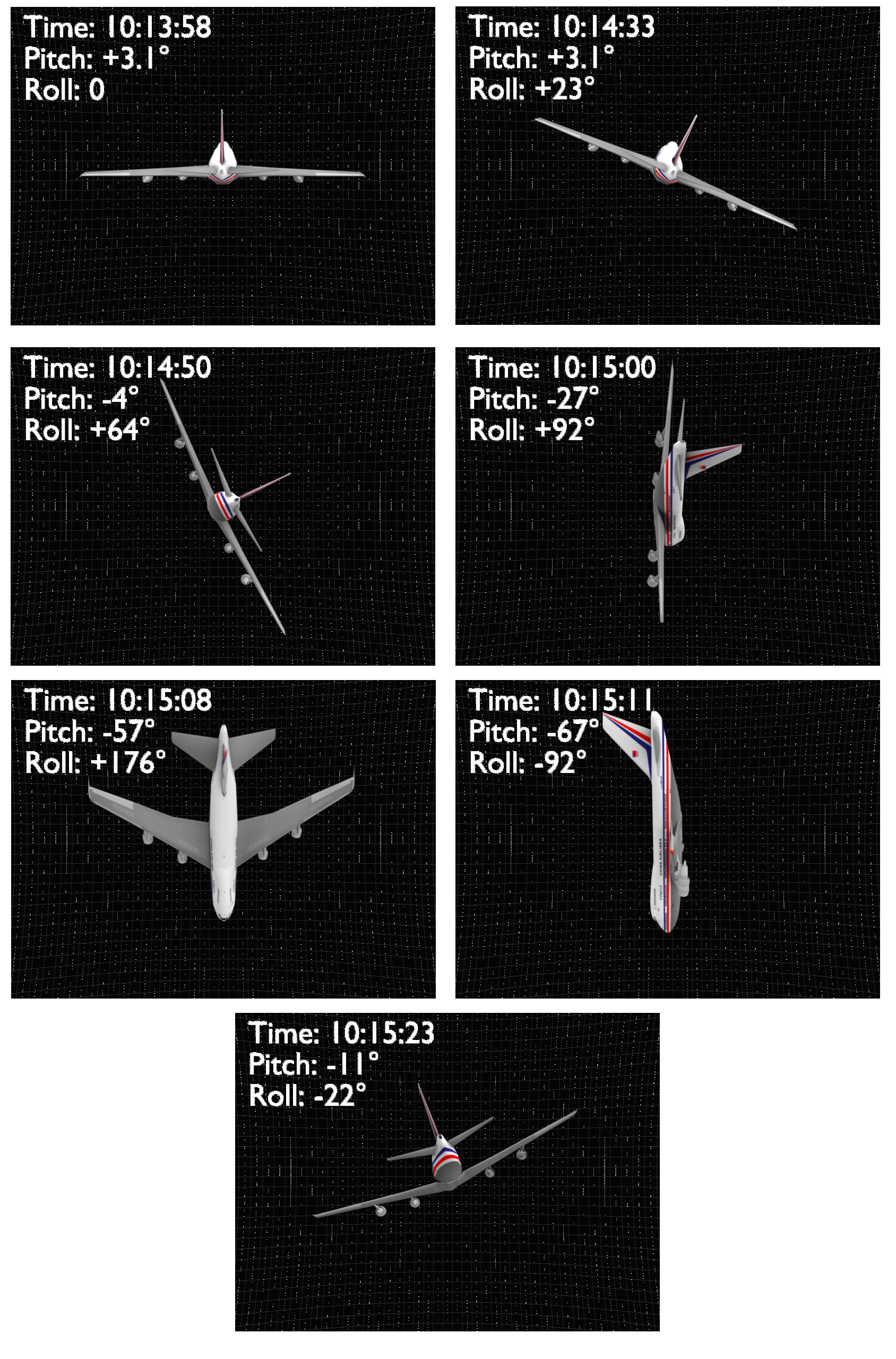
China Airlines flight 006:

747-CA006-1.png


They approached up to 5g, I can't find the exact amount of g-force.
The main landing gears where forced open.

[rant]
I absolutely -hate- how every news service in the world does things like that.
Why do they round numbers up or down?
You are a news service deliver the FACTS, deliver the ACTUAL numbers.
[/rant]


The wings were permanently bent upwards by two inches, the inboard main landing gear lost two actuator doors, and the two inboard main gear struts were left dangling. Most affected was the tail, where large outer parts of both horizontal stabilizers had been ripped off.

This was the damage:
Damaged_empennage_of_China_Airlines_Flight_006-N4522V.JPG


.
 
Last edited:
We were looking pretty much looking straight down AND there was plenty of slip. Enough to get the passenger cabin going.
No.

Like I said, bank angles look a lot steeper when you're looking out a tiny side window and have no frame of reference. No commercial airplane pilot is going to make a 3G turn with a load full of passengers.
 
Yes. I doubt we pulled 3g's. There was plenty of sideslip, no skidding. Much of it was a weather issue of a sort. I remember ominous skies and highly contrasted clouds, still today.
 
No.

Like I said, bank angles look a lot steeper when you're looking out a tiny side window and have no frame of reference.

I will agree with you here, and I do think it's likely that they weren't banking at a full 70 degrees. But...

No commercial airplane pilot is going to make a 3G turn with a load full of passengers.

3 g's is the g-loading you need to pull to maintain level flight at that bank, but if you get knocked into that kind of bank by turbulence or other factors out of your control, you're more likely to maintain 1g or so and allow yourself to lose altitude as you recover.
 
Back
Top