

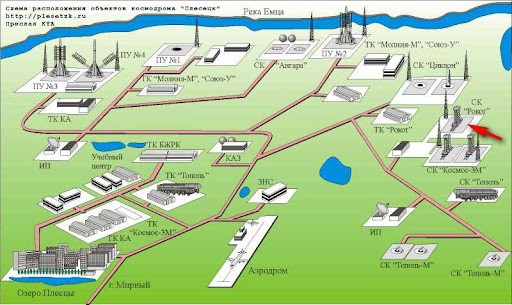
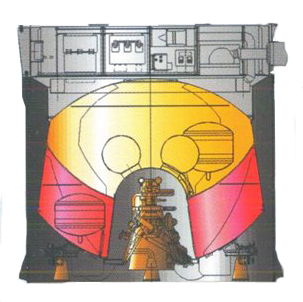
So welcome to 2013! :tiphat: The first launch of the year fell to the Russian military, which launched a group of three low orbit communication satellites yesterday. Khrunichev's Rockot launch vehicle (which uses converted UR-100N / SS-19 "Stiletto" ICBMs topped by the Breeze-KM upper stage, similar to the notorious Breeze-M but without the outer drop tank) lifted off pad 133/3 of the Plesetsk Cosmodrome in northern Russia at 16:25 UTC (20:25 Moscow / 11:25 EST) yesterday. To the relief of Khrunichev engineers, the Breeze-KM did the two burns perfectly and deployed the three satellites into the planned 1500 km circular, 82.5 degree inclination orbit 1.5 hours after launch.
The three satellites are of the Rodnik/Strela-3M series, the latest in a long-running series of low orbit military communication satellites. These "store-and-dump" (i.e. non-real-time messaging) satellites have been transmitting e-mails, secret documents and messages for the likes of the KGB, army intelligence department and Soviet/Russian embassies overseas for almost 50 years. This latest series of satellites has been deployed since 2005. A civilian version is also available (known as Gonets) for telecommunication uses.
A summary of the launch vehicle and the satellites:
Launch location:
Plesetsk Launch pad no. 133/3 62°53'13.35"N, 40°50'48.30"E
PAYLOADS 1/2/3
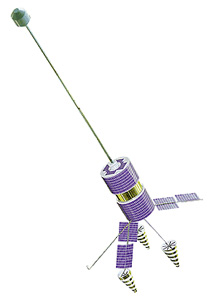
Strela-3M / Rodnik (Russian: Arrow-3M / Creek) communications satellite:
The Rodnik are the military versions of the Gonets-M communication satellites, which in turn are upgraded versions of the Gonets satellites, a civilian derivate of the military Strela-3 satellite system. They are operated in the Gonets-D1M constellation. The Gonets system was offered to support international health organizations to meet their global communications needs for the transfer of medical data and records to remote sites.
After two prototype Gonets satellites the operational satellites were to be deployed in the Gonets-D1 constellation of 12 satellites consisting of 6 satellites in 2 orbital planes between 1996 and 1998. Each satellite had a single simultaneous earth-space and space-earth channel. On-board storage was 12 Mbits of data, with a transmission rate of 2.4 kbit/sec. Attitude control was achieved through gravity-gradient stabilization. The electrical power system, provided by solar cells and nickel-hydrogen batteries, provided an average 40 W for the payload which was designed to operate for five years.
In the commercial variant, the satellites, known as Gonets (Messenger), were capable of store-dump communications on 2-3 channels in the 2004-400 MHz band with a transmitter output power of 10 W. Data transmission rates available include 2.4 kbits/s, 9.6 kbit/s, and 64 kbit/s with an onboard storage capacity of 8 Mbytes. A handheld user terminal (UT-P) resembles a cellular phone and weighs only 1-3 kg. Finally the 250 kg Gonets were to be deployed at 1,350 km at 82.5 degrees, similar to the Strela-3 satellites, but distributed among six orbital planes for a total constellation of 36 spacecraft. This infrastructure would ensure a mean communication waiting time of less than 20 minutes with more than 80% probability.
[table="head"]Characteristics|
|
 [/table]
Launch Vehicle:
[table="head"]{colsp=2}Characteristics
 |[table="head"]{colsp=2}
[/table]
[/table]
The vehicle's reliability statistics according to http://www.spacelaunchreport.com/log2013.html#stats:
Currently I can only find a news clip of the launch, but I will continue to look for launch photos!
Here's to a good year for spaceflight development!
The three satellites are of the Rodnik/Strela-3M series, the latest in a long-running series of low orbit military communication satellites. These "store-and-dump" (i.e. non-real-time messaging) satellites have been transmitting e-mails, secret documents and messages for the likes of the KGB, army intelligence department and Soviet/Russian embassies overseas for almost 50 years. This latest series of satellites has been deployed since 2005. A civilian version is also available (known as Gonets) for telecommunication uses.
A summary of the launch vehicle and the satellites:
Launch location:
Plesetsk Launch pad no. 133/3 62°53'13.35"N, 40°50'48.30"E
PAYLOADS 1/2/3
Strela-3M / Rodnik (Russian: Arrow-3M / Creek) communications satellite:
The Rodnik are the military versions of the Gonets-M communication satellites, which in turn are upgraded versions of the Gonets satellites, a civilian derivate of the military Strela-3 satellite system. They are operated in the Gonets-D1M constellation. The Gonets system was offered to support international health organizations to meet their global communications needs for the transfer of medical data and records to remote sites.
After two prototype Gonets satellites the operational satellites were to be deployed in the Gonets-D1 constellation of 12 satellites consisting of 6 satellites in 2 orbital planes between 1996 and 1998. Each satellite had a single simultaneous earth-space and space-earth channel. On-board storage was 12 Mbits of data, with a transmission rate of 2.4 kbit/sec. Attitude control was achieved through gravity-gradient stabilization. The electrical power system, provided by solar cells and nickel-hydrogen batteries, provided an average 40 W for the payload which was designed to operate for five years.
In the commercial variant, the satellites, known as Gonets (Messenger), were capable of store-dump communications on 2-3 channels in the 2004-400 MHz band with a transmitter output power of 10 W. Data transmission rates available include 2.4 kbits/s, 9.6 kbit/s, and 64 kbit/s with an onboard storage capacity of 8 Mbytes. A handheld user terminal (UT-P) resembles a cellular phone and weighs only 1-3 kg. Finally the 250 kg Gonets were to be deployed at 1,350 km at 82.5 degrees, similar to the Strela-3 satellites, but distributed among six orbital planes for a total constellation of 36 spacecraft. This infrastructure would ensure a mean communication waiting time of less than 20 minutes with more than 80% probability.
[table="head"]Characteristics|
Gonets-M
Customer:
|- Russian Space Forces ()

Prime contractor:
|- JSC "Information Satellite Systems Reshetnev Company"

GRAU index:
|- 14F132
Platform:
|- Strela-3
Mass at Separation:
|- 280 kg
Dry Mass:
|- ?
Stabilization:
|- Gravity boom
Batteries:
|- 40 W
Life time:
|- 5 years
|
Launch Vehicle:
[table="head"]{colsp=2}Characteristics
Rockot / Briz-KM
Prime contractor:
|- Khrunichev State Research And Production Space Centre, Moscow

GRAU Index:
|- Converted 15A35 (Common name: UR-100NUTTKh)
Height:
| 29.15 m with upper stage and payload fairingDiameter:
| 2.5 m (body)Liftoff mass:
| 107.5 metric tonnesPayload mass (with Briz-KM to LEO):
| 1 950 kg max1st stage:
|- 3 x RD-0233 & 1 x RD-0234 engines
- Length 17.2 m
- Propellants: UDMH & N2O4
- Thrust in vacuum 2080 kN (520 x 4)
- Thrust at sea level 1880 kN (470 x 4)
- ISP 310 s / 285 s
- Burn time 121 s
2nd stage:
|- 1 x RD-0235 engine & 1 x RD-0236 vernier engine
- Length 3.9 m
- Propellants: UDMH & N2O4
- Thrust in vacuum 240 kN + 15.76 kN (vernier)
- ISP 320 s (293 s vernier)
- Burn time 183 s
Upper Stage:
|
- GRAU Index: -
- Common Name: Briz-KM (meaning Breeze)
- Designer & Manufacturer: Khrunichev Space Centre
- Dimensions: Length 2.5 m, Diameter 2.5 m
- Empty Mass 1.42 tonnes
- Propellants 5055 kg (UDMH + N2O4)
- Flight time: no less than 7 hours
- Main Engine: 1 X С5.98М
- Thrust in vacuum 2.0 tonnes of force
- ISP 328,6 s
- Main engine restarts: up to 8 times
- Correction Engine: 4 X 11D458
- Thrust in vacuum 400 N each
- ISP 252 s
- RCS Engines: 12 X 17D58E
- Thrust in vacuum 13.3 N each
- ISP 274 s
Payload Fairing:
|- Diameter 2.62 m
- Length 6.74 m
[/table]
[/table]
The vehicle's reliability statistics according to http://www.spacelaunchreport.com/log2013.html#stats:
Code:
================================================================
Vehicle     Successes/Tries Realzd Pred  Consc. Last     Dates
                             Rate  Rate* Succes Fail
================================================================
Rokot/Briz/K(M)  16    18    .89  .85      2    02/01/11 1994-
Currently I can only find a news clip of the launch, but I will continue to look for launch photos!
Here's to a good year for spaceflight development!


