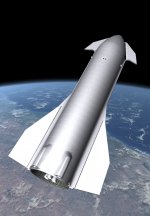
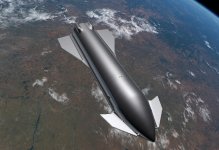
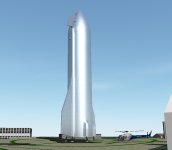
Project Starship Mk.1

BrianJ

Addon Developer
Addon Developer
Joined
Apr 19, 2008
Messages
1,875
Reaction score
1,281
Points
128
Location
Code 347
"Never compose anything unless the not composing of it becomes a positive nuisance to you." [Gustav Holst]


In terms of Orbiter add-ons, Mr.Musk is proving to be positive nuisance to me :lol:


Work in progress.....
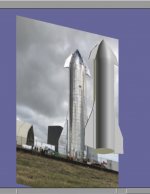
wip1.jpg


Question is - how to implement those aerofoil control surfaces using OrbiterAPI. Maybe need to go a different route than Orbiter's vertical/horizontal aerofoils and control surfaces?


No idea about RCS placement or landing gear - any info out there?


Cheers,
Brian
 
Depends - do you think somebody will notice the difference, that this spacecraft is not using real control surfaces, but actually fictive, physically implausible standard aircraft controls? Based on a real world behavior that you don't know and no human might ever know because a computer is doing the magic of turning guidance (or manual) commands into surface position commands?

Then yes, you might need some magic in the air foil functions.

But I think you might get away easy by just animating them as plausible as you can.
 
Hi,
yes, I might go the simple route in the end. I don't really want to get into trying to make my own lift/drag functions. I was looking at those independently variable geometry airfoils and thinking "how's that going to work?"
But it's easy enough to change Orbiter's airfoil area/position on-the-fly, I might give that a try and see how it behaves.
Could be "realistic" enough for me.
Then try and figure how to translate pitch/yaw/roll commands into variable airfoil position/area. Should be interesting :-)
Cheers,
Brian
 
This thing could be a field day for those fancy D3D9 Client reflections and textures.
 
For starship's reentry I understand the 'forward' motion is in belly direction, while the wings (fins) are swept back. They control
- the roll axis by independently moving left and right wings
- the pitch axis (AoA close to 90°) by moving main wings vs. canards
- possibly also the yaw axis by a clever combination of spreading out the mains and canards.

For a start I would do:
Kill the lift function during ascent, to avoid interference during the launch.

For the reentry first define the lift of the main body, a cylindro-conical object at supersonic speed. The center of lift should be aft of the geometrical center.
ESTIMATED AERODYNAMICS OF ALL-BODY HYPERSONIC AIRCRAFT

Then starting adding the fins and playing around with their lift functions.

For subsonic speeds, which will occur only shortly before touchdown, I would again drop all lift functions, using only Orbiters drag and control all movements with the RCS and main thrusters.
 
This thing could be a field day for those fancy D3D9 Client reflections and textures.
I'm hoping one of the D3D9 texture artists out there might be interested in helping out :-)


For starship's reentry I understand the 'forward' motion is in belly direction, while the wings (fins) are swept back. They control
- the roll axis by independently moving left and right wings
- the pitch axis (AoA close to 90°) by moving main wings vs. canards
- possibly also the yaw axis by a clever combination of spreading out the mains and canards.

For a start I would do:
Kill the lift function during ascent, to avoid interference during the launch.

For the reentry first define the lift of the main body, a cylindro-conical object at supersonic speed. The center of lift should be aft of the geometrical center.
ESTIMATED AERODYNAMICS OF ALL-BODY HYPERSONIC AIRCRAFT

Then starting adding the fins and playing around with their lift functions.

For subsonic speeds, which will occur only shortly before touchdown, I would again drop all lift functions, using only Orbiters drag and control all movements with the RCS and main thrusters.
Hey, thanks for the ideas and link to extremely informative doc! (lot of stuff for me to take onboard there). In the presentation, Elon is talking about a 60deg AoA and needing lift to control the maximum heating during reentry, also the more lift there is the easier it is to target the touchdown zone during later stages, so I think I'll be needing whatever lift I can use.

I can see the pitch/roll control won't be a problem, using the aerofoils in pairs of aft/fwd or port/stbd. But yaw has me wondering - my onboard fluid dynamics computer (my imagination ;-) is telling me that there will be torque around the yaw axis if an aerofoil is angled back, due to deflection of the airflow, and it's not obvious to me how to do that using Orbiter's horizontal/vertical airfoils.


Actually, I'm just thinking about flying the planned 20km "hop", not even thinking about reentry yet.


Figuring out how to do that last-minute back-flip and land will also be "interesting"!


Cheers,
Brian
 
It will have hot gas thrusters. That would work for yaw.
 
It will have hot gas thrusters. That would work for yaw.
Hi Don, yep, it might have to be that way. Although, I'm not seeing any RCS on the Mk.1 at all (might just not be obvious from the photos) but I've put some on mine anyway, on the aft blisters. My hunch is they are using the Mk.1 to test the aerofoil control system and landing, maybe don't need RCS for that. And I'm wondering if the algorithm for the aerofoil control is more than I can handle anyway, but I'm interested to have a go ;-)
Cheers,
Brian
 
Hi Don, yep, it might have to be that way. Although, I'm not seeing any RCS on the Mk.1 at all (might just not be obvious from the photos) but I've put some on mine anyway, on the aft blisters. My hunch is they are using the Mk.1 to test the aerofoil control system and landing, maybe don't need RCS for that. And I'm wondering if the algorithm for the aerofoil control is more than I can handle anyway, but I'm interested to have a go ;-)
Cheers,
Brian

For Starhopper the RCS was one of the last things they installed. Still quite a bit of work to be done on Starship Mk. 1 before it can fly.
 
...maybe don't need RCS for that

The wings become ineffective in slow flight, just before landing. While this can be controlled with the main thrusters, I am pretty sure an RCS will be included in the Starship Mk.1.

Elon also mentioned in the presentation to do the flip-over rather with the RCS, as the main engines are giving it initially a forward push, in the wrong direction if you want to slow down.
 
For Starhopper the RCS was one of the last things they installed. Still quite a bit of work to be done on Starship Mk. 1 before it can fly.
Right. If anyone sees any RCS installation, let me know :-) Or landing gear, for that matter.

The wings become ineffective in slow flight, just before landing. While this can be controlled with the main thrusters, I am pretty sure an RCS will be included in the Starship Mk.1.

Elon also mentioned in the presentation to do the flip-over rather with the RCS, as the main engines are giving it initially a forward push, in the wrong direction if you want to slow down.
I'm sure your right about the wings in slow flight. My experience with the Falcon booster and Dragon capsule add-ons was that you need to use any bit of lift you can get to help targeting the touchdown zone, before you switch the engines on, so I'm loath to get rid of any!
IIRC Elon said they could do the back-flip with RCS only when they go to "hot gas" RCS (Mk.3 or 4), and something tells me that will be easier than using only main engines, so I might end up doing that :thumbup:

Got a workable mesh, so now to work on the code. And then some flight test fun.

Cheers,
Brian
 
I did see a test version for a full nose thruster pack and it look a lot like the crewed dragon pattern. and a lot like the Shuttle's nose It will use the wings and canards quite a bit lower in its descent. If you guys have a go at the winged landing up might keep in mind an MFD for all winged craft like the Shuttle or X33. I did speak with one engineer and he has done the calculations for Venture Star and using today's knowledge about metal tanks it would have been feasible.
 
It's almost as exciting as the real Starship.
Got a workable mesh, so now to work on the code.
Does the mesh also have landing legs?
It would be great if you could share your work in progress, preferably via a git repository.
 
That's easy, use the D3D9 debugger :thumbup:
Ah! I'll take a look at that. The texturing needs a bit more work anyway. Thanks.

I did see a test version for a full nose thruster pack and it look a lot like the crewed dragon pattern. and a lot like the Shuttle's nose It will use the wings and canards quite a bit lower in its descent. If you guys have a go at the winged landing up might keep in mind an MFD for all winged craft like the Shuttle or X33. I did speak with one engineer and he has done the calculations for Venture Star and using today's knowledge about metal tanks it would have been feasible.
Hi Barry, many thanks! Can't beat info from the shop floor :thumbup:
I wasn't happy about having RCS on the underside anyway (I imagine holes in the heatshield are not a good thing) - going to remake my RCS along Shuttle lines.

Yes, I'm guessing the aerodynamic steering only starts somewhere below 20km (my Falcon booster starts at ~15km) and well past peak heating.

Does the mesh also have landing legs?
It would be great if you could share your work in progress, preferably via a git repository.
Yes, six very basic stubby legs at the moment, tucked away in the aft blisters and wing/hull assembly. When I get something flyable I'll upload somewhere. Autopilot for landing etc. may well take some time for me to figure out(if ever!).

I realised last night that since I know(reasonably accurately) the cross-section area of the hull, canards and wings, and can estimate their respective CoP points - I can calculate the total effective area(depending on aerofoil angle) and effective CoP, and simulate that using one (or maybe three) aerofoils. And if I can calculate where the CoP needs to be for steering, then I can set the aerofoil angle as required.

And as a fudge for the yaw torque, I figure I can calculate that by using proportion of the total drag * aerofoil area * sin(aerofoil angle) ... or something like that.

Unsurprisingly, I find if I shift the CoG on my mesh down 3m, the canards and wings turn out to be nicely "balanced" (aerofoil area x distance to CoG). Think I'll go with that. I'm ignoring shift in CoG due to fuel consumption for the time being, but I think it would actually help stability on the way up and down.

Going to give it a try and see what happens. Need to remake RCS and shift mesh, etc.etc. before that though.

Cheers,
Brian
 
There's a detailed flight profile of Starship and Super Heavy on flightclub.io that you may find useful for a rough estimate.
 
picture.php


I tried to estimate the lift and drag of a lifting body at hypersonic speeds, based on the NASA paper mentioned earlier. The graph shows lift (blue) and drag (red). Note the different scales of the Y-axis.

The NASA paper only covers an AoA of 0 to 20°. The rest is guesswork. The lift/drag ratio changes over the AoA, this is why the drag line has a kink at 15°.
Attached is also the Excel-file to play around. This includes sheets for Orbiter's Delta Glider and Atlantis shuttle as well.
 

Attachments

There's a detailed flight profile of Starship and Super Heavy on flightclub.io that you may find useful for a rough estimate.
Great, thanks. Had a quick look but I could only get the SuperHeavy+Starship ascent profile (will be useful in future) - is there a way to look at the Starship back-flip sequence? I couldn't find it! :)

@francisdrake
Totally awesome - thanks! I have a feeling I will be needing your help implementing the correct Lift/Drag functions in the code. I'm just using my Falcon booster aerodynamics at the moment, no idea if it is anywhere near correct, so your data will be extremely useful. :thumbup:


Got the mesh into Orbiter just to test the basics, first thing I find is I have to use really strong RCS to get this beast to turn, even when it's mostly empty - what are the Space Shuttle RCS engines rated at? (I better check if I got the right PMI inertia values too).


Default Orbiter2016
wip_d3d7.jpg


D3D9 Graphics
wip_d3d9.jpg


Cheers,
Brian
 
This is the best I could find and I'm sure you've already seen it. Looks like the flip takes place at 500m (!) moving at a velocity of 66 m/s. What specifically do you wish to know about the backflip sequence? I'm sure I could dig and find out at least educated guesses.

 
Thanks for the extremely useful videos, guys :thumbup: I hadn't seen such a clear version of either.
I'm just looking for any and all info about the reentry and landing.
Very useful to see that "terminal velocity" is around 70m/s - I'm surprised it's that low, but that is indeed close to what I'm getting in Orbiter using airfoils sized to the cross section area of hull, wings, etc.

I've implemented vertical/ horizontal airfoils for the hull, and horizontal airfoils for the canards and wings, sized and positioned as realistically as I can, equally balanced around CoG. The aerofoil size and position is set according to the angle of the wing/canard - maximum deflection is 60deg, so that is a 50% reduction in effective area. Seems to steer OK! Yaw torque is a fudge, using a proportion of current drag.

Lift/Drag is about 1/2 at 45deg AoA, which is better than I used previously with the Dragon capsule or Falcon booster, and reflects francisdrake's graph data.

RCS is now more Shuttle style, and mounted above centreline, 9000N each which I think is equivalent to two Shuttle RCS engines.

RCS is switched off while main engines are active, control is by main engine gimballing.

If OH is working, I might upload a trial version soon.

Cheers,
Brian
wip_onthepad.jpg
 
Back
Top