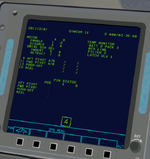
Yep, the problem is filling them with data. Even a DISP needs somebody to generate the data it shows. The SPEC has a specific process for that, and also a function to respond to user inputs.the displays are quite easy to make haha.
The lines were pixel based.my only question is about drawing lines, are those parameters the pixel positions on the display or something else?
For now "can of worms".i wonder for future versions, a display creating tool could be used for custom payloads, but thats another can of worms.

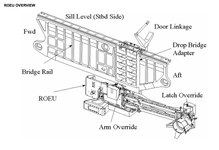
I don't think that ever happened... but I could be wrong. AFAIK small payloads had to make a custom bridge, or more often used one for the GAS canisters, that had a few side mount points. The ROEU wasn't a payload...would it be possible now or in a future release to have payloads mounted on the bridge rails but not needing latches?
First time I heard of that, but I'd say probably no. I didn't look much into the ROEU, and most of what I looked at was on the electrical side, so I don't really know the details of the mountings.Were the Drop Bridge Adapters "common" parts provided to payload users for mounting in the bay?
The ROEU was for electrical connections... data or power, both could be payload dependent, so maybe not all used it.Working on making 135 and it had the umbilical for the MPLM, as I'm sure all MPLM flights did.
Well, there was only one MPLM that was going to support "active payloads" and that was FM-03, Donatello that never flew. It was going to use a version of the ROEU called the Remotely Operated Fluid Umbilical (ROFU). ROEU was only used to supply keep-alive power to certain payloads to keep things like heaters going until permanent power could be supplied. Once the ROEU was disconnected, they were on a timer as the payload could no longer be kept at an safe temperature.I don't think that ever happened... but I could be wrong. AFAIK small payloads had to make a custom bridge, or more often used one for the GAS canisters, that had a few side mount points. The ROEU wasn't a payload...
First time I heard of that, but I'd say probably no. I didn't look much into the ROEU, and most of what I looked at was on the electrical side, so I don't really know the details of the mountings.
Perhaps I should take another look at the ROEU, and maybe support it...
The ROEU was for electrical connections... data or power, both could be payload dependent, so maybe not all used it.
The MPLM was going to have a water cooling system, but I think that lost its need before it was ever used.

I use that term loosely, more a generic term for SSV for things in the payload bay for me, so sorry for that confusion.The ROEU wasn't a payload...
I think the MPLM in general might be a good base payload to have in SSV to have more "complete" flights come with it by default. maybe a simple MFD for managing the cargo weights and such to simulate the transfers.Perhaps I should take another look at the ROEU, and maybe support it...
Hmm, IMO that is going outside of the project scope (which is already large enough). Yes, there are some payloads and missions already included in SSV, but they usually exist as a demonstration of some feature (I even removed some of them in the last version that where adding nothing).I think the MPLM in general might be a good base payload to have in SSV to have more "complete" flights come with it by default. maybe a simple MFD for managing the cargo weights and such to simulate the transfers.
Now I know why I didn't recognize the Drop Bridge Adapter... it doesn't seem to be "original" hardware. The regular location for the ROEU is mounted on top of the bridge rail. This might just be a custom location for the MPLM... and I just love things like this
For sure, wasnt trying to rag on the project. I understand the issues with feature-creep, its just so hard for the shuttle cause so much was payload dependent and unique.SSV is still far from supporting everything, but I think the current state isn't that bad, and slowly more things are being added.
I'm looking into getting an early PAM Deploy CL scanned, so hopefully that'll help out with adding this to SSV later on past 2.0Without the GPC, SCA, etc, it comes down to this:
1) close sunshields once in orbit
2) once time comes to deploy, point vehicle +Zo -VV
3) open sunshields
4) unlatch PAM
5) spin up PAM
6) when crossing the equator, deploy PAM
7) move away
8) 45 minutes later watch it fire from a safe distance
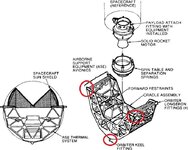
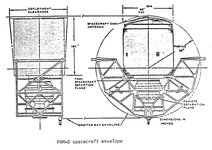
There you go. I'm pretty sure I have a diagram somewhere showing that the PAM keel trunnion is one PLID aft of the forward longeron trunnions. Plus, it certainly looks like that:I cant have the ASE keel latch at Xo 1202.73, but i can have it one further aft
The PLID numbering represents a position each 3.933 inches, starting somewhere forward of the vehicle (I don't know why). Anyway, in the PLB there are PLID positions that can have a keel passive latch, or a keel active, or a longeron passive or a longeron active, or some combination of them, or none at all. When a PLID can't have any latch, I still show the number in the diagram, without the Xo coord, as an indication that this particular PLID is unusable. When picking a PLID for a latch, only the PLIDs that support that latch type and location are shown.I've noticed some of the latches that cant be used in the mission editor have a number, but no Xo position when looking at the bay in the mission editor. Xo 1202.73 has both, but isn't useable in the editor
That is not what I see: in the image above, the right trunnion seems to be on this side of the structure plane, while the keel trunnion seems to be on the other side of the structure plane.It looks like the keel trunnion is at the same position as one of the side trunnion except in the center
update on this: The one i was looking at getting scanned is ITAR restricted. I'm reaching out to see if all of the checklists like this are restricted, or just this one for some reason.I'm looking into getting an early PAM Deploy CL scanned, so hopefully that'll help out with adding this to SSV later on past 2.0
But the IUS, being much more powerful, versatile and smarter, had its deploy checklist posted online by NASA itself...Update part 2: seems like all the PAM DPY checklists are ITAR restricted
do we have anything on what the SSP might have looked like for the PAMs?But the IUS, being much more powerful, versatile and smarter, had its deploy checklist posted online by NASA itself...
![]()