penlu
New member
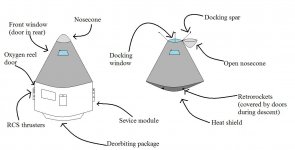
If you want to make something simple, then form follows function, right? So, I’ve come up with a thing I call a Small Orbital Craft. It’s a one-seated, simple spacecraft that launches into orbit on top of a twenty-foot, solid fueled rocket, to be docked to the ISS or something else.
The crew cabin itself is only one meter tall, just enough to fit one less-than-six-foot astronaut. It would be oxygenated and maneuvered by the attached service module. Just as a random point, the RCS of the service module is not like that of Apollo’s. It is more like that of the Delta Glider’s rear thruster assembly, a box with holes in it. The RCS can be retracted, and is powered by hydrazine and nitrogen tetroxide.
The basic mission plan is as follows: The craft would launch and fly up to about 180 kilometers using its first stage. It would then turn horizontal and continue firing the remainder of its first stage. After that, it would fire its second in order to circularize its orbit. Final corrections would be done with the ship’s RCS thrusters. RCS would be used again to dock with the ISS or another target craft. At launch, the craft would have a sea level pressure nitrogen/oxygen atmosphere, to be replaced with a pure oxygen atmosphere at 5 psi in space.
In preparation for docking, the nosecone would open on a hinge. Since the currently exposed surface is too small for a typical ISS or Space Shuttle dock, a set of spars with clamps at their tips would unfold from the now flat top of the craft. The span of the unfolded spars would be enough to reach across the dock of the ISS, allowing the craft to attach itself.
In order to transfer from the small ship to another one, an EVA must be performed because of the lack of an access tunnel. The ship would first be depressurized, and an entire half of the cabin would then swing outwards to provide the astronaut access to space. Another couple of random points: the astronaut launches and flies with the suit on, so changing in the small room would be no problem. The suit is not pressurized, either! It’s made out of tight rubber pressing in on the skin in order to simulate air pressure. The only part of the suit that is pressurized is the helmet. Continuing on, the astronaut would first attach an oxygen hose from the service module to the oxygen port of the docked craft before finding and entering an airlock on the ship.
Deorbiting would be done in the same manner as Mercury did it. The craft would then open its parachutes, stored inside the nosecone, and make a landing with retrorockets like Soyuz, ending its long mission. Interesting, no?
The crew cabin itself is only one meter tall, just enough to fit one less-than-six-foot astronaut. It would be oxygenated and maneuvered by the attached service module. Just as a random point, the RCS of the service module is not like that of Apollo’s. It is more like that of the Delta Glider’s rear thruster assembly, a box with holes in it. The RCS can be retracted, and is powered by hydrazine and nitrogen tetroxide.
The basic mission plan is as follows: The craft would launch and fly up to about 180 kilometers using its first stage. It would then turn horizontal and continue firing the remainder of its first stage. After that, it would fire its second in order to circularize its orbit. Final corrections would be done with the ship’s RCS thrusters. RCS would be used again to dock with the ISS or another target craft. At launch, the craft would have a sea level pressure nitrogen/oxygen atmosphere, to be replaced with a pure oxygen atmosphere at 5 psi in space.
In preparation for docking, the nosecone would open on a hinge. Since the currently exposed surface is too small for a typical ISS or Space Shuttle dock, a set of spars with clamps at their tips would unfold from the now flat top of the craft. The span of the unfolded spars would be enough to reach across the dock of the ISS, allowing the craft to attach itself.
In order to transfer from the small ship to another one, an EVA must be performed because of the lack of an access tunnel. The ship would first be depressurized, and an entire half of the cabin would then swing outwards to provide the astronaut access to space. Another couple of random points: the astronaut launches and flies with the suit on, so changing in the small room would be no problem. The suit is not pressurized, either! It’s made out of tight rubber pressing in on the skin in order to simulate air pressure. The only part of the suit that is pressurized is the helmet. Continuing on, the astronaut would first attach an oxygen hose from the service module to the oxygen port of the docked craft before finding and entering an airlock on the ship.
Deorbiting would be done in the same manner as Mercury did it. The craft would then open its parachutes, stored inside the nosecone, and make a landing with retrorockets like Soyuz, ending its long mission. Interesting, no?