- Joined
- Oct 30, 2009
- Messages
- 14,018
- Reaction score
- 4
- Points
- 0
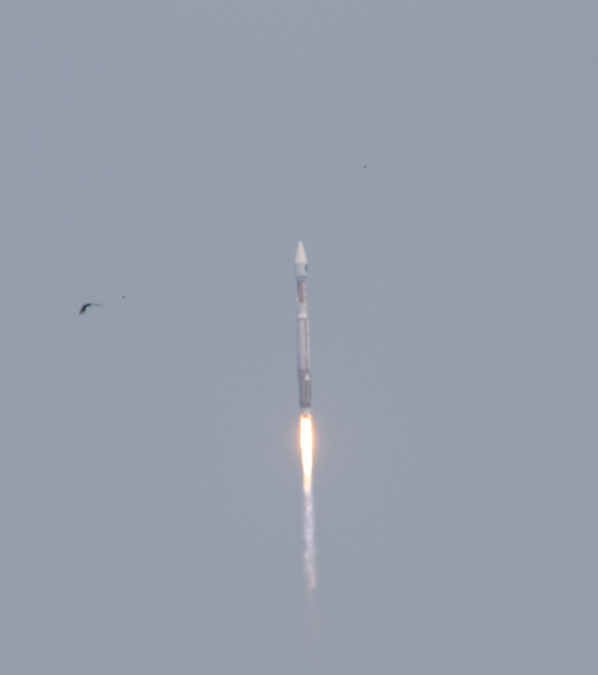
The United Launch Alliance Atlas 5 rocket (AV-022) will launch the U.S. military's first Space Based Infrared System Geosynchronous satellite, or SBIRS GEO 1, for missile early-warning detection. The rocket will fly in the 401 vehicle configuration with a four-meter fairing, no solid rocket boosters and a single-engine Centaur upper stage.
 |
|
{colsp=2}
|

Scrubbed on Friday, May 6 (window: 2:14-2:54 p.m. EDT / 18:14-18:54 UTC) because of cumulus clouds weather constraint.
If the flight is scrubbed again for some reason, a backup launch opportunity is available on Sunday between 2:06 and 2:46 p.m. EDT / 18:06-18:46 UTC.
There is calendar event created for this launch, for which you can request a reminder.
Viewing the Launch Live:
Payload:
Launch Vehicle:
Launch preparations:


Launch Updates:
Launch Timeline & Ground Track:
[table="head;width=500"]
{colsp=2}
{colsp=2}
{colsp=2}
{colsp=2}
{colsp=2}
{colsp=2}
{colsp=2}
{colsp=2}
{colsp=2}
{colsp=2}
{colsp=2}

Links:
Weather Report:
|
Launch date:
|
May 7, 2011
Window open:
|
18:10 UTC / 2:10 p.m. EDT
Window close:
|
18:50 UTC / 2:50 p.m. EDT
Launch site:
|
SLC-41, CCAFS, Florida
{colsp=2}
[highlight]L[eventtimer]2011-5-7 18:10;%c%%ddd%/%hh%:%mm%:%ss%[/eventtimer][/highlight]
Scrubbed on Friday, May 6 (window: 2:14-2:54 p.m. EDT / 18:14-18:54 UTC) because of cumulus clouds weather constraint.
If the flight is scrubbed again for some reason, a backup launch opportunity is available on Sunday between 2:06 and 2:46 p.m. EDT / 18:06-18:46 UTC.
There is calendar event created for this launch, for which you can request a reminder.
[table="head"]{colsp=2}
 |
| [/table]
Mission Insignia (clickable)
 |
| [/table]
Viewing the Launch Live:
The SBIRS launch will be carried live beginning 20 minutes prior to launch and will conclude approximately 45 minutes following launch. A simulcast of the broadcast can be viewed here:
- Flash Player - Standard quality
- Flash Enabled Mobile Devices - Low quality
- Satellite TV (where applicable): SATELLITE - AMC 3; TRANSPONDER - 16C; BAND - C-BAND ANALOG; ORBITAL POSITION - 87 DEGREES W; CARRIER - SES AMERICOM; BANDWIDTH - 36 MHz; UPLINK FREQ - 6245 MHz (Horizontal); DOWNLINK FREQ - 4020 MHz (Vertical); TEST - 1:00 P.M. EDT; BARS AND TONE - 1:23 P.M. EDT; BROADCAST START - 1:54 P.M. EDT; LAUNCH WINDOW - 2:14 - 2:54 P.M. EDT; END TRANSMISSION: 3:45 P.M. EDT
The live coverage [eventtimer]2011-5-6 17:54?will begin in|has begun;%c% %h% hours, %m%[/eventtimer]minutes[eventtimer]2011-5-6 17:54?.| ago.;%c%[/eventtimer]
Payload:
SBIRS-GEO (Space Based Infra Red Sensor - Geostationary) is the geostationary component of the SBIRS-High program, which will replace the DSP system of early warning satellites in providing early warning for Intercontinental Ballistic Missile launches.

The SBIRS sensors are designed to provide greater flexibility and sensitivity than DSP and can detect short-wave and expanded mid-wave infrared signals allowing the system to perform a broader set of missions. These enhanced capabilities will result in improved prediction accuracy for global strategic and tactical warfighters.
The SBIRS-GEO spacecraft is a 3-axis stabilized A2100M platform with a scanning sensor and a staring sensor. Sensor pointing is accomplished with pointing mirrors within the telescopes. The GEO scanning sensor will provide a shorter revisit time than DSP over its full field of view, while the staring sensor will be used for step-stare or dedicated stare operations over smaller areas.
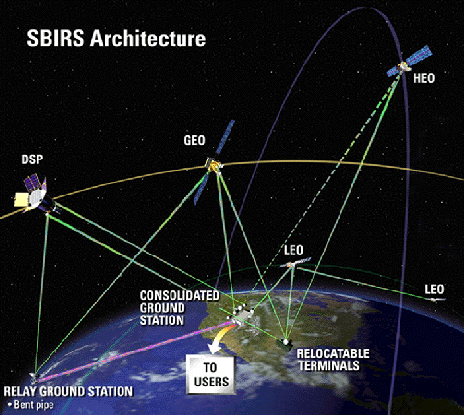
The SBIRS sensors are designed to provide greater flexibility and sensitivity than DSP and can detect short-wave and expanded mid-wave infrared signals allowing the system to perform a broader set of missions. These enhanced capabilities will result in improved prediction accuracy for global strategic and tactical warfighters.
The SBIRS-GEO spacecraft is a 3-axis stabilized A2100M platform with a scanning sensor and a staring sensor. Sensor pointing is accomplished with pointing mirrors within the telescopes. The GEO scanning sensor will provide a shorter revisit time than DSP over its full field of view, while the staring sensor will be used for step-stare or dedicated stare operations over smaller areas.
[table=head]{colsp=2}
Operator:|
Contractors:|
Equipment:|
Configuration:|
Dimensions:|
Propulsion:|
Power:|
Launch Weight:|
On-orbit Weight:|
Orbit:|
Appearance:|_CCAFSscpp.jpg)
 [/table]
Specifications
Type / Application:
|- Early Warning
Operator:|
- USAF
Contractors:|
- Lockheed Martin
- Northrop Grumman
Equipment:|
- 2 SBIRS sensors (scanning and staring)
Configuration:|
- A2100M
Dimensions:|
- 7 ft x 6.3 ft x 19.7 ft (stowed)
- 48.6 ft x 22.4 ft x 19.7 ft (deployed)
Propulsion:|
- LEROS-1C
Power:|
- 2 deployable solar arrays
- batteries
- 2361 watts (end of life)
Launch Weight:|
- 4833 kg (10656 lb) - max wet weight at launch
On-orbit Weight:|
- 2547 kg (5603 lb) - initial on-orbit estimated wet weight
Orbit:|
- GEO
Appearance:|
_CCAFS.jpg)

Launch Vehicle:
The Atlas 5 was developed by Lockheed Martin Commercial Launch Services as part of the US Air Force Evolved Expendable Launch Vehicle (EELV) program. Each Atlas 5 rocket uses a Russian-built RD-180 engine burning kerosene and liquid oxygen to power its first stage and an American-built RL10 engine burning liquid hydrogen and liquid oxygen to power its Centaur upper stage.
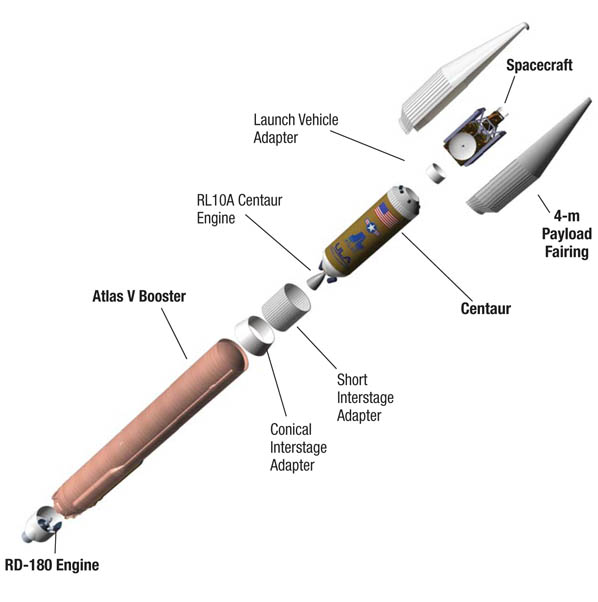
The Atlas 5 launcher will fly in the so-called 401 configuration, denoting a 4-meter payload fairing, no strap-on solid rocket boosters and a single-engine Centaur upper stage.
The Atlas 5 launcher will fly in the so-called 401 configuration, denoting a 4-meter payload fairing, no strap-on solid rocket boosters and a single-engine Centaur upper stage.
[table=head]{colsp=2}
Specifications
Gross mass:
|- 338640 kg (746570 lb)
Payload:
|- 7095 kg (15641 lb) SSO
- 4950 kg (10910 lb) GTO
Height:
|- 58.30 m (191.20 ft)
Diameter:
|- 3.81 m (12.49 ft)
Span:
|- 3.81 m (12.49 ft)
Thrust:
|- 3827.00 kN (860343 lbf)
Launch preparations:


Launch Updates:
- Spaceflight Now's Mission Status Center
- ULA Twitter
- AF Space Command Twitter
- Lockheed Martin Twitter
- ULA launch hotline - dial at 1-877-852-4321
Launch Timeline & Ground Track:
[table="head;width=500"]
T [MM:SS]
| Event
-00:02.7
| Engine Start{colsp=2}
The Russian-designed RD-180 main engine is ignited and undergoes checkout prior to launch.
+00:01.1
| Liftoff{colsp=2}
The United Launch Alliance Atlas 5 vehicle, designated AV-022, lifts off and begins a vertical rise away from Complex 41 at Cape Canaveral Air Force Station, Florida.
+01:30.6
| Mach 1 and Max Q{colsp=2}
The Atlas rocket achieves Mach 1 some 81 seconds into the flight, then passes through the region of maximum dynamic pressure at 91 seconds.
+04:03.0
| Main Engine Cutoff{colsp=2}
The RD-180 main engine completes its firing after consuming its kerosene and liquid oxygen fuel supply in the Atlas first stage.
+04:09.0
| Stage Separation{colsp=2}
The Common Core Booster first stage of the Atlas 5 rocket separates from the Centaur upper stage. Over the next few seconds, the Centaur engine liquid hydrogen and liquid oxygen systems are readied for ignition.
+04:19.0
| Centaur Ignition 1{colsp=2}
The Centaur RL10 engine ignites for the longer of the two upper stage firings. This burn will inject the Centaur stage and SBIRS GEO 1 spacecraft into a parking orbit.
+04:27.0
| Nose Cone Jettison{colsp=2}
The two-piece payload fairing that protected the SBIRS GEO 1 craft during the atmospheric ascent is separated to reveal the satellite to space.
+15:31.9
| Centaur Cutoff 1{colsp=2}
The Centaur engine shuts down after arriving in a planned parking orbit. The vehicle enters a brief coast period lasting nearly 9 minutes before arriving at the required location in space for the second burn.
+24:17.0
| Centaur Ignition 2{colsp=2}
The Centaur re-ignites over the equatorial Atlantic to accelerate the payload into geosynchronous transfer orbit from the parking achieved earlier in the launch sequence.
+28:09.5
| Centaur Cutoff 2{colsp=2}
At the conclusion of its second firing, the Centaur will have delivered the SBIRS GEO 1 spacecraft into the targeted orbit with an apogee of 22,236 statute miles, perigee of 115 statute miles and inclination of 21.64 degrees.
+43:19.5
| Spacecraft Separation{colsp=2}
The U.S. military's first Space Based Infrared System Geosynchronous spacecraft, or SBIRS GEO-1, is released into orbit from the Centaur upper stage to complete the AV-022 launch.
[/table]Links:
- Lockheed Martin:
- Space Based Infrared System (SBIRS)
- SBIRS flickr photo gallery
- SBIRS Videos
- SBIRS Status Updates
- Press Releases for Space Based Infrared System
- Press Releases:
- 2009-10-29: First SBIRS GEO Spacecraft Progressing in Thermal Vacuum Test Phase
- 2009-12-01: U.S Air Force/Lockheed Martin-Led Team Successfully Complete Environmental Testing Of First-Of-Its-Kind Missile Warning Satellite
- 2010-01-13: U.S. Air Force/Lockheed Martin Team Achieves Key Ground Segment Milestone For Nation's Space-Based Missile Warning System
- 2010-12-13: U.S. Air Force/Lockheed Martin Complete Major Testing Milestone for First-Of-Its Kind Missile Warning Satellite
- 2011-01-31: Lockheed Martin SBIRS Team Passes Major Flight Operations Test Milestone on Path to GEO-1 Launch
- 2011-02-16: Lockheed Martin Completes Final Installations on First of its Kind Missile Warning Spacecraft
- 2011-03-07: U.S. Air Force and Lockheed Martin Deliver First-Of-Its-Kind Missile Warning Spacecraft
- 2011-04-26: Lockheed Martin-Built Missile Warning Satellite Encapsulated in Launch Vehicle Payload Fairing
- 2011-05-04: U.S. Air Force Poised To Launch First-Of-Its-Kind Space Based Infrared System Satellite
- [highlight]▤[/highlight] SBIRS Informational Brochure (PDF - 4.0 MB)
- [highlight]▤[/highlight] SBIRS GEO Fact Sheet (PDF - 233 KB)
- [highlight]▤[/highlight] SBIRS GEO-1 Thermal Vacuum Testing (PDF - 2.6 MB)
- United Launch Alliance:
- Air Force Space Command:
- Space Based Infrared Systems
- Press Releases:
- Los Angeles Air Force Base:
- Infrared Space Systems Directorate
- Press Releases:
- Buckley Air Force Base:
- Northrop Grumman: Space-Based Infrared System (SBIRS)
- Spaceflight Now:
- Mission Status Center
- Atlas 5 vehicle diagram
- Atlas/SBIRS launch timeline
- Atlas launch ground track
- 2011-03-06: SBIRS missile warning craft shipped to Cape Canaveral
- SBIRS GEO 1 readied for Atlas rocket launch (PHOTO GALLERY)
- Atlas on the launch pad with SBIRS GEO 1 (PHOTO GALLERY)
- Panoramic views of Atlas 5 rocket (PHOTO GALLERY)
- Florida Today - The Flame Trench:
- 2011-05-04: Atlas V, military satellite on track for Friday launch
- 2011-05-05: Atlas V Ready To Launch Friday At The Cape
- Space News:
- 2010-10-15: Pentagon’s 1st SBIRS Craft Faces Narrow Window for 2011 Launch
- 2011-03-04: SBIRS Satellite Arrives at Cape Canaveral for Launch
- Aviation Week:
- 2011-04-01: Next Sbirs Buy Proposed, GEO-1 Launch Readied
- 2011-04-13: USAF Prepares For First Sbirs GEO Launch
- 2011-04-15: Sbirs GEO-1 Fueled, Marching Toward May Launch
- 2011-04-27: Sbirs Encapsulated, Launch Progress Continues
- Space Daily:
- 2011-02-01: SBIRS Team Passes Major Flight Ops Test Milestone On Path To GEO-1 Launch
- 2011-04-27: Missile Warning Satellite Encapsulated in Launch Vehicle Payload Fairing
- GlobalSecurity.org:
- Space Based Infrared System [SBIRS]
- Press Releases:
- airforce-magazine.com:
- 2011-04-12: [highlight]▤[/highlight] SBIRS GEO-1 Fueled for Launch (PDF - 300 KB)
- 2011-04-28: SBIRS Satellite in Launch Fairing
- aerospace-technology.com: Space-Based Infrared System (SBIRS), GEO and HEO Satellites, USA
- Defence Talk:
- Defense Industry Daily:
- 2011-04-05: Despite Problems, SBIRS-High Moves Ahead
- AirForceTimes:
- 2011-04-13: Troubled SBIRS satellite poised for 1st launch
- Missile Defense Advocacy Alliance:
- 2011-05-04: Friday Launch to Upgrade US Missile Defenses
- Defense Media Network:
- 2011-05-05: Countdown Under way for SBIRS GEO-1
- Gunter's Space Page: SBIRS-GEO 1, 2, 3, 4, 5
- Wikipedia:
- Space-Based Infrared System
- [ame=http://en.wikipedia.org/wiki/Atlas_V]Atlas V[/ame]
Weather Report:
The weather forecast for Friday's launch now calls for a 60 percent chance of acceptable conditions during the afternoon's 40-minute launch window. Air Force meteorologists are calling for a chance of isolated showers and thunderstorms, scattered low clouds and a broken deck of high clouds, good visibility, southeasterly winds of 14 to 18 knots and a temperature of 77 degrees.
The outlook for Saturday is 80 percent favorable.