Radiated heat

Dickie

Wannabe Rocket Scientist
Donator
Joined
Apr 13, 2008
Messages
162
Reaction score
4
Points
18
Location
Out there...
I was in a lecture today as part of ground-school when the subject of heat transfer came up - i.e radiation, conduction and convection. It's pretty simple (GCSE level, if that) but the definition of 'radiation' stated that every body radiates heat. I can see how a star, a lightbulb or microwave might emit heat via radiation (EM waves IIRC?), but what about soil, a rock or a toothbrush for instance - what EM waves do they emit to transfer heat?

I was wondering if someone here might be able to explain this as I've had a quick google but couldn't find anything which answered my question?!
 
The principle is just the same, what changes is how good things can emit heat, if they are no perfect black body. There is a coefficient for the transparency/blackness of the object.
 
The principle is just the same, what changes is how good things can emit heat, if they are no perfect black body. There is a coefficient for the transparency/blackness of the object.

OK, so basically my toothbrush emits EM waves that transfer heat from it into the surrounding area?
 
OK, so basically my toothbrush emits EM waves that transfer heat from it into the surrounding area?

Yes and it also absorbs thermal radiation from other things.

The equilibrium temperature of the toothbrush is the result of the heat balance, of the various incoming and outgoing heats.
 
Yes and it also absorbs thermal radiation from other things.

The equilibrium temperature of the toothbrush is the result of the heat balance, of the various incoming and outgoing heats.

OK, that makes sense. I understand the basic concept from A-Level physics (and common sense), I'd just never thought about how it radiates the heat before. Any idea what waves would be used to radiate heat from something that doesn't emit light (hate to keep using the example but can't think of anything better) such as my toothbrush - does it transfer heat with IR waves or something?

Oh, and thanks for answering what must seem a daft question! :cheers:
 
Well, every body that is above absolute zero emits some kind of EM radiation. And since there are no absolute zero objects, that means every object radiates a bit.

Earth receives it's EM spectrum from the sun, ranging from radio waves, up to UV rays. IR - which you know as heat - is only part of the spectrum that isn't blocked by the atmosphere. UV, for example, gets almost completely blocked... along with some other nasty parts of the spectrum.


To address your question more specifically... but I'll put the object in space to isolate radiation specifically...

If you put your toothbrush in space, it'll continuously receive energy from the Sun, but that doesn't mean it's temperature will keep on rising to infinity. It will also radiate heat outwards so that it cools off and it will stay at a certain temperature.
On Earth, majority of the heat gets transferred by conduction, but a small amount still gets transferred by radiation.


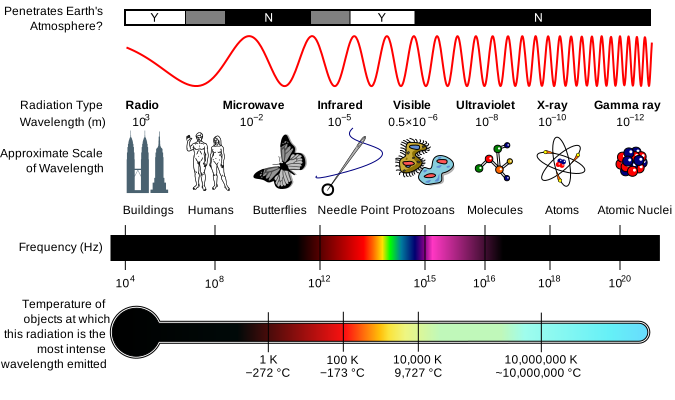
The EM waves that an object gives off varies with the temperature of the object.

The image to the right of this page: http://en.wikipedia.org/wiki/EM_spectrum shows roughly what kind of EM radiation a body at a certain temperature will radiate.

EM_Spectrum_Properties_edit.svg
 
Ah, so IR is what us laymen would call the heat that we feel when we place our hands near a hot object then? But heat can also be transferred by any other part of the EM spectrum?

So my toothbrush sitting in space being heated by the Sun will recieve energy in the form of radiation from all of the EM spectrum - but primarily from the IR part - and likewise emit energy (i.e heat) itself in all of the EM spectrum, but again, primarily in the IR part?
 
Ah, so IR is what us laymen would call the heat that we feel when we place our hands near a hot object then? But heat can also be transferred by any other part of the EM spectrum?

So my toothbrush sitting in space being heated by the Sun will recieve energy in the form of radiation from all of the EM spectrum - but primarily from the IR part - and likewise emit energy (i.e heat) itself in all of the EM spectrum, but again, primarily in the IR part?


Primarily from the IR part... cos visible light (which is another part) will bounce off and radio waves will mostly pass through (or do they reflect from plastic).

Not all substances reflect all parts of the EM spectrum. Glass for instance, is mostly transparent to light, yet reflects UV rays.
Flesh and blood are mostly transparent to x-rays, while bones reflect them (and the part that gets reflected is picked up by the sensors and made into an image).
Water ice reflects quite a lot of visible light and radio waves... and so on.
 
Thanks, that does pretty much answer my question! Although I don't think I'll be looking at my toothbrush the same way for a while :P
 
Flesh and blood are mostly transparent to x-rays, while bones reflect them (and the part that gets reflected is picked up by the sensors and made into an image).
The first part is correct.
But I think with usual radiography, the x-rays are more absorbed/scattered by the denser parts (bones). So it's the lack of radiation at the image/sensor plate that causes bones to 'appear' on an x-ray image, not the reflection.
 
The first part is correct.
But I think with usual radiography, the x-rays are more absorbed/scattered by the denser parts (bones). So it's the lack of radiation at the image/sensor plate that causes bones to 'appear' on an x-ray image, not the reflection.


Ah... yes!

Thanks for correcting me :)
 
One small addition to the above statements.

The emitted wavelength also depends upon the object temperature. If you make a metal glowing hot it is radiating in visible light. If you cool something down to near absolute zero it will be emitting primarily radio waves.

The cool (or warm) side effect is that the hotter a radiator is the more heat it can disperse. Then again a hot radiator gives less efficiency for a heat engine.
 
As mentioned above, any blackbody (perfectly efficient radiation absorber) above absolute zero radiates a particular EM spectrum which is predictable with quantum mechanics. Most objects are sufficiently close to blackbody we can use that theory for real objects.

The exact spectrum depends on its temperature, and only temperature. In objects below about 1000K, the peak of the emitted spectrum is in the infrared. For really cold objects, like the cosmic background, the peak is all the way into microwave.

When the object gets above 1000K, enough radiation is emitted at visible wavelengths that it starts glowing red. It was always glowing, just not enough of it was in the visible range to be seen. As it gets hotter still, the object goes through orange, yellow, and then white, at around 5500K. At this temperature, the peak of the radiation spectrum is near green, but the spectrum is spread out such that our eyes receive basically equal signals from all visible wavelengths, and thus the object appears white. This is why there are no green stars.

As an object gets even hotter, the peak leaves the visible range headed towards ultraviolet, and even x-rays and gamma rays for some astronomical objects. Some light is always still emitted in the visible range, but they cover the spectrum such that they appear blue.

The sun is effectively a blackbody at around 5500K, and emits something like 90% of its radiation in the visible range. (It seems reasonable that the visible range is what it is precisely due to this fact. For critters around other colored stars, the visible range is probably different.) So, almost all the heating of the earth is actually performed by visible light, not infrared.

A room-temperature object, such as the surface of the Earth, does emit infrared. The atmosphere is not as transparent to infrared, due mostly to water vapor with some contribution by carbon dioxide and methane.

Because of this, radiation from the sun is free to transit the atmosphere, be absorbed by and thus heat the ground. In turn, because the ground is above absolute zero, it re-radiates some energy as infrared and transfers some energy to the atmosphere by conduction, which in turn also emits infrared. Because the atmosphere is partially opaque to infrared, the energy transfer is impeded, and the equilibrium temperature of the ground is something like 20-50K higher than it would have been with a pure nitrogen atmosphere (or vacuum). This is the 'greenhouse effect.'

So, it is incorrect to refer to infrared as 'heat', as is sometimes done. The only special relation between infrared and heat is that room-temperature objects emit in infrared. So-called 'heat lamps' do emit large amounts of infrared, but this is because most everyday objects absorb better (are closer to "black") in that range, and therefore the energy transfer is more efficient. If you wanted to heat a visibly black object, a visible light lamp, or even a laser with a sharp spectrum in the visible range and no infrared at all, would work just as well. I have burned paper with a sufficiently powerful visible-light laser.

Radiation transfer is an extremely interesting problem, and its solution is what put Planck on the road to quantum mechanics in the first place. Go check Wikipedia on Planck's law for more detail than you may care to have.

 
H=Energy radiated
σ=5.67E-8

T= Temperature (Kº)
A=Area
H = σAT^4
the wavelength at which the peak emission and a black body temperature.
λmax = 0.002898 / T (S.I.)

where T is the temperature of the black body in Kelvin (K) and λmax is the wavelength of the emission peak in meters.
 
Back
Top