Orbiter Screenshot Thread

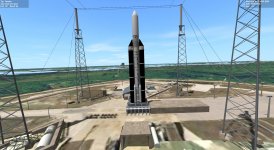
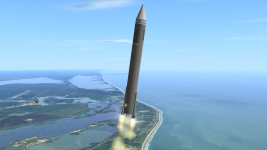
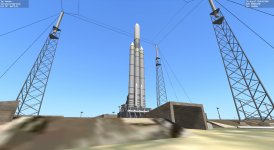
I've gone full Kerbal.

Boosters are two 5 segment SRBs, 4 GEM63XL boosters to help with TWR. 5 segment SRB as the center stage doesn't ignite until after the side boosters burn out. Second stage is famandy's second stage from the awesome Neptune launcher.

Total payload to LEO: 74,000 kg. More than FH.
 

Attachments
  • 0005.jpg
    0005.jpg
    902.3 KB · Views: 47
Last edited:
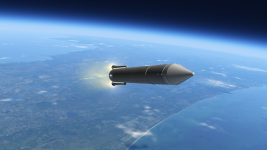
I've gone full Kerbal.

Boosters are two 5 segment SRBs, 4 GEM60XL boosters to help with TWR. 5 segment SRB as the center stage doesn't ignite until after the side boosters burn out. Second stage is famandy's second stage from the awesome Neptune launcher.

Total payload to LEO: 74,000 kg. More than FH.
You get more if you use FWC segments instead of metal.... :sneaky:
 
Well, didn't add more boosters, just replaced them with the Orbital ATK Dark Knight conceptual ones.

Payload to LEO: 105,000 kg, a little less than the Saturn V.

I don't think anything that big would fit inside the payload fairing though! So maybe better suited for interplanetary missions.
 

Attachments

  • 0006.jpg
    0006.jpg
    1.2 MB · Views: 41
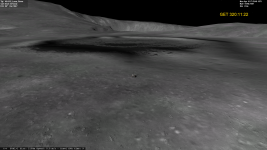
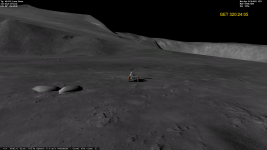
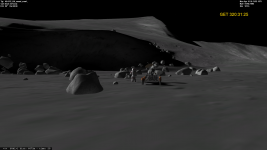
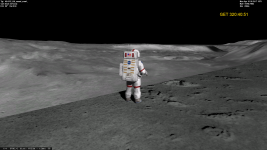
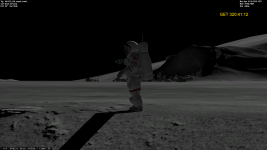
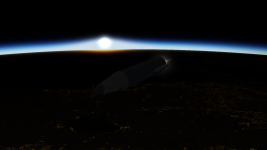
D3D9 terrain flattening allows me to have back the detailed meshes for the Apollo 18 EVA's !
It's seamless when driving around, and not that bad on more distant views.
Very happy for being able to have detailed EVAs in Orbiter 2016. Looking forward to update the Apollo 18 addon ;)

0078.png

0079.png

0080.png

0082.png

0083.png
 
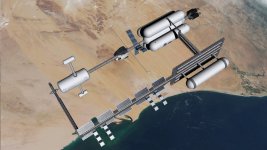
New and improved LDEF
Xltqgym.jpg

ZwV8L56.jpg
 
John,
Did you fix all your RMS problems ?
 
Pioneer 10 Jupiter.png
Pioneer 10 Jupiter 2.png

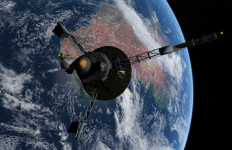
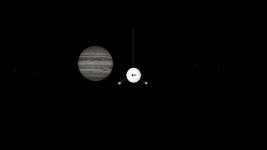
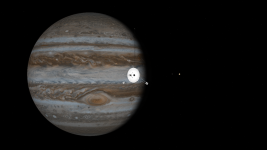
Pioneer 10 at Jupiter. This isn't the most recent Pioneer add-on but the original. Still working on updating the Old-Atlas-Series to Orbiter 2016. I've finished the Atlas Agena, the Atlas ICBMs, and the Atlas Able. I'm currently working on perfecting the Atlas Centaur which is most of the way complete.

I learned two new things actually: The solid fueled kick stage for Pioneer 10 and 11 was a Star 37E, rather than the standard Star 37, and those missions were flown on a direct ascent trajectory to Jupiter, skipping a parking orbit.

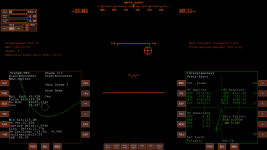
I was able to replicate the direct ascent on Pioneer 10 using Interplanetary MFD:

Pioneer 10 Direct Ascent.png
 
Pioneer P30 Rough Facsimile.png

A rough facsimile of Pioneer P-30 in orbit around the Moon, September 1960.

It was the closest an Atlas Able ever came to succeeding, so I thought it would make an interesting "what if" scenario if the U.S. had managed to put something in lunar orbit 6 years before the U.S.S.R. would do with Luna 10. The spacecraft specs are correct down to the fuel, engine isp, weight, and thrust, but I used the generic Velcro Luna 3 mesh as a placeholder since I don't have a proper mesh for that series of Pioneer spacecraft. The transit time from launch to the Moon was ~64 hours. Insertion into a 6,800km x 7,000km orbit on 90 newtons of thrust takes nearly 22 minutes.
 
View attachment 22868

A rough facsimile of Pioneer P-30 in orbit around the Moon, September 1960.

It was the closest an Atlas Able ever came to succeeding, so I thought it would make an interesting "what if" scenario if the U.S. had managed to put something in lunar orbit 6 years before the U.S.S.R. would do with Luna 10. The spacecraft specs are correct down to the fuel, engine isp, weight, and thrust, but I used the generic Velcro Luna 3 mesh as a placeholder since I don't have a proper mesh for that series of Pioneer spacecraft. The transit time from launch to the Moon was ~64 hours. Insertion into a 6,800km x 7,000km orbit on 90 newtons of thrust takes nearly 22 minutes.
If you want to create a mesh for Pioneer P-30, this image might help:)
Pioneer_P-1_P-3_P-30_P-31.jpg

I think Pioneer 5 is also built in the same model as P-30
 
Back
Top