Updates NPOESS Preparatory Project (Suomi NPP) Updates

IronRain

The One and Only (AFAIK)
Administrator
Moderator
Orbiter Contributor
News Reporter
Donator
Joined
Oct 11, 2009
Messages
3,488
Reaction score
407
Points
123
Location
Utrecht
Website
www.spaceflightnewsapi.net
The NPOESS Preparatory Project (NPP) is a joint mission to extend key measurements in support of long-term monitoring of climate trends and of global biological productivity. It extends the measurement series being initiated with EOS Terra and AQUA by providing a bridge between NASA's EOS missions and the National Polar-orbiting Operational Environmental Satellite System (NPOESS) of the Integrated Program Office (IPO). The NPP mission will provide operational agencies early access to the next generation of operational sensors, thereby greatly reducing the risks incurred during the transition. This will permit testing of the advanced ground operations facilities and validation of sensors and algorithms while the current operational systems are still in place. This new system will provide nearly an order of magnitude more data than the current operational system.

NPOESS will provide long-term systematic measurements of key environmental variables beginning about 2009. In preparation for this system, NPP will provide risk reduction for this future operational system and it will maintain continuity of certain environmental data sets that were initiated with NASA's Terra and Aqua satellites. These measurements will be taken by three different sensors; Visible Infrared Imaging spectroRadiometer Suite (VIIRS), Crosstrack Infrared Sounder (CrIS), and Advanced Technology Microwave Sounder (ATMS). These sensors will collect data on atmospheric and sea surface temperatures, humidity soundings, land and ocean biological productivity, and cloud and aerosol properties. This data will be used for long-term climate and global change studies.

Its launch atop a Delta 2 rocket is scheduled for October 25 during a 9-minute window opening at 2:48 a.m. local time (5:48 a.m. EDT, 9:48 UTC).


npoess-preparatory-project-npp.jpeg
 
Spaceflight Now: Climate satellite moves to California launch base

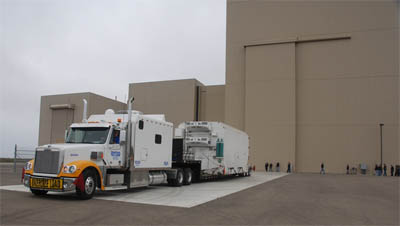
An advanced polar-orbiting weather observatory took a 1,600-mile roadtrip from Colorado to California this week, arriving at the satellite's Vandenberg Air Force Base launch site after the 40-hour journey.

A crew of 16 people including team members from satellite-builder Ball Aerospace and NASA's project group escorted the spacecraft on the long-awaited shipment.

"It was a good trip, no incidents," said Scott Tennant, Ball's program manager. "The guys commented...one-lane construction zones are kind of an adventure when you have a wide payload."

Valued at $1.5 billion, the satellite's mission will continue global weather monitoring and climate data records while covering virtually the entire planet twice per day from its 512-mile-high polar orbit.

{...}

31npp400226.jpg
 
NASA:
Oct. 5, 2011​
MEDIA ADVISORY : M11-208
NASA Announces News Briefing On Next Earth Science Launch


WASHINGTON -- NASA will hold a news briefing on Wednesday, Oct. 12, at 1 p.m. EDT, on the agency's next Earth-observing satellite mission, the National Polar-orbiting Operational Environmental Satellite System Preparatory Project (NPP), scheduled to launch on Oct. 27 from Vandenberg Air Force Base, Calif.

NPP is the first of a new generation of satellites that will observe many facets of our changing Earth. The mission will collect critical data to improve our understanding of long-term climate change and short-term weather conditions. With NPP, NASA continues many key data records of Earth's atmosphere, oceans, vegetation, and ice initiated by the agency's Earth Observing System satellites.

The panelists are:
  • Andrew Carson, NPP program executive, NASA Headquarters
  • Ken Schwer, NPP project manager, Goddard Space Flight Center, Greenbelt, Md.
  • Dr. Jim Gleason, NPP project scientist, Goddard Space Flight Center
  • Dr. Louis Uccellini, director, National Oceanic and Atmospheric Administration's National Centers for Environmental Prediction, Camp Springs, Md.

The briefing will be held in the James E. Webb Auditorium at NASA Headquarters, 300 E St. SW, Washington. {...}

The news conference will air live on NASA Television and the agency's website. For NASA TV streaming video, downlink and scheduling information, visit:


{...}


Here's calendar event for the launch of NPP. You can request a reminder for it here.
 
NASA:
Oct. 12, 2011​
RELEASE : 11-345
NASA Readies New Type Of Earth-Observing Satellite For Launch


WASHINGTON -- NASA is planning an Oct. 27 launch of the first Earth-observing satellite to measure both global climate changes and key weather variables.

The National Polar-orbiting Operational Environmental Satellite System Preparatory Project (NPP) is the first mission designed to collect critical data to improve weather forecasts in the short-term and increase our understanding of long-term climate change. NPP continues observations of Earth from space that NASA has pioneered for more than 40 years.

NPP's five science instruments, including four new state-of-the-art sensors, will provide scientists with data to extend more than 30 key long-term datasets. These records, which range from the ozone layer and land cover to atmospheric temperatures and ice cover, are critical for global change science.

"NPP's observations of a wide range of interconnected Earth properties and processes will give us the big picture of how our planet changes," said Jim Gleason, NPP project scientist at NASA's Goddard Space Flight Center in Greenbelt, Md. "That will help us improve our computer models that predict future environmental conditions. Better predictions will let us make better decisions, whether it is as simple as taking an umbrella to work today or as complex as responding to a changing climate."

NPP serves as a bridge between NASA's Earth Observing System of satellites and the planned Joint Polar Satellite System (JPSS), which will collect climate and weather data. JPSS will be developed by NASA for the National Oceanic and Atmospheric Administration (NOAA).
NOAA meteorologists will incorporate NPP data into their weather prediction models to produce forecasts and warnings that will help emergency responders anticipate, monitor and react to many types of natural disasters.

"The timing of the NPP launch could hardly be more appropriate," said Louis W. Uccellini, director of NOAA's National Centers for Environmental Prediction in Camp Springs, Md. "With the many billion dollar weather disasters in 2011, NPP data is critical for accurate weather forecasts into the future."

A Delta II rocket will carry NPP into an orbit 512 miles above Earth's surface. Roughly the size of a mini-van, the spacecraft will orbit Earth's poles about 14 times a day. It will transmit data once each orbit to a ground station in Svalbard, Norway, and to direct broadcast receivers around the world.

NPP is set to launch from Space Launch Complex 2 at Vandenberg Air Force Base in California on Oct. 27. The launch window extends from 5:48 a.m. to 5:57 a.m. EDT. The launch recently was delayed two days due to the repair of the Delta II's hydraulic system. The NPP spacecraft is scheduled to be transported to the launch pad for attachment to the Delta II on Oct. 12.

NPP's Delta II launch vehicle also will carry several auxiliary payloads into orbit, which together comprise NASA's third Educational Launch of Nanosatellite, or ELaNa, mission. This mission will put five small research payloads, or CubeSats, into orbit: two for the University of Michigan; and one each for Auburn University, Montana State University and Utah State University.

Goddard manages the NPP mission for the Earth Science Division of the Science Mission Directorate at NASA Headquarters in Washington. The JPSS program is providing the ground system for NPP. NOAA will provide operational support for the mission. Launch management is the responsibility of the NASA Launch Services Program at the Kennedy Space Center in Florida.

{...}


SPACE.com: NASA to Launch New Satellite to Track Earth's Weather, Climate
 
Launch slipped by 24 hours due to insufficient time for conducting pre-launch engineering reviews. The new launch time is 02:48 - 02:57 PDT / 09:48 - 09:57 UTC on October 28th.

Source
 
NASA:
Oct. 20, 2011​
RELEASE : 11-357
NASA Invites Twitter Followers to Launch of Earth-Observing Satellite


WASHINGTON -- Twenty lucky followers of NASA's Twitter account will get behind-the-scenes access at the launch of the agency's next Earth-observing satellite mission. They will participate in a daylong Tweetup program at Vandenberg Air Force Base in California on Thursday, Oct. 27 and view the launch of NASA's NPP satellite, which is scheduled to lift off aboard a United Launch Alliance Delta II rocket between 2:48 and 2:57 a.m. PDT on Friday, Oct. 28.

{...}


Latest pictures from NPP processing, from KSC Media Gallery - NPP category, which were added today to the gallery:
[table="head"]{colsp=3}
Click on images to enlarge​

|
|

|
|

|
|

|
|

|
|

|
|

|
|

|
|
[/table]​
 
NPP being encapsulated into fairing

NASASpaceflight: Delta II passes FRR for next week’s NPP (NPOESS Preparatory Project) launch:
The United Launch Alliance (ULA) Delta II launch with the NPP (NPOESS Preparatory Project) satellite has passed through its Flight Readiness Review (FRR) on Friday. The launch from SLC-2W at Vandenberg Air Force Base (VAFB) in California has been set for a launch window which opens at 9:48am GMT on October 28.

{...}


New pictures that appeared today of NPP being encapsulated (Oct. 20):
[table="head"]{colsp=3}
Click on images to enlarge​

|
|

|
|

{colsp=3}
[/table]​
 
Links:


Ascent Timelline:
[table="head;width=500"]
T [MM:SS]
|EVENT

T-00:00​
|Liftoff

{colsp=2}
The Delta 2 rocket's main engine and twin vernier steering thrusters are started moments before launch. Six of the nine strap-on solid rocket motors are ignited at T-0 to begin the mission.


T+01:04.0​
|Ground SRB Burnout

{colsp=2}
The six ground-start Alliant TechSystems-built solid rocket motors consume all their propellant and burn out.


T+01:05.5​
|Air-Lit SRM Ignition

{colsp=2}
The three remaining solid rocket motors strapped to the Delta 2 rocket's first stage are ignited.


T+01:26.0​
|Jettison SRBs

{colsp=2}
The spent solid rocket boosters are jettisoned to fall into the Pacific Ocean. The spent casings remained attached until the vehicle passed into preset drop zone, clear of offshore oil platforms.


T+02:11.5​
|Jettison Air-Lit SRMs

{colsp=2}
Having burned out, the three spent air-started solid rocket boosters are jettisoned toward the Pacific Ocean.


T+04:23.4​
|Main Engine Cutoff

{colsp=2}
After consuming its RP-1 fuel and liquid oxygen, the Pratt & Whitney Rocketdyne RS-27A first stage main engine is shut down. The vernier engines cut off moments later.


T+04:31.4​
|Stage Separation

{colsp=2}
The Delta rocket's first stage is separated now, having completed its job. The spent stage will fall into the Pacific Ocean.


T+04:36.9​
|Second Stage Ignition

{colsp=2}
With the stage jettisoned, the rocket's second stage takes over. The Aerojet AJ118-K liquid-fueled engine ignites for the first of two firings needed to place the NPP spacecraft into the proper orbit.


T+04:41.0​
|Jettison Payload Fairing

{colsp=2}
The 10-foot diameter payload fairing that protected the NPP cargo atop the Delta 2 during the atmospheric ascent is jettisoned is two halves.


T+10:23.7​
|Second Stage Cutoff 1

{colsp=2}
The second stage engine shuts down to complete its first firing of the launch. The rocket and attached spacecraft are now in a long coast period before the second stage reignites. The orbit achieved should be 460 nautical miles at apogee, 100 miles at perigee and inclined 98.655 degrees.


T+52:05.0​
|Second Stage Restart

{colsp=2}
Delta's second stage engine reignites for a short firing to boost the elliptical orbit into a more circular one.


T+52:26.7​
|Second Stage Cutoff 2

{colsp=2}
The second stage shuts down after a 22-second burn. The orbit achieved should be 445.7 nautical miles at apogee, 438.8 miles at perigee and inclined 98.705 degrees.


T+58:45.0​
|NPP Separation

{colsp=2}
The NPOESS Preparatory Project spacecraft for NOAA and NASA is released from the Delta 2 rocket, completing the primary launch sequence.


T+92:30.0​
|Second Stage Restart

{colsp=2}
Delta's second stage engine reignites for 39 seconds to perform its planned evasive maneuver to leave the orbital plane of the NPP satellite, resulting in a new orbit of 437.6 nautical miles at apogee, 183.6 nautical miles at perigee and inclined 101.8 degrees.


T+98:20.0​
|CubeSat Deploys

{colsp=2}
A half-dozen student-made CubeSats are ejected from carriers on the Delta second stage in three deployment events occurring in 100-second intervals. AubieSat 1, DICE, Explorer 1 (Prime) Unit 2, M-Cubed and RAX 2 are part of NASA's Educational Launch of Nanosatellite, or ELaNa.


T+114:58.6​
|Second Stage Restart

{colsp=2}
Delta's second stage engine reignites for 32 seconds to deplete its remaining fuel supply, resulting in a new orbit of 399.0 nautical miles at apogee, 100.1 nautical miles at perigee and inclined 107.5 degrees.
[/table]​


Ground Track:
[table="head"]
Click on image to enlarge​

[/table]​
 
NASA:
Delta II Poised to Launch NPP

Oct 27, 2011

A technological trailblazer is poised to lift off from a California launch pad to take a place in space to show us what is happening on Earth. Known as the NPP, for National Polar-orbiting Operational Environmental Satellite System Preparatory Project, the two-ton spacecraft is destined for an orbit 512 miles above the planet where it will be able to see every part of the Earth.

Because it is going into a polar orbit crossing both the north and south poles while the world spins beneath it, the NPP mission will launch from NASA's Space Launch Complex-2 at Vandenberg Air Force Base in California.

[table="head;width=450"]{colsp=2}
Click on images to enlarge​

|

Image above: The NPP spacecraft stands atop the Delta II rocket that will lift it into Earth orbit.
Photo credit: NASA/Don Kososka, VAFB​
|
Image above: The Delta II rocket stands at Space Launch Complex-2 at Vandenberg Air Force Base, Calif., soon after being assembled. The NPP satellite and payload fairing have not been attached to the rocket yet in this photo.
Photo credit: NASA/VAFB​
[/table]​


NPP has two goals, according to James Gleason, NPP project scientist.

"One is to get the data for the weather forecasts, environmental observations and take a whole suite of observations that continue our satellite data records which span from measuring aerosols, you know, dust particles in the atmosphere, how have they changed over the past decade?," Gleason said. "Is the ground greener or browner over time? Has the sea surface temperature changed? Has the ozone changed? These are all data sets that we have that we have multi-decades sets of data sets and we just want to keep adding to that so we can answer the question, is the climate changing?"

Members of NASA's Launch Services Program, based at Kennedy Space Center, have been working at Vandenberg to get the spacecraft ready to launch on a United Launch Alliance Delta II rocket.

"We began build-up of the vehicle in July of this year, erecting first stage, the nine solid rocket motors, the second stage, putting the payload fairing into the mobile service tower," NASA Launch Director Tim Dunn said.

Once in orbit, the NPP spacecraft is to scan the world with five instruments that track their development through the sensors used on previous Earth-observation missions.

"NPP is a continuation of the earth orbiting satellite systems," Gleason said. "For weather forecasting and for climate predictions, you need to have continuous observations. So what NPP does is continue the data record started by the NASA EOS satellites and improves on the instruments that are used for numerical weather forecasting from the current series of NOAA satellites."

Taking five sensors into orbit lets the spacecraft gather information about a range of aspects of the Earth.

"NPP data will be used by virtually all of the national weather services for all the nations of the world," Gleason said. "And then there are the scientific users who are trying to understand the individual phenomena both at home and abroad."

The instrumentation also requires extra care from the launch team in the time leading up to liftoff.

"Every mission has its own set of challenges, you know, what's challenging about NPP is the fact we have five instruments," said Bruce Reid, NASA's mission manager for NPP. "Some spacecraft have one instrument. And every mission has to go through environmental testing, so now you have to go through environmental testing with five different instruments, which all carry their own set of requirements and restrictions."

With months of preparations behind them, the launch teams will assemble on launch day expecting the payoff of a successful liftoff to begin the NPP's five-year mission.

"By the time you get there on launch day, it's kind of like you've planned a trip and you've packed for the trip and all you have left to do is gas and go," said Bruce Reid, "So that's what we do on launch day, we load the rocket with fuel and liquid oxygen and then we do our final avionics and electrical checks and we push the button and we sit on the edge of our seats."

{...}


SPACE.com: NASA to Launch Trailblazing Weather & Climate Satellite Friday
 
NPP Launch: Intro to Coverage


Delta II processing flow
[ame="http://www.youtube.com/watch?v=DmqDP-3Kkck&feature=feedu"]ksc_102811_npp_flow.mov - YouTube[/ame]
 
Delta II with NPP successfully launched this morning. NPP is now in the coast phase
 
Launch video

[ame="http://www.youtube.com/watch?v=cg9Z0-WEQIQ&feature=feedu"]NPP Launch - YouTube[/ame]
 
Goodbye Delta II, another rocket out of service.
Thanks for all the launches, especially the interplanetary missions:hailprobe:
 
Back
Top