

Turbinator
New member
Where there ever any other atmospheric probes ever sent to either Jupiter, Saturn, Uranus, or Neptune.
Other than the Galileo probe that "landed" on Jupiter?
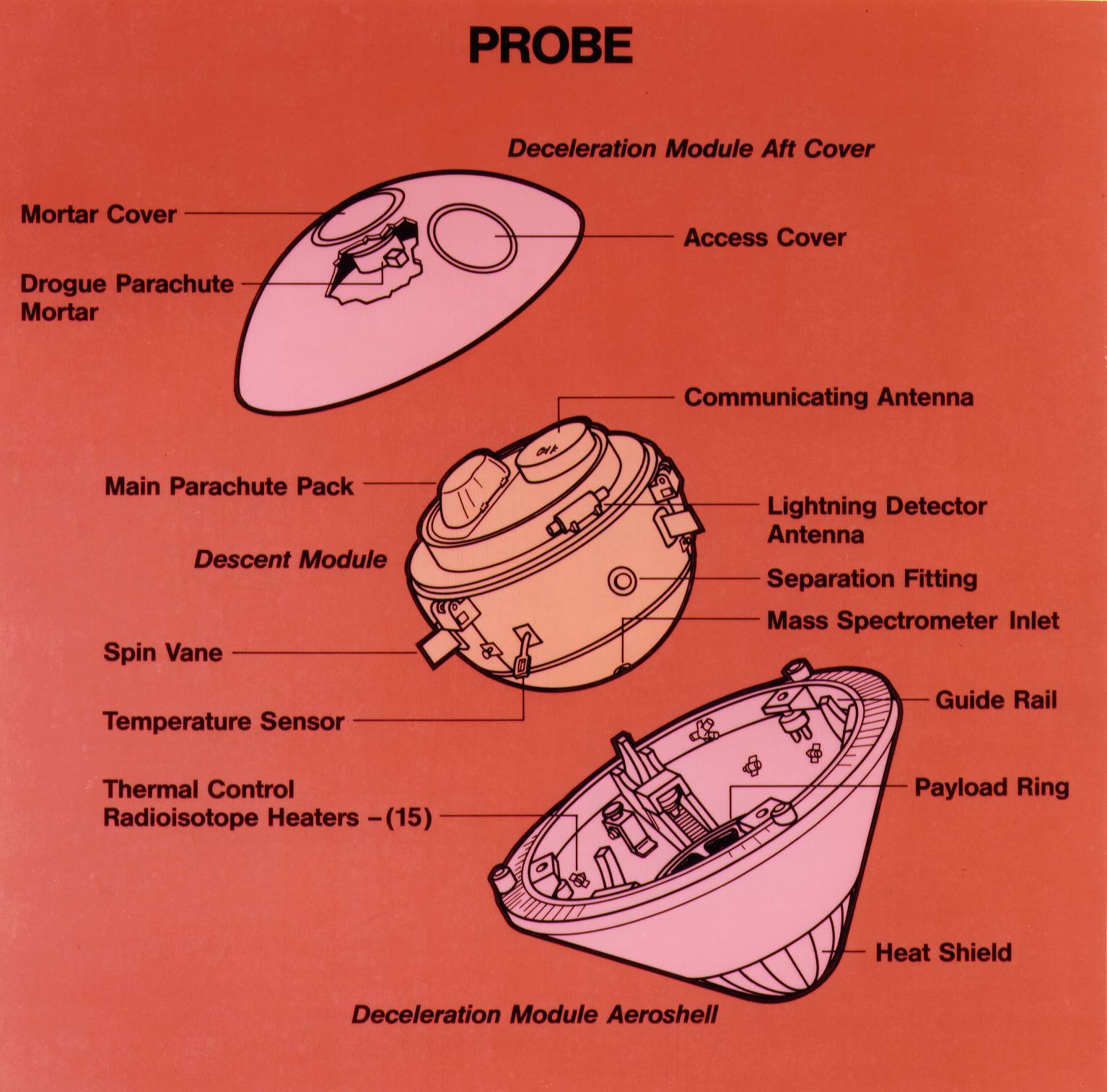
Some quick info:
The probe included six instruments for taking data on its plunge into Jupiter:
Total data returned from the probe was about 3.5 megabits. The probe stopped transmitting before the line of sight link with the orbiter was cut. The likely proximal cause of the final probe failure was overheating, which sensors indicated before signal loss. The atmosphere through which the probe descended was somewhat more turbulent and hotter than expected. The probe was eventually completely destroyed as it continued to descend. The parachute would have melted first, roughly 30 minutes later,[31] then the aluminum components after another 40 minutes of free fall. The titanium structure would have lasted 6.5 hours more before disintegrating. Due to the high pressure, the droplets of metals from the probe would finally have vaporised once their critical temperature had been reached, and mixed with Jupiter's liquid metallic hydrogen interior.
http://en.wikipedia.org/wiki/Galileo_(spacecraft)#Galileo.27s_atmospheric_entry_probe
Other than the Galileo probe that "landed" on Jupiter?
Some quick info:
The probe included six instruments for taking data on its plunge into Jupiter:
- an atmospheric structure instrument group measuring temperature, pressure and deceleration,
- a neutral mass spectrometer and
- a helium-abundance interferometer supporting atmospheric composition studies,
- a nephelometer for cloud location and cloud-particle observations,
- a net-flux radiometer measuring the difference between upward and downward radiant flux at each altitude, and
- a lightning/radio-emission instrument with an energetic-particle detector that measured light and radio emissions associated with lightning and energetic particles in Jupiter's radiation belts.
Total data returned from the probe was about 3.5 megabits. The probe stopped transmitting before the line of sight link with the orbiter was cut. The likely proximal cause of the final probe failure was overheating, which sensors indicated before signal loss. The atmosphere through which the probe descended was somewhat more turbulent and hotter than expected. The probe was eventually completely destroyed as it continued to descend. The parachute would have melted first, roughly 30 minutes later,[31] then the aluminum components after another 40 minutes of free fall. The titanium structure would have lasted 6.5 hours more before disintegrating. Due to the high pressure, the droplets of metals from the probe would finally have vaporised once their critical temperature had been reached, and mixed with Jupiter's liquid metallic hydrogen interior.
http://en.wikipedia.org/wiki/Galileo_(spacecraft)#Galileo.27s_atmospheric_entry_probe


