

orbekler
Member
- Joined
- Nov 25, 2010
- Messages
- 340
- Reaction score
- 0
- Points
- 16
Hello, I have a question about the Surface Launch program of IMFD.
Scenario: XR-5 Ready for takeoff to the ISS (target changed to moon).
Guideline: IMFD Full Manual, page 93, Tutorial #2—Mars to Phobos
I activated the Surface Launch program, and following the tutorial, I waited until EIn was nearly 0.
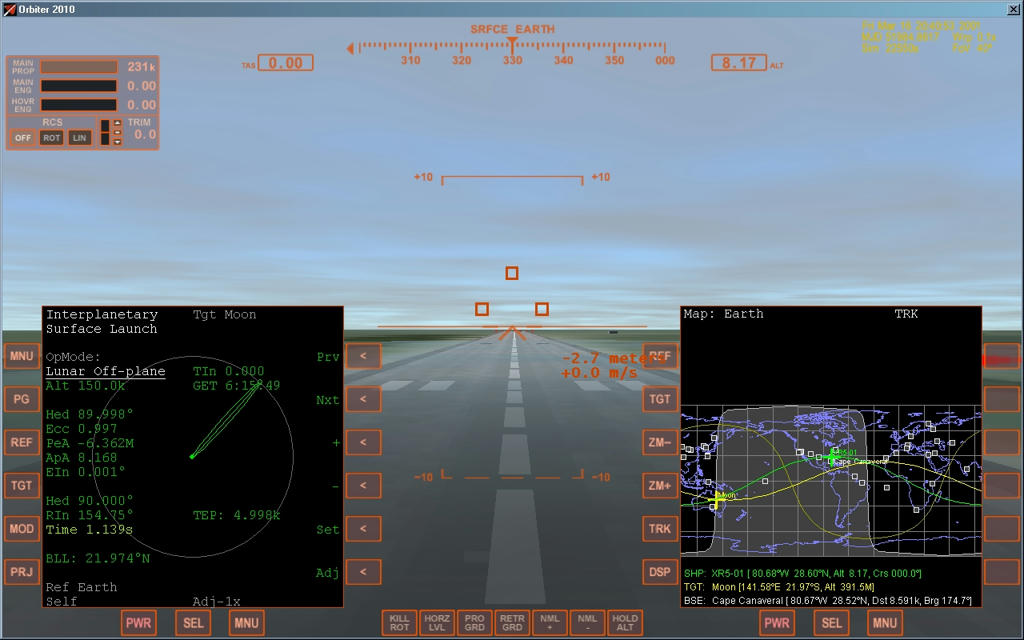
Then I began the climbup with a heading of ~90°, and added side shift to mantain EIn=0.
LEO completed, RInc with the moon was about 25°.
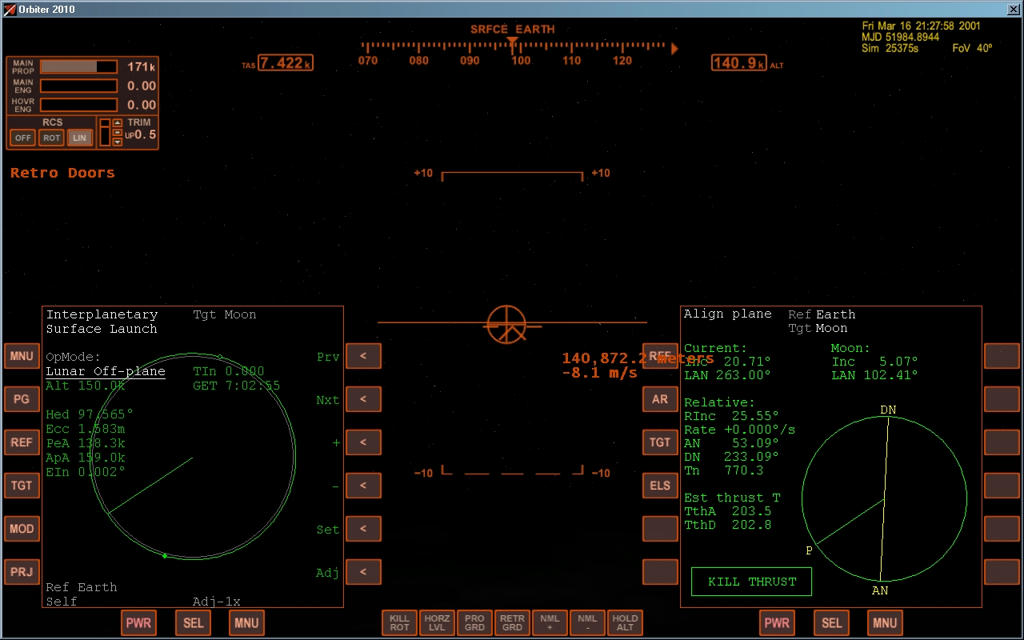
The Course Target Intercept program set to Source-Plane calculated about 6.1k of total dV (PlC included, Off-Plane was about 13k - EjA~85°!!!).
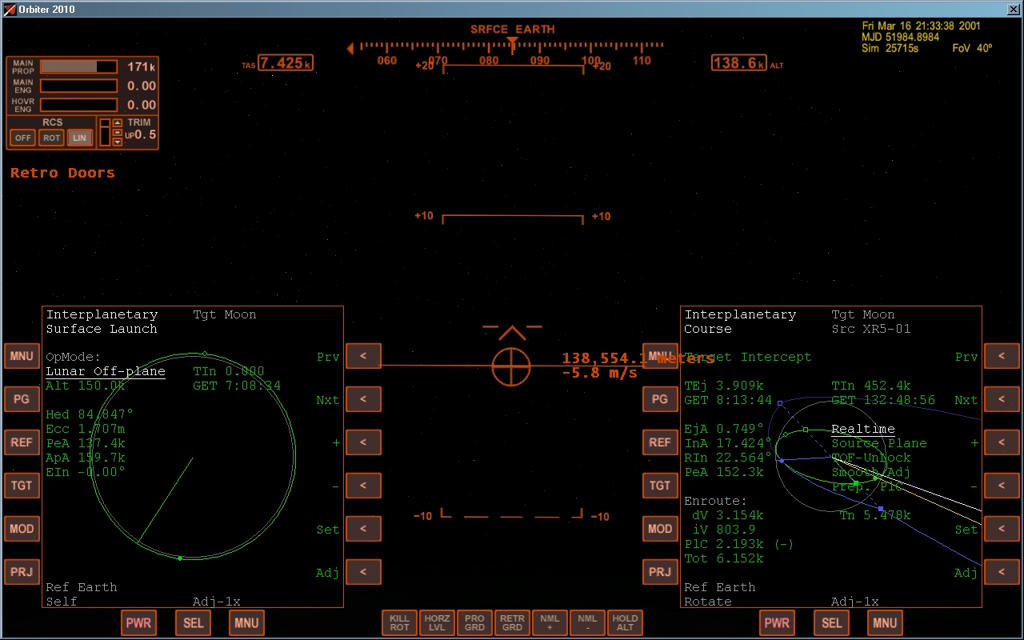
I repeated once again the same Scenario, but this time I just used Map and Align MFDs, awaited when RInc was at his minimum (~5.8°, about 4 hours later than time indicated by Surface Launch), began climbup with a heading of 90°, and mantained RInc of about 5.8°.
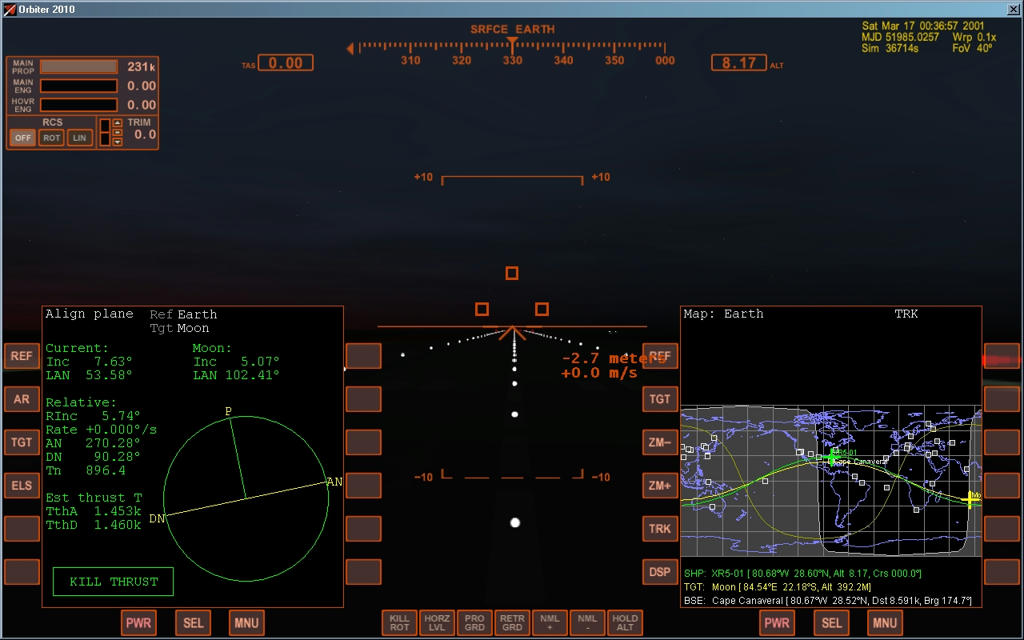
The Course Target Intercept program this time calculated about 4.4k of total dV, making a pretty substantial difference in dV from the first try.
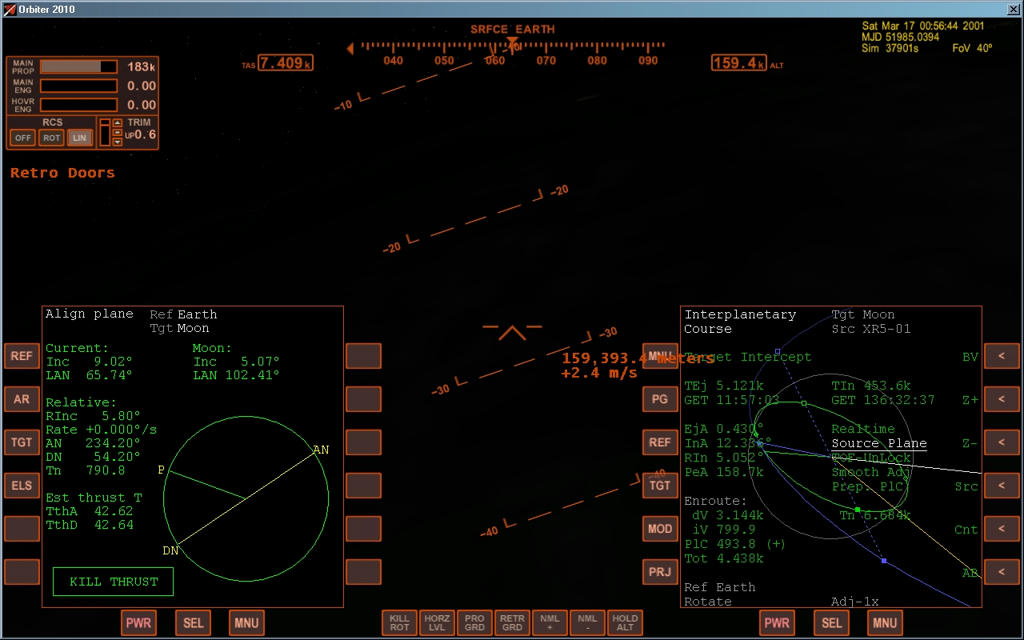
My question is: Surface Launch program should find the first best possible launch window, but just referred to the best latitude (BLL), or also from the current latitude? In this case, why RInc is much greater with Surface Launch?
Also, it seems there was a small difference between IMFD and Align MFD RInc (about 3° in the first example and 2° in the second).
Scenario: XR-5 Ready for takeoff to the ISS (target changed to moon).
Guideline: IMFD Full Manual, page 93, Tutorial #2—Mars to Phobos
I activated the Surface Launch program, and following the tutorial, I waited until EIn was nearly 0.
Then I began the climbup with a heading of ~90°, and added side shift to mantain EIn=0.
LEO completed, RInc with the moon was about 25°.
The Course Target Intercept program set to Source-Plane calculated about 6.1k of total dV (PlC included, Off-Plane was about 13k - EjA~85°!!!).
I repeated once again the same Scenario, but this time I just used Map and Align MFDs, awaited when RInc was at his minimum (~5.8°, about 4 hours later than time indicated by Surface Launch), began climbup with a heading of 90°, and mantained RInc of about 5.8°.
The Course Target Intercept program this time calculated about 4.4k of total dV, making a pretty substantial difference in dV from the first try.
My question is: Surface Launch program should find the first best possible launch window, but just referred to the best latitude (BLL), or also from the current latitude? In this case, why RInc is much greater with Surface Launch?
Also, it seems there was a small difference between IMFD and Align MFD RInc (about 3° in the first example and 2° in the second).


