
Get Time to a given distance

Topper

Addon Developer
Addon Developer
Donator
Joined
Mar 28, 2008
Messages
671
Reaction score
32
Points
43
Hi one question:
When
V0 - Speed relativ to given point
s - distance to a given point
a - constant acceleration, (positiv, negativ or 0)
are given,
how can I calculate the time to pass the point in a common formula?

I have found the formula
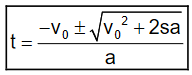
1624892871228.png

but I don't guess it's corect for this case because if a = 0, I have a problem...
 
Hi one question:
When
V0 - Speed relativ to given point
s - distance to a given point
a - constant acceleration, (positiv, negativ or 0)
are given,
how can I calculate the time to pass the point in a common formula?

I have found the formula

View attachment 25789

but I don't guess it's corect for this case because if a = 0, I have a problem...
1) You need to check if a = 0
If YES, then: t = s / V0
(if t is negative, you are moving away from the given point and will not arrive there)

2) If a is not 0, you can use the formula you found - but you need to check if: (VO^2 + 2sa) >= 0
If NO, then you will not arrive at the given point.

3) I think only positive values of t are valid solutions (two positive solutions means you will travel past the given point and then return there) - but I'm not sure about that!

EDIT: I suppose you can think of negative t as indicating that you were at the given point in the past)

Cheers,
Brian
 
Last edited:
Some answers here already, but I'll give my own too:

The equation you have (\( t=\frac{-v_0 \pm \sqrt{v_0^2+2as}}{a} \)) is the equation from Marijn (\( s=v_0 t + \frac{1}{2}a t^2 \))[1] solved for \(t\) using the quadratic formula. By using the quadratic formula, you have already "stated" that you have a quadratic equation (i.e. that \(a \neq 0\), because if \(a = 0\) you don't have a quadratic equation anymore).
If \(a = 0\), you can see that the kinematic equation reduces to \( s = v_0 t \), for which the time is easily solvable.

Also, as BrianJ mentions, you have to be sure that the square root is positive. A negative square root states that you will never reach the desired state that you are trying to solve for. An example is that if you tried to solve for a throw of a ball, solving for at what time the ball would be at an altitude of 1 km. Of course your arm is too weak / gravity too strong to throw that high, and you will never reach the wanted altitude, before the ball fall backs towards the earth. This is represented by the resulting square root of a negative number, i.e. undefined solution of \(t\).

[1]: A fairly standard formula, a part of the kinematic equations. Comes from integrating acceleration to find the speed, and integrating the resulting speed to find the distance.
 
Ok that answers my questions thank you!
 
Back
Top