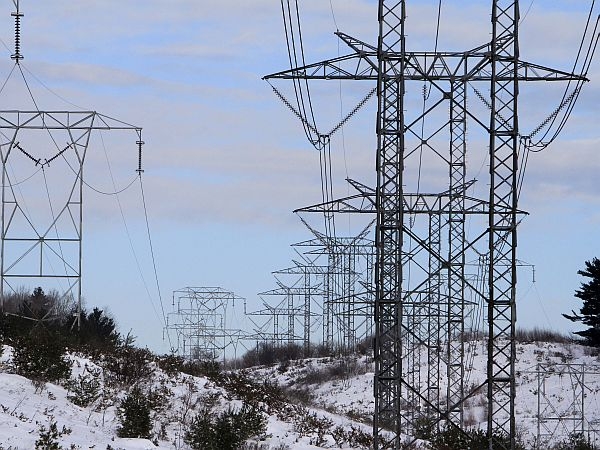
Next-generation electricity pylons unveiled

Some of them look really feasible, but most should better remain in a museum.
 
Why is there so much design in them?
It's a workhorse piece of engineering, there is no place for design in it.
 
3029787271_fb4a116b06.jpg


---------- Post added at 04:02 PM ---------- Previous post was at 04:01 PM ----------

Why is there so much design in them?
It's a workhorse piece of engineering, there is no place for design in it.

Is this why the Russian and the US space hardware looks so much different from one another?
I always found Russian space probes to have this certain feel to them, I can't put it in to words.
 
Is this why the Russian and the US space hardware looks so much different from one another?
I always found Russian space probes to have this certain feel to them, I can't put it in to words.

It is form follows function. In both cases.

Western hardware uses vacuum hardened electronics, old soviet hardware had pressurized gas-cooled electronics. So, with this single technological difference between both (The soviets had more experience and confidence in the heavier but cheaper electronics modules), you already changed the shape of the spacecraft completely.
 
Electrical cables should be buried, not strung up across the landscape as easy targets for tornadoes, lightning, snow and ice.
It's not always feasible to bury them--in low-lying areas, it's better to have them strung up.

Also, you must construct additional pylons.
 
That's how we do it in Canada. The cables are underground.


God I hate this edit text thingy bellow.
||
||
\/
 
Last edited:
Design is engineering, just because it looks beautiful, doesn't mean that it won't do its job.

Based on wait I see, nothing really bold about them. It looks like that they are only in small scale testing. Large scale testing would possibly present issues to some of them.

It is possible that they will find unusual properties in the tower design that are highly desirable.

Also it is not always feasible to run power cables underground. Not only is it expensive, the losses can be orders of magnitude higher. This is because of the potential of the ground.
 
Some nice designs there. I would like to see the ones that don,t stand out too much and are not so noticeable. Some of these are just asking to be climbed up though.
 
It's a workhorse piece of engineering, there is no place for design in it.

There is a place for design anywhere, if you have the spare money to pay for it. Of course the form is in no way allowed to impair the function, but that still leaves you a lot of room to make stuff look good. And for something as prominent as electricity pylons, it is worth thinking about it. Once the design is finished, mass production is not even neccesarily more expensive.

In some instances, design can even move technology forward, especially in apliances. The touchscreen wouldn't be as prominent today as it has become if not for designers that pushed it. Most engineers were perfectly content with a keypad. The same goes for the computer mouse, by the way, which was laughed on by Xerox computer engineers, and it took apple, who had a broader perspective, to rip it off, interfaces and all, to make it an established input device. The engineers saw absolutely nothing wrong with using the keyboard for everything. After all, it works...
 
"...dancing across the landscape..."? Sounds like some hippie stuff to me.
Honestly I don't care what they look like. All I want is for the enegy generated by my turbine-generator to pass through a step-up transformer, through an sf6 breaker, out past the disconnects and onto the grid.
That's an over-simplification, but, hey...

What is the most common sized transmission lines in the UK? Our 500KV lines require 11 foot insulators (4 ft for 161), and there is some loud talk from some to upgrade to a 750 KV system. That would be a drastic hit to the wallet to change out transmission towers if they were all pieces of artwork as well.
 
Re: work of art - look at Roman aqueducts, and always remember Isambard Brunel.

I have even come across an album of transmission line overpasses; there are numerous albums of bridges. I'd definitely like towers to be as cheap as possible (hence, durable, cheap to manufacture and maintain), and reasonably aesthetically pleasing. Tupolev used to say that a plane must look good to fly well.
 
I enjoy the design of the pylon in the OP's video thats shaped like a an arc, which stand as two seperate pylons. I think the older pylons are quite ugly and any improvement over them I think is a good idea.
 
Some of those designs look they would have lot more wind loads on them than traditional lattice pylons

I'd say if you are accepting more expensive pylons, better invest that money into making them and transmission lines stronger to better stand up to storms, ice, snow and what not. Who cares how the pylon looks if it fails in a storm cutting your electricity supply.

Besides I often find industrial hardware that's designed for maximum functionality with no thought about how it will look to have some cool astheatics.
 
Will those work on other planets ? :lol:

I don't get it. Is this an art project or an engineering one? They may look good, but some of them are non-functional and a maintenance nightmare. If they really wanted to pack them all into a smaller shape, I'm sure there are more efficient ways of doing it.

Pylons have a huge impact on landscape. The artistic dimension is there to limit this impact. The problem is that the value of art is often quite subjective.

Of course, burying cables is the ultimate solution (or maybe microwaves), but the cost is prohibitive on long distance (imagine digging trenches all over Siberia's permafrost with dynamite to connect some little towns...)
 
Back
Top