Math Interesting Geometry Problem

fireballs619

Occam's Taser
Donator
Joined
Nov 4, 2009
Messages
788
Reaction score
4
Points
33
I was given this geometry problem a few months ago, and was never able to quite solve it. I figured you all would enjoy it too, so here it is.

Take a rectangle with side lengths of 3 and 5. Taking the opposite corners of this rectangle, fold them so they meet. What is the length of the crease you just formed?

This can easily be visualized by folding a 3x5 notecard in the manner described above. I have come very close to solving this, but one assumption I made threw me off. Anyone here able to get a solution? Be sure to share how!

EDIT: Also, it must be exact, not a decimal approximation. That means no rulers! (cough Kaito cough)
 
Last edited:
Oh thats easy. Just take a 3x5 note card, fold the corners together, crease it, and take a ruler to it :P

On a serious note, I have not a clue, although I would like to know
 
3 / (Cos(Atan(3 / 5)) ???

How do you figure this? I can't see how you got it, but, then again, my trig isn't that great.

EDIT: That sounds about right though. The decimal aproximation comes out right around where it should, so I am really interested in seeing how you came to that!
 
Last edited:
Yeah, okay.

The angle of the crease is going to be the same if you fold it from corner to corner or by bringing two opposite corners together (except it is across the paper), so I just sneered at that red herring and went ahead and calculated the angle of a 3 x 5 triangle.

Atan(3 / 5)

Then, you want the length of the hypotenuse of a triangle that has an adjacent base of 3 with an angle of 31º (aprox).

3 / Cos(31º).

That's all.
 
Last edited by a moderator:
Yeah, okay.

The angle of the crease is going to be the same if you fold it from corner to corner or by bringing two opposite corners together, so i just sneered at that red herring and went ahead and calculated the angle of a 3 x 5 triangle.

Atan(3 / 5)

Then, you want the length of the hypotenuse of a triangle that has an adjacent base of 3 with an angle of 31º (aprox).

3 / Cos(31º).

That's all.


I'm afraid I don't follow. Where does this 3x5 triangle come from that you are referring to? Do you mean a triangle of side lengths 3 and 5, because I don't see how you could get that from folding the note card.

---------- Post added at 05:58 AM ---------- Previous post was at 05:19 AM ----------

Okay, I just got the same answer using a Euclidean approach. There is one part that was sketchy. Can someone help me solve this equation?

[math]5-x=sqrt(x^2+9)[/math]

Wolfram gave me an answer of x = 8/5, but I have no clue how. If I get this, I will have this solved :thumbup:

EDIT:With a little help, I got that one. If anyone wants, I can post the euclidean approach (or at least I think it is) tomorrow.
 
Last edited:
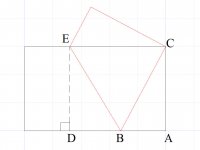
Drawing things always makes things clearer. :)
5X3.jpg
 
I'd be intersted in the explanation, did some working in LaTex

[math]
5-x=sqrt(x^2+9)
[/math]

Squaring both sides
[math]
5-x \left( 5-x \right) ={x}^{2}+9
[/math]

expanding the brackets
[math]
25-10\,x+{x}^{2}={x}^{2}+9
[/math]

Cancelling out the x squareds, and moving the 25 to the right side.
[math]
-10\,x=-16
[/math]

so,
[math]
x=8/5[/math]

Got the same answer, but of course, I don't know why I'm doing this...?

N.
 
so,
[math]
x=8/5[/math]

Got the same answer, but of course, I don't know why I'm doing this...?

N.

The lenght of BC is: [math]30-8/5[/math] :thumbup:

---------- Post added at 02:04 PM ---------- Previous post was at 01:53 PM ----------

I went the direct way.

a² = b² + c² and a + c = 5 and b = 3

a² = 3² + (5 - a)²

a² = 9 + 25 + a² - 10a

a = 3.4

That makes c = 5 - 3.4 = 1.6 :)
 
Last edited:
Unless im mistaking...if you fold the opposite corners of a 3x5 notecard together, wont the crease NOT go through the other corners of the notecard? This is where I'm getting confused with a "simple triangle"...
 
Unless im mistaking...if you fold the opposite corners of a 3x5 notecard together, wont the crease NOT go through the other corners of the notecard? This is where I'm getting confused with a "simple triangle"...

Exactly. Look at the attached file in my previous post. You have to figure out 2 simple triangles. :)

Noone got the final result yet?

---------- Post added at 03:48 PM ---------- Previous post was at 03:08 PM ----------


In my previous post we found:
BC = 3.4
AB = 1.6

The highlightet triangles are equal (mirrored)
EC = AB =>
GE = 5 - AB =>
DB = 5 - GE - AB = 5 - 1.6 - 1.6

EB² = 3² + (5 - 1.6 - 1.6)² =>
EB = SQRT12.24 = 3.4986

---------- Post added at 04:23 PM ---------- Previous post was at 03:48 PM ----------

You can "construct" the figure this way. It can help understanding the solution.
 
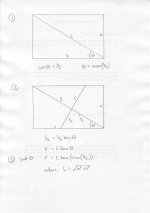
By knowing that the fold must be a perpendicular bisector of the diagonal and doing some simple trig on the triangles produced I got

f = l tan(acos(b/l))

where

f = length of fold

a = short side, b = long side

l = sqrt(a^2 + b^2) = length of diagonal

When a=3 and b=5 the result is 3.4986
 
Last edited:
I got that result last night, but was to tired to post the final solution. Here is mine, all the way through. I apologize for any pictures that may be unclear, but I am not used to the program I am using.

First we fold the notecard, getting line EF, as seen below.

picture.php


Lets fill in a few values, shall we? I will just list them here, but if you are confused, be sure to ask. For clarity's sake, the smaller segments of BE and FD will be named x.
[math] BE=x[/math]

[math]FD=x[/math]

[math]AF=5-x[/math]

[math]EC=5-x[/math]

[math]BA=3[/math]

[math]CD=3[/math]

[math]EC=FC [/math]

Now, you may be confused as to how I came to that final conclusion, so let me edit our diagram.

picture.php


You can now see that both EC and FC are radii of the circle C, and are therefore the same lenght. But there is more we can determine about FC!

FC is the hypotenuse of triangle FCD, and therefore it's length can be determined through the Pythagorean theorem.

[math]FD^2+CD^2=FC^2[/math]
plugging in the values we determined earlier;
[math]x^2+3^2=FC^2[/math]
[math]x^2+9=FC^2[/math]
[math]sqrt(x^2+9)=FC[/math]

We can now create an equation to find x, from what we have deduced thus far.
[math] EC=FC[/math]
[math]5-x=sqrt(x^2+9)[/math] (this is where I got stuck yesterday)
[math]5-x (5-x)=x^2+9[/math]
[math]25-10x+x^2=x^2+9[/math]
[math]25-10x=9[/math]
[math]-10x=-16[/math]
[math]x=8/5[/math]

Now that we have x (which is 1.6, as C3P0 got), we must form an equation to plug it into. Let me add to our diagram again, to better explain my process.

picture.php

(note that I took the circle out, just so it didn't get too cluttered.

As you can see, I dropped in a line through point F, perpendicular to line BC. Let us fill in values again.

[math]FG=3[/math]

[math]GC=x[/math]

[math]EG=5-2x[/math]

We know that GC is x, since it forms rectangle FDCG. The opposite side of FD is also x, so there fore GC must also be, too. Doing this, we have formed triangle FGE, where the hypotenuse, EF, is also the crease. We can find it through the Pythagorean theorem. First, let's plug in for x in line segment EG.

[math]5-2x=EG[/math]
[math]5-2(8/5)=EG[/math]
[math]5-(16/5)=EG[/math]
[math]9/5=EG[/math]

So now, to find the hypotenuse, we must simply do the following equation.

[math]EG^2+FG^2=EF^2[/math]
[math](9/5)^2+3^2=EF^2[/math]
[math](81/25)+9=EF^2[/math]
[math](306/25)=EF^2[/math]
[math](3sqrt34)/5=EF[/math]

So, for our final solution, we have;

[math](3sqrt34)/5=EF[/math]

Now that I have that solved, I'm off to generalize! :thumbup:
Thanks for the help all, it was an interesting one.

Also, C3P0 (if you read this far :lol:), what program were you using in your pictures? It looks pretty nice :thumbup:

 
I made those in TurboCAD Designer v5 (very old :lol:)
http://www.imsidesign.com/

Do you use an editor for the equations, or have you memorized the LaTex codes? :rofl:
I'll have to look at streb's solution. I missed that those two were perpendicular.:facepalm:
 
I made those in TurboCAD Designer v5 (very old :lol:)
http://www.imsidesign.com/

Do you use an editor for the equations, or have you memorized the LaTex codes? :rofl:
I'll have to look at streb's solution. I missed that those two were perpendicular.:facepalm:

I'll look into that :thumbup:

I've memorized the LaTex (which I suppose is a bit depressing that I have done so :lol:). I don't really understanf streb's solution, since I have yet to take trig, but it makes me eager to, since it is such a simple solution.
 
Fireballs, here is my solution. Trigonometry is really easy, at my basic level anyway! Sorry it is handwritten but I don't have MiKTeX installed.

s2k1

ps. forgot to indicate on the diagram that f and l are perpendicular...
 

Attachments

  • fold.JPG
    fold.JPG
    131.4 KB · Views: 15
Double? Nah, tripple!!! :facepalm::facepalm::facepalm:

½f=½d x tan(acos(5-d)) =>

f = d x tan(acos(5-d))

Simple, eh? :lol:
 
Fireballs, here is my solution. Trigonometry is really easy, at my basic level anyway! Sorry it is handwritten but I don't have MiKTeX installed.

s2k1

ps. forgot to indicate on the diagram that f and l are perpendicular...

Thanks much! One question, however. How do you know that the two lines bisect each other?
 
Thanks much! One question, however. How do you know that the two lines bisect each other?

Because folding on the other diagonal will produce a symetric mirror image, and diagonals cross in the middle. :)
 
I suppose it is strictly an assumption. I just reckoned that the fold would naturally be mid-way between the points so bisecting the diagonal and that the "hinge" of the fold must be perpendiculat to the diagonal otherwise the points would not meet!

Your solution is probably more rigorous though.
 
Back
Top