
You are using an out of date browser. It may not display this or other websites correctly.
You should upgrade or use an alternative browser.
You should upgrade or use an alternative browser.
Updates Orion (MPCV) Updates and Discussion
- Thread starter apollo13
- Start date

Phillips
Regular witty saying title.
- Joined
- Jan 4, 2011
- Messages
- 46
- Reaction score
- 0
- Points
- 0
Thought I'd bring this up, but with the space shuttle being close to retirement, and STS-133 tomorrow, what will the Orion launch vehicle be? Will it be a CCDev rocket like the new Liberty that uses the Ares I first stage and the Ariane 5 2nd stage? Also, what about Lockheed Martin's Orion Delta IV Heavy test? I read United Launch Alliance was working on an emergency detection system for the DIVH.
The Liberty seems like an intresting one, seeing as a test launch wouldn't be full of planning and dummy stages, like Ares I-X. Seeing as the Ares I first stage has been partly used and tested, im wondering if liberty is using the Ares I 5 ring SRB or whatever it was called. And the Ariane 5's 2nd stage being used as the 2nd stage on Liberty seems fine, as it has been used 200 times now.
I've also read that Obama has cancelled the Moon return on constellation, but is focusing on landing on Mars and Astroids. A problem would be the cargo, on the Astroid mission, 2 orions would be used, but on the Mars mission, NASA needs a mars lander. And with the Ares V cancelled, there arent much launch vehicles that can launch a heavy payload into orbit.
The Liberty seems like an intresting one, seeing as a test launch wouldn't be full of planning and dummy stages, like Ares I-X. Seeing as the Ares I first stage has been partly used and tested, im wondering if liberty is using the Ares I 5 ring SRB or whatever it was called. And the Ariane 5's 2nd stage being used as the 2nd stage on Liberty seems fine, as it has been used 200 times now.
I've also read that Obama has cancelled the Moon return on constellation, but is focusing on landing on Mars and Astroids. A problem would be the cargo, on the Astroid mission, 2 orions would be used, but on the Mars mission, NASA needs a mars lander. And with the Ares V cancelled, there arent much launch vehicles that can launch a heavy payload into orbit.
Phillips
Regular witty saying title.
- Joined
- Jan 4, 2011
- Messages
- 46
- Reaction score
- 0
- Points
- 0
Really? I thought NASA proposed a HLV and complained it couldnt reach the goal, or will the launch vehicles be proposed some time in this year in April, IIRC.Launch vehicle has not been decided yet.


Star Voyager
Space Shuttle Refugee
- Joined
- Oct 25, 2008
- Messages
- 1,980
- Reaction score
- 38
- Points
- 48
Now we're talking!
diogom
Well-known member
- Joined
- Aug 2, 2010
- Messages
- 1,556
- Reaction score
- 911
- Points
- 128
- Website
- github.com
- Preferred Pronouns
- he/him
I think this should come here:
NASA Announces Key Decision For Next Deep Space Transportation System
http://www.nasa.gov/home/hqnews/2011/may/HQ_11-164_MPCV_Decision.html
NASA Announces Key Decision For Next Deep Space Transportation System
http://www.nasa.gov/home/hqnews/2011/may/HQ_11-164_MPCV_Decision.html

- Joined
- Oct 11, 2009
- Messages
- 3,488
- Reaction score
- 407
- Points
- 123
- Location
- Utrecht
- Website
- www.spaceflightnewsapi.net
The NASA twitter says the following:
Is it really Charlie Bolden who makes the final call or do they vote?
Charlie Bolden decided to use Orion for MPCV development.
Is it really Charlie Bolden who makes the final call or do they vote?

Spaceflight Now

[FONT=VERDANA, ARIAL, HELVETICA, SANS-SERIF][SIZE=+2]NASA selects Orion moon ship as exploration capsule[/SIZE][/FONT]
[FONT=VERDANA, ARIAL, HELVETICA, SANS-SERIF][SIZE=-2]BY STEPHEN CLARK
SPACEFLIGHT NOW
Posted: May 24, 2011
[/SIZE][/FONT]NASA announced Tuesday the design of a new deep space exploration capsule will be based on the canceled Orion vehicle, a spacecraft in which the space agency has invested more than $5 billion since 2006.

[FONT=Verdana, Arial, Helvetica, sans-serif][SIZE=-2]Artist's concept of an Orion-based crew capsule in orbit around Mars. Credit: NASA
[/SIZE][/FONT]But despite the capsule's familiar design, a senior NASA official could not say when the Multi-Purpose Crew Vehicle would be ready to carry astronauts into space or how much it will cost. "In terms of deep space exploration, we hope to have test flights in this decade," said Doug Cooke, the chief of NASA's exploration division. "We're not exactly sure when, but certainly as early possible."
Lockheed Martin Corp., the Orion spacecraft's prime contractor, says the MPCV could be ready for initial crewed operations in low Earth orbit by 2016. But Cooke did not specify a timetable for Orion's readiness.
NASA is still reviewing plans for a heavy-lift launch vehicle to send the MPCV toward distant destinations. Called the Space Launch System, or SLS, the powerful booster must boost 130 metric tons into low Earth orbit under a mandate set by Congress.
Cooke said NASA is on track to finish those studies and select a reference design for the SLS in the "early summer" of this year. Accurate cost and schedule estimates will not be available until NASA settles on a design for both the crew capsule and heavy-lift rocket, Cooke said.
"We still have to do the integrated cost and schedule to understand the phasing of it, and that will affect how much it ultimately costs," Cooke said. "We have to work an integrated approach with both vehicles."
In the wake of the Constellation program's cancellation, NASA is turning to commercial spacecraft to carry astronauts into low Earth orbit following the retirement of the space shuttle. The agency expects to have one or more privately-owned space systems ready for transportation services by 2015 or 2016.
While the White House directed NASA to invigorate the commercial market, Congress struck a compromise for the agency to kick off development of a new rocket and capsule to take the place of the Ares launcher family and Orion spacecraft from the ill-fated Constellation moon program.
"The NASA Authorization Act lays out a clear path forward for us by handing off transportation to the International Space Station to our private sector partners, so we can focus on deep space exploration," said NASA Administrator Charles Bolden. "As we aggressively continue our work on a heavy-lift launch vehicle, we are moving forward with an existing contract to keep development of our new crew vehicle on track."
NASA and Lockheed Martin are working on efficiency initiatives to reduce the ultimate cost of the MPCV, officials said.
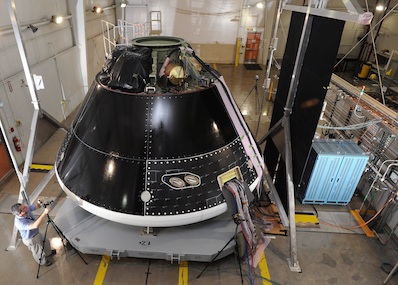
[FONT=Verdana, Arial, Helvetica, sans-serif][SIZE=-2]An Orion ground test article is being tested at Lockheed Martin's facility in Denver. Credit: Lockheed Martin[/SIZE][/FONT]
"NASA's designation of the Orion crew exploration vehicle as the Multi-Purpose Crew Vehicle (MPCV) provides our nation with a sound solution for deep space mission capability within the currently proposed budgets," Lockheed Martin said in a statement. "This path forward will soon enable humans to venture out into the cosmos to explore and study interplanetary destinations never before seen or touched by mankind."
Weighing up to 50,000 pounds, the MPCV is designed to carry four astronauts into space for 21-day missions. It has a pressurized volume of 690 cubic feet, with 316 cubic feet of habitable space, according to NASA.
For voyages to asteroids, the moon and Mars, the MPCV could be accompanied by a habitation module to extend the capsule's stay in space.
Congress directed NASA to recycle the Orion design for the MPCV in authorization and spending legislation, and Cooke said the Orion's ability to travel into deep space and return to Earth at high velocities confirmed its viability as an exploration vehicle.
"It made the most sense to stick with it," Cooke told reporters Tuesday.
NASA and Lockheed Martin designed the Orion capsule to reach the moon in the Constellation progam, which was canceled last year amid mounting cost and schedule concerns.
"We found and confirmed that the design approach we've got (with Orion) is really the best for this type of mission beyond low Earth orbit," Cooke said.
Since the termination of the Constellation program, Lockheed Martin launched internal study groups to analyze other potential applications for the Orion vehicle. Company engineers concluded the spacecraft is capable of long-duration missions to asteroids and the rocky moons of Mars.
With a tough heat shield, a broadband communications system, a powerful rocket motor, and solar arrays for electricity, the Orion could conceivably survive in space much longer than stipulated in design requirements, according to Josh Hopkins, an engineer in Lockheed Martin's advanced programs group.
"We were surprised by how well the Orion design works for other missions," Hopkins said.
[FONT=VERDANA, ARIAL, HELVETICA, SANS-SERIF][SIZE=+2]NASA selects Orion moon ship as exploration capsule[/SIZE][/FONT]
[FONT=VERDANA, ARIAL, HELVETICA, SANS-SERIF][SIZE=-2]BY STEPHEN CLARK
SPACEFLIGHT NOW
Posted: May 24, 2011
[/SIZE][/FONT]NASA announced Tuesday the design of a new deep space exploration capsule will be based on the canceled Orion vehicle, a spacecraft in which the space agency has invested more than $5 billion since 2006.
[FONT=Verdana, Arial, Helvetica, sans-serif][SIZE=-2]Artist's concept of an Orion-based crew capsule in orbit around Mars. Credit: NASA
[/SIZE][/FONT]But despite the capsule's familiar design, a senior NASA official could not say when the Multi-Purpose Crew Vehicle would be ready to carry astronauts into space or how much it will cost. "In terms of deep space exploration, we hope to have test flights in this decade," said Doug Cooke, the chief of NASA's exploration division. "We're not exactly sure when, but certainly as early possible."
Lockheed Martin Corp., the Orion spacecraft's prime contractor, says the MPCV could be ready for initial crewed operations in low Earth orbit by 2016. But Cooke did not specify a timetable for Orion's readiness.
NASA is still reviewing plans for a heavy-lift launch vehicle to send the MPCV toward distant destinations. Called the Space Launch System, or SLS, the powerful booster must boost 130 metric tons into low Earth orbit under a mandate set by Congress.
Cooke said NASA is on track to finish those studies and select a reference design for the SLS in the "early summer" of this year. Accurate cost and schedule estimates will not be available until NASA settles on a design for both the crew capsule and heavy-lift rocket, Cooke said.
"We still have to do the integrated cost and schedule to understand the phasing of it, and that will affect how much it ultimately costs," Cooke said. "We have to work an integrated approach with both vehicles."
In the wake of the Constellation program's cancellation, NASA is turning to commercial spacecraft to carry astronauts into low Earth orbit following the retirement of the space shuttle. The agency expects to have one or more privately-owned space systems ready for transportation services by 2015 or 2016.
While the White House directed NASA to invigorate the commercial market, Congress struck a compromise for the agency to kick off development of a new rocket and capsule to take the place of the Ares launcher family and Orion spacecraft from the ill-fated Constellation moon program.
"The NASA Authorization Act lays out a clear path forward for us by handing off transportation to the International Space Station to our private sector partners, so we can focus on deep space exploration," said NASA Administrator Charles Bolden. "As we aggressively continue our work on a heavy-lift launch vehicle, we are moving forward with an existing contract to keep development of our new crew vehicle on track."
NASA and Lockheed Martin are working on efficiency initiatives to reduce the ultimate cost of the MPCV, officials said.
[FONT=Verdana, Arial, Helvetica, sans-serif][SIZE=-2]An Orion ground test article is being tested at Lockheed Martin's facility in Denver. Credit: Lockheed Martin[/SIZE][/FONT]
"NASA's designation of the Orion crew exploration vehicle as the Multi-Purpose Crew Vehicle (MPCV) provides our nation with a sound solution for deep space mission capability within the currently proposed budgets," Lockheed Martin said in a statement. "This path forward will soon enable humans to venture out into the cosmos to explore and study interplanetary destinations never before seen or touched by mankind."
Weighing up to 50,000 pounds, the MPCV is designed to carry four astronauts into space for 21-day missions. It has a pressurized volume of 690 cubic feet, with 316 cubic feet of habitable space, according to NASA.
For voyages to asteroids, the moon and Mars, the MPCV could be accompanied by a habitation module to extend the capsule's stay in space.
Congress directed NASA to recycle the Orion design for the MPCV in authorization and spending legislation, and Cooke said the Orion's ability to travel into deep space and return to Earth at high velocities confirmed its viability as an exploration vehicle.
"It made the most sense to stick with it," Cooke told reporters Tuesday.
NASA and Lockheed Martin designed the Orion capsule to reach the moon in the Constellation progam, which was canceled last year amid mounting cost and schedule concerns.
"We found and confirmed that the design approach we've got (with Orion) is really the best for this type of mission beyond low Earth orbit," Cooke said.
Since the termination of the Constellation program, Lockheed Martin launched internal study groups to analyze other potential applications for the Orion vehicle. Company engineers concluded the spacecraft is capable of long-duration missions to asteroids and the rocky moons of Mars.
With a tough heat shield, a broadband communications system, a powerful rocket motor, and solar arrays for electricity, the Orion could conceivably survive in space much longer than stipulated in design requirements, according to Josh Hopkins, an engineer in Lockheed Martin's advanced programs group.
"We were surprised by how well the Orion design works for other missions," Hopkins said.

GoForPDI
Good ol' Max Peck
Well, hardware is being built, and people seem to be thinking towards it.
With todays kind of budget, we will not get there as rapidly as we did with Apollo. It will be a more Chinese style approach, with a lot of time between missions, each one with a clear objective to demonstrate a capability.
Hopefully with this kind of approach, long duration deep space missions will not just ''stop'' at the end of the programme.
With todays kind of budget, we will not get there as rapidly as we did with Apollo. It will be a more Chinese style approach, with a lot of time between missions, each one with a clear objective to demonstrate a capability.
Hopefully with this kind of approach, long duration deep space missions will not just ''stop'' at the end of the programme.

Off-topic but interesting: "Chinese style" - it is amazing we can say that now; in the days of the great leap and the cultural revolution ANY piecemeal approach would have been actively frowned upon, with the "actively" being the operative word...

Unstung
Active member
If the program doesn't get scrapped like Constellation, to clarify. Space programs, even Apollo, did not interest the public and was not the top priority of people in congress. The way congress is reducing an insignificant amount of debt lately is cutting smaller things, including NASA.



- Joined
- Feb 11, 2008
- Messages
- 2,604
- Reaction score
- 31
- Points
- 63
I can't figure out where the "news" in "NASA's designation of the Orion crew exploration vehicle as the Multi-Purpose Crew Vehicle (MPCV)..." is. :hmm:
What else was Orion supposed to be? Or were they planning to use another space craft that I missed completely?
Or is this a way to separate Orion from the failed Ares launchers? Is congress likely to become desperate enough to allow NASA to use Ariane 5?
What else was Orion supposed to be? Or were they planning to use another space craft that I missed completely?
Or is this a way to separate Orion from the failed Ares launchers? Is congress likely to become desperate enough to allow NASA to use Ariane 5?
I can't figure out where the "news" in "NASA's designation of the Orion crew exploration vehicle as the Multi-Purpose Crew Vehicle (MPCV)..." is. :hmm:
What else was Orion supposed to be? Or were they planning to use another space craft that I missed completely?
Or is this a way to separate Orion from the failed Ares launchers? Is congress likely to become desperate enough to allow NASA to use Ariane 5?
While the MPCV utilizes a lot of components from Orion, it is not Orion.
For one it is 4 tons heavier.
For another it has twice the fuel capacity.
Yet another different you may notice is the color, it now uses the fiber ceramic tile material off of the space shuttle rather than the high-cost ablative they originally were going to use.
Another difference people have not noticed but I have is that the main engine on Orion has been changed, and now has 50% more thrust over the older unit.
What people fail to realize is how Orion had been crippled over it's development cycle, due to the performance shortfalls of the lifter it was married to, Ares I. Remember, Ares I was originally to lift 28 metric tons to orbit. When cancelled, it was looking to lift only 18 tons, lofting Orion into a sub-orbital trajectory it then needed to circularize by itself, wasting its fuel capacity. MPCV restored a great many of the systems removed over the years, reducing the cost of the program dramatically as well as reducing the time to delivery from 2015 to 2013.

- Joined
- Feb 11, 2008
- Messages
- 2,604
- Reaction score
- 31
- Points
- 63
While the MPCV utilizes a lot of components from Orion, it is not Orion.
Huh?
"NASA's designation of the Orion crew exploration vehicle as the Multi-Purpose Crew Vehicle (MPCV)..."
Did they forget to tell NASA?
For one it is 4 tons heavier.
For another it has twice the fuel capacity.
Yet another different you may notice is the color, it now uses the fiber ceramic tile material off of the space shuttle rather than the high-cost ablative they originally were going to use.
Another difference people have not noticed but I have is that the main engine on Orion has been changed, and now has 50% more thrust over the older unit.
What people fail to realize is how Orion had been crippled over it's development cycle, due to the performance shortfalls of the lifter it was married to, Ares I. Remember, Ares I was originally to lift 28 metric tons to orbit. When cancelled, it was looking to lift only 18 tons, lofting Orion into a sub-orbital trajectory it then needed to circularize by itself, wasting its fuel capacity. MPCV restored a great many of the systems removed over the years, reducing the cost of the program dramatically as well as reducing the time to delivery from 2015 to 2013.
We don't know what the final performance of MPCV will be. We don't even know what it will be launched on. (unless congress is actually able to design a rocket)
When Orion finally flies, I expect most of the initial requirements and performance will have changed.


